Finding the Big Idea: Sea Turtles and National Parks
Determine the main idea of a text and tell the key details that support it.
You will read two short texts today. Neither one tells you its main idea, so you have to build it yourself out of the details. Use these three steps every time: 1. Read the whole text. Do not stop after one sentence. 2. Name the key details. What are the most important things the text tells you? 3. Test your idea. Ask: do ALL the key details point to it? Watch out for two traps. An idea can be TOO SMALL, which means it fits only one detail, so it is a detail and not the main idea. An idea can also be TOO BIG, which means it says more than the text really says. The main idea fits every key detail, and nothing more. After the two texts, each question gives you a new set of details to practice on. Use the same three steps on every one.
Arrows point from the details up to the main idea, never the other way. If a detail does not point to your idea, your idea is not the main idea yet.
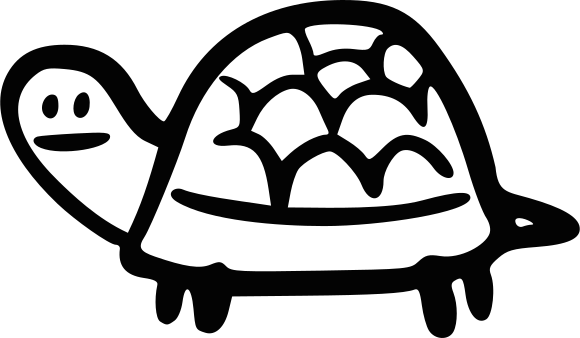
All three highlighted details answer the same question: how does a sea turtle know where to go? That is your clue to the main idea.

| How it keeps nature safe | |
|---|---|
| Rules: leave plants, rocks, and animals alone | Living things do not get harmed |
| Rangers count the animals every year | Trouble is spotted before it is too late |
| Some parks keep the night sky dark | Owls and bats can still hunt at night |
Three different details. Read the right column: each one is another way of keeping nature safe. That is the big idea they all support.
Practice questions
- 1
Which detail best supports the idea that sea turtles know how to travel well?
- Scientists watch these animals.
- Some sea turtles eat sea grass.
- They use the sun and Earth’s magnetic field.
- Their hard shells help protect them.
- 2
A student wrote: 'The main idea is that sea turtles have hard shells.' What detail shows this is too small?
- The text says sea turtles are birds.
- The text is about jellyfish only.
- The text has only one sentence.
- The text gives several details about travel, not just shells.
- 3
Which main idea best matches this group of details: 'Scientists watch these animals. They learn where they travel. They learn how to keep them safe.'
- Scientists study sea turtles to help keep them safe.
- Scientists only watch animals for fun.
- Scientists like beaches best.
- Scientists build trails in parks.
- 4
Read the details: Sea otters have thick fur that keeps them warm. They float on their backs while resting. Sea otters also crack open shellfish with rocks to eat them. What is the best main idea of the text?
- Sea otters have thick fur.
- Sea otters live in the ocean.
- Sea otters use special traits to live and find food.
- Sea otters crack open shellfish with rocks.
- 5
At a national park, visitors learn about sea otters, seals, and fish. Rangers post signs, protect quiet nesting areas, and teach families how to stay safe. These actions help animals and people share the park. What is the best main idea of this text?
- Rangers help protect animals and visitors in the park.
- Sea otters are the only animals in the park.
- Visitors should never learn about park animals.
- Signs are more important than nesting areas.
- 6
Which main idea best fits this sentence set: 'Rangers help visitors stay safe. Trails give people places to walk. Many families visit parks to learn about nature.'
- National parks are only for animals.
- National parks help people explore nature safely.
- National parks are noisy places.
- National parks have no rules.
- 7
Which detail is a reason why national parks help protect nature?
- Rangers help visitors stay safe.
- Trails give people places to walk.
- Signs and rules help protect animals, plants, and rocks.
- Many families visit parks.
- 8
Which detail would NOT support the main idea "National parks protect sea animals"?
- Signs and rules help keep sea animals safe.
- Rangers watch over nesting beaches.
- Many people come to the park to explore.
- People stay on marked paths near the coast.
Part of the question set is shown. Generate the whole intervention, freshly themed and with an answer key, for your own class in the product.