Common Core (CCSS)4th GradeEla

L.4.4Using Context Clues and Word Parts

Language Standards · Vocabulary Acquisition and Use: Vocabulary Acquisition and Use

Free printable worksheet

Download the L.4.4 worksheet

The lesson, the visual models, and 11 practice questions with space to work.

Download the PDF

PDF · 9 pages · answer key · no sign-up

What this standard means: In this lesson, your child will learn how to figure out the meaning of new and multiple-meaning words by using context clues and common word parts. They will read short passages and examples, look at the words around an unknown word, and check whether the clue in the sentence matches the meaning suggested by the word part. The lesson focuses on noticing prefixes and suffixes such as tele-, sub-, -port-, and -ology, and using them to make sense of words more quickly. Your child will also practice understanding words that can mean different things in different sentences, like bank, by paying attention to the sentence around them.

What the standard says, word for word · L.4.4

Determine or clarify the meaning of unknown and multiple-meaning words and phrases based on grade 4 reading and content, choosing flexibly from a range of strategies
Read it at the source: Common Core State Standards

What’s inside

What you get, and who it’s for

Everything below is measured from the actual lesson and the actual file. Nothing here is an estimate.

Time to run
About 25 minutes. 10 min lesson, then 15 min of practice.
In the download
9 printable pages: the full lesson, the worked examples, the visual models, and 11 practice questions with space to work. An educator answer key is included at the end, so the student pages come first and it is still ready to hand out. The lesson’s worked examples do show their solutions, because that is how they teach.
Question set
The download carries all 11 questions. The page shows 11 of them as a sample.
Question format
Every question is multiple choice. Students show their work on the page.
Assumed before this

Students who are shaky on these will struggle with L.4.4. Worth a quick check first.

  • L.4.1(4th Grade) Students should already know how to use context clues in a sentence to figure out an unknown word, and they should be able to notice common word parts like prefixes and suffixes. They also need experience with multiple-meaning words, such as choosing the meaning of a word that fits the sentence.
Dates
Published August 17, 2026. Not revised since.

The sample intervention

See a real lesson for L.4.4

A real intervention, not a generic worksheet.

L.4.4

Word Clues and Word Parts: Guided Notes with Volcanoes and Telescopes

Determine or clarify the meaning of unknown and multiple-meaning words and phrases using context clues and common word parts.

This lesson is about figuring out what a new word means. You will practice two tools: context clues (the helpful words in the sentence around the new word) and word parts (tele-, -port-, sub-, and -ology). As you read each passage and example, use BOTH tools: find the clue in the sentence, then check the word part inside the word. If the clue and the word part point to the same meaning, you can trust your answer.
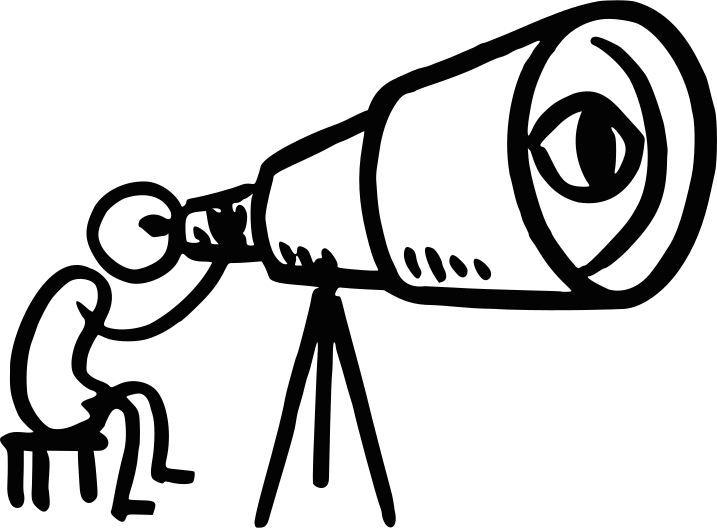
A person sitting at a large telescope, looking through it at the sky.
Two ways to figure out a new word

Use the clue in the sentence and the part in the word. If both point to the same meaning, you can trust it.

When you read, some words are new, and some words have more than one meaning. Good readers do not guess carelessly. They look for clues in the sentence and in nearby sentences. They also notice prefixes and suffixes, which are word parts at the beginning or end of a word. These tools help readers figure out what a word means.
A word can have one meaning in one sentence and a different meaning in another. For example, the word bank can mean a place where people keep money, or it can mean the side of a river. The words around the word help you tell which meaning fits. This is called using context clues.
Worked exampleThe word bank can mean money place or river side, so the sentence around it tells the meaning.
Some word parts help, too. The prefix tele- means far away. The suffix -ology means the study of something. The prefix sub- means under or below. The word part -port- means carry. When you know these parts, you can use them to understand new words more quickly.
The four word parts in this lesson
MeaningExample word
tele-far awaytelescope
sub-under or belowsubmarine
-port-carrytransport
-ologystudy of somethinggeology

Find the part inside a new word, then check its meaning here. The part is a clue you carry with you.

Break a word into its parts

telescope

tele-prefixfar away
-scoperootto look or see

= a tool for looking at things that are far away

Every long word hides smaller parts. Find a part you know and you have a head start on the meaning.
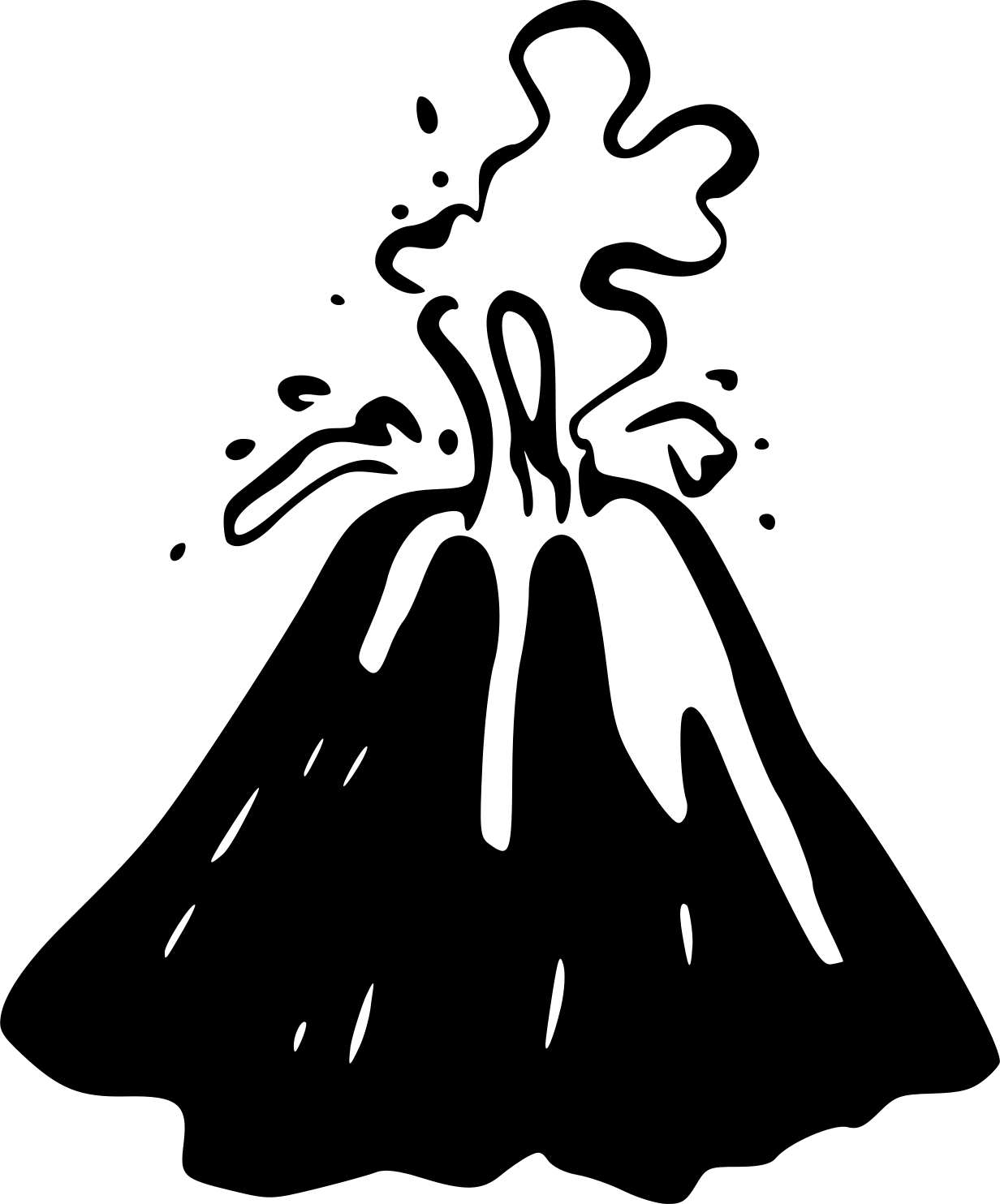
A volcano with smoke rising from the top.
Maya loves volcanoes and stars. A telescope helps people look at stars that are far away, and Maya uses hers every clear night. At school she is reading about geology, the study of Earth and its volcanoes. Her book says a submarine travels under the water so scientists can watch a volcano grow on the ocean floor. Maya will transport her telescope to the volcano trip, carrying it carefully so the lens does not break.
Worked exampleThe word telescope has tele-, which means far away, and the sentence says it helps people look at stars that are far away.
Worked exampleThe word geology ends with -ology, and the sentence says it is about the study of Earth.
Worked exampleThe word submarine begins with sub-, and the sentence says it travels under the water.
Worked exampleThe word transport includes -port-, and the sentence says Maya carries her telescope carefully.
Good readers use both the clue in the sentence and the word part in the word. Sometimes one clue is enough, and sometimes both together make the meaning clear. This helps readers understand stories, science texts, and directions more easily.

Practice questions

  1. 1

    What do good readers do when they meet a word they do not know?

    • Look for clues in the sentence and nearby sentences
    • Change the sentence to make it easier
    • Guess the word as fast as possible
    • Skip every unknown word
  2. 2

    The word bank can mean a place for money or the side of a river. In the sentence, the words around bank help the reader figure out the _____.

    • number of syllables
    • capital letter
    • correct meaning
    • sound of the word
  3. 3

    Which word part would help you understand the word telescope?

    • tele-
    • -ology
    • sub-
    • -port-
  4. 4

    A student reads, 'The telescope lets people look at stars that are far away.' What clue helps the reader most?

    • The sentence mentions people.
    • The word has eight letters.
    • The word starts with t.
    • The words 'look at stars that are far away' explain what the telescope does.
  5. 5

    Which explanation best shows how a reader can understand an unknown word?

    • Ignore the word and keep reading
    • Use only the picture in the book
    • Use sentence clues and word parts together
    • Use only the first letter of the word
  6. 6

    A student reads, 'The submarine moved under the water.' What does submarine mean?

    • a study of Earth
    • a place where people keep money
    • a paper people carry
    • something that goes under the water
  7. 7

    A student says, 'Sub- means far away because a submarine goes far away.' What is wrong with the student's idea?

    • sub- means study of something
    • sub- means money place
    • sub- means under or below, not far away
    • sub- means carry
  8. 8

    A scientist studies volcanoes in geology. What does the suffix -ology help show?

    • paper to carry
    • far away
    • under the water
    • study of something
  9. 9

    A student says, 'The word bank always means money place.' What is the best correction?

    • Bank always means the side of a river.
    • Bank means study of something.
    • Bank can mean a money place or the side of a river.
    • Bank means far away.
  10. 10

    Which sentence best uses the word part -port- to help show meaning?

    • The passport was hidden under the bed.
    • The passport was a paper people carry when they travel.
    • The passport was a telescope for stars.
    • The passport was wet from rain.
  11. 11

    A scientist who studies volcanoes is called a volcanologist. What does the suffix -ologist help the reader understand?

    • a person who studies something
    • a place where something is kept
    • an action that happens quickly
    • a tool used to see far away

Part of the question set is shown. Generate the whole intervention, freshly themed and with an answer key, for your own class in the product.

Watch for this

Common mistakes

Word Part Only Students often focus on just one clue, usually the word part, and ignore the sentence around the word. In this lesson, that can lead to mistakes like thinking sub- means far away because submarine sounds like a far-away word, or saying bank always means money place. Good readers check both the context clues and the word parts before deciding what the word means.

Vocabulary

Key terms

context clues
The words around a word that help show what it means.
word parts
Parts of a word, like prefixes and suffixes, that can help explain meaning.
prefix
A word part at the beginning of a word.
suffix
A word part at the end of a word.

In the classroom

How to use this intervention

Use this worksheet after a brief whole-class review of context clues and common word parts, then let students work independently for the 15-minute practice. If needed, pull a small group to reread the passages aloud and point out the clue word and the word part before students answer on their own.

Want this themed to your class instead?

Generate a fresh, standards-aligned intervention like this one, themed to whatever your students are into, in about 2 minutes.

Generate for my class

Questions educators ask

Educator FAQ

What grade is this worksheet for?

This worksheet is for Grade 4.

Which CCSS standard does it align to?

It aligns to CCSS L.4.4, which focuses on determining or clarifying word meaning using context clues and word parts.

Does the worksheet include an answer key?

The provided lesson content does not include an answer key.