What this standard means: In this lesson, your child will learn how to support answers with details from informational text. They will practice noticing the difference between what a passage says directly and what can be inferred from clues in the text. The lesson begins with notes that explain what text evidence is and how to use it well. Then your child will read two short articles, one about why middle schools should start later and one about how astronauts prepare. As they answer questions, they will point to details from the articles and explain how those details support their ideas. They will also practice the RACE pattern, which helps them restate the question, answer it, cite evidence, and explain their thinking.
What the standard says, word for word · RI.6.1
Cite textual evidence to support analysis of what the text says explicitly as well as inferences drawn from the text
Everything below is measured from the actual lesson and the actual file. Nothing here is an estimate.
Time to run
About 51 minutes. 15 min lesson, then 36 min of practice.
In the download
12 printable pages: the full lesson, the worked examples, the visual models, and 11 practice problems with space to work. An educator answer key is included at the end, so the student pages come first and it is still ready to hand out. The lesson’s worked examples do show their solutions, because that is how they teach.
Question set
The download carries all 11 questions. The page shows 11 of them as a sample.
Question format
Every question is short answer. Students show their work on the page.
Assumed before this
Students who are shaky on these will struggle with RI.6.1. Worth a quick check first.
L.6.1(6th Grade) Students should already be able to identify facts stated directly in an informational text and tell the difference between a direct statement and an inference. They also need basic practice finding a detail in the text to use as evidence for an answer.
Dates
Published August 17, 2026. Last updated August 31, 2026.
The sample intervention
See a real lesson for RI.6.1
A real intervention, not a generic worksheet.
RI.6.1
Cite the Clues: Informational Text Notes and Practice
Cite text evidence to support what the text says directly and what you can infer from it.
Below you will find notes on citing text evidence, then two short articles: one arguing that middle schools should start later, and one about how astronauts prepare. Read the notes first, then read both articles. Every answer you write should point to a detail from one of the articles and explain how that detail supports your point. Use the RACE pattern: restate, answer, cite, explain.
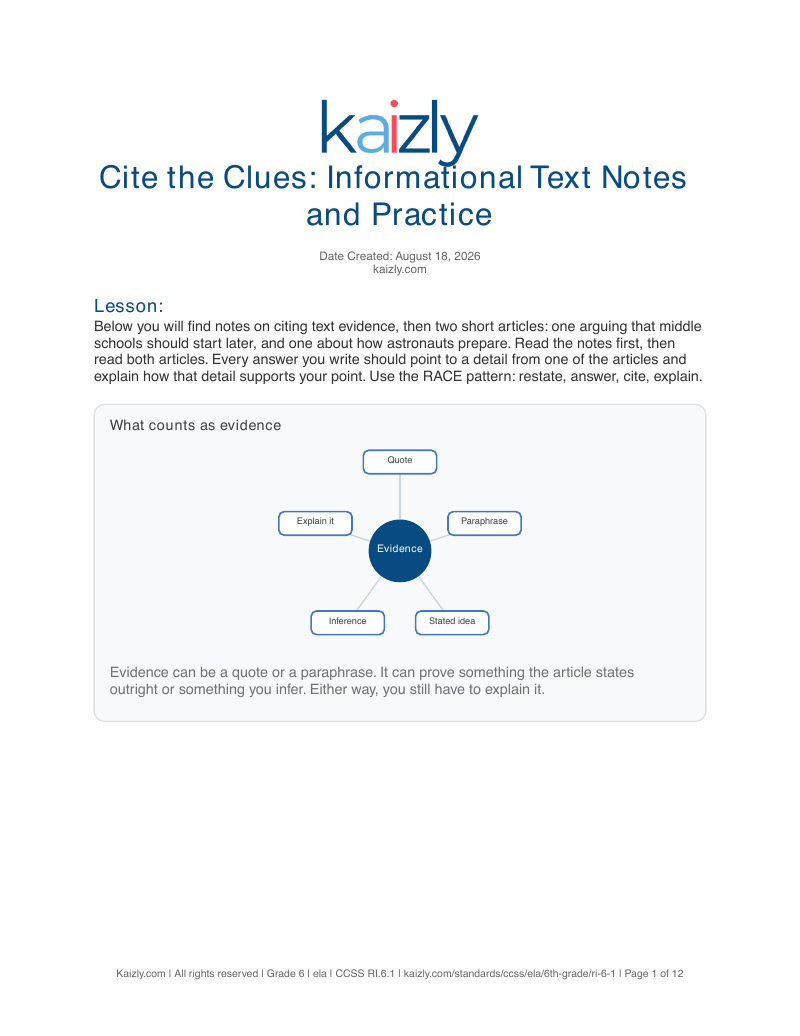
What counts as evidence
Evidence can be a quote or a paraphrase. It can prove something the article states outright or something you infer. Either way, you still have to explain it.
When you read informational text, look for two kinds of meaning. First, some ideas are stated directly. These are facts the author tells you clearly. Second, some ideas are inferred. An inference is a reasonable idea you build from clues in the text and what you already know. Good readers do not guess wildly; they use evidence to support their thinking.
Text evidence is a detail, fact, or quotation from the passage that supports an answer. Evidence can be a short quote or a paraphrase. A strong response usually follows this pattern: restate the idea, answer it, cite the text, and explain how the evidence proves the point. This helps the reader see both the answer and the reason behind it.
Read carefully for words that show cause, result, opinion, or comparison. For example, if a passage says students are more alert after a later school start time, that is a direct statement. If the passage also says many teens sleep too little because their schedules are packed, you can infer that later starts may help them feel less tired. The inference is stronger when you connect it to the text.
Informational texts often include facts, examples, and statistics that make an argument stronger. In a passage about space exploration, evidence might include training, technology, or safety reasons. In a passage about school start times, evidence might include sleep research, attention, or attendance. When you cite evidence, choose details that clearly match the claim you are making.
Should Middle Schools Start Later?
Most middle schools in the United States open their doors before eight in the morning. That schedule should change, and the reason is simple: it does not match the way teenagers actually sleep.
Sleep researchers have found that during adolescence the body's internal clock shifts later. Teenagers naturally fall asleep later at night, even when they are tired, so an early alarm cuts their rest short at the one end they cannot control. Many teens also get less sleep because their schedules are packed with homework, sports, jobs, and family responsibilities that fill the evening.
The results show up in the classroom. Districts that pushed their start times back by an hour report that longer sleep can improve alertness, and teachers in those schools describe students who are awake enough to take part in a lesson rather than resting their heads on their desks. Attendance improves as well, because students who are not exhausted are less likely to stay home.
There are real costs to changing a schedule. Bus routes have to be rewritten, and after-school practices start and end later. Those are problems of planning, though, and several districts have already solved them.
A school day that begins while students are still asleep wastes the first hour of it. Starting later is a change worth making.
Three pieces of evidence, one claim
Districts that pushed their start times back by an hour report that longer sleep can improve alertness1, and teachers in those schools describe students who are awake enough to take part in a lesson2 rather than resting their heads on their desks. Attendance improves as well3, because students who are not exhausted are less likely to stay home.
Evidence 1: Sleep and alertness
Evidence 2: What teachers see
Evidence 3: Attendance
The writer claims schools should start later. These are the three details that back it up. When you answer, quote one of them and say what it proves.
Why Astronauts Train for Months
A rocket launch lasts a few minutes, but the preparation behind it takes far longer. Astronauts train for months before a mission, and often for years before their first one.
Much of that time is spent rehearsing tasks until they become automatic. Crew members practice spacewalks in an enormous pool, where floating in water feels something like floating in orbit. They run the same emergency drills again and again, so that a warning light in space produces a trained response instead of panic.
They also learn the machine itself. A modern spacecraft carries thousands of systems, and a crew has to understand enough of them to solve a problem when help is a long radio call away.
None of this preparation is wasted effort. In a place where a small mistake can end a mission, careful planning is the difference between a hard day and a disaster.
Worked exampleDirect statement: The passage says astronauts train for months before a mission. Evidence: This detail shows space travel requires preparation.
Worked exampleInference: If the passage says teens often get less sleep because their schedules are packed, you can infer that a later start time may give them back some of that lost rest.
Worked exampleRACE model response: Later school start times can help students learn better (Restate and Answer). The passage says, "longer sleep can improve alertness" (Cite). This shows that students who are not sleep-deprived can pay attention and take part in class (Explain).
Worked exampleStrong evidence sentence: The author explains that longer sleep can improve alertness, which supports the idea that later school start times may help students focus better.
Practice questions
1
A student says, 'The text tells me astronauts train for months before a mission.' What is the text evidence, and what does it show?
2
A student wrote: 'Inference means a wild guess.' What is wrong with that idea?
3
The notes say: 'Text evidence can be a short quote or a paraphrase.' What does that mean?
4
Use RACE to answer this prompt: Why might later school start times help students? Write two or three sentences.
5
A passage says teens often get less sleep because their schedules are packed. What can you infer about a later school start time?
6
Which detail is stronger evidence for a claim that space exploration needs careful planning: 'astronauts train for months' or 'space is interesting'? Explain your choice.
7
A student says, 'The passage says longer sleep can improve alertness, so later school starts may help students focus better.' Is this a fact or an inference? Explain.
8
Fill in the missing part of this response: 'The text says __________, which supports the idea that __________.' Use the school start times notes.
9
A student wrote a response about space exploration: 'Astronauts train for months, so missions need preparation.' What should the student add to make the response stronger using RACE?
10
Two students answer the same question. Student A says, 'Later school start times may help students because longer sleep can improve alertness.' Student B says, 'Later school start times are good because I like sleeping in.' Which response uses better text evidence? Explain.
11
Use RACE to answer: Why is astronaut training worth the months it takes? Cite one detail from the article and explain how it supports your answer. Write two or three sentences.
Part of the question set is shown. Generate the whole intervention, freshly themed and with an answer key, for your own class in the product.
Watch for this
Common mistakes
Evidence-Free Answers: Students often give a correct-sounding idea, but do not point to a detail from the text to prove it. On this skill, the common mistake is treating an inference like a guess or opinion, instead of using a quote or paraphrase from the passage, then explaining how it supports the answer.
Vocabulary
Key terms
text evidence
A detail, fact, or quotation from a passage that supports an answer.
inference
A reasonable idea you build from clues in the text and what you already know.
informational text
A text that gives facts and explains ideas.
alertness
Being awake and able to pay attention.
In the classroom
How to use this intervention
Use the notes and the first one or two questions as a whole-class warm-up, then have students work independently through the remaining questions for practice. With 36 practice minutes, leave time to check responses with a small group or the whole class, especially for the RACE questions.
Want this themed to your class instead?
Generate a fresh, standards-aligned intervention like this one, themed to whatever your students are into, in about 2 minutes.