Common Core (CCSS)4th GradeMath

4.NBT.A.2Read, Write, and Compare Multi-Digit Whole Numbers

Number & Operations in Base Ten · 4.NBT.A: Generalize place value understanding for multi-digit whole numbers.

Free printable worksheet

Download the 4.NBT.A.2 worksheet

The lesson, the visual models, and 5 practice questions with space to work.

Download the PDF

PDF · 5 pages · answer key · no sign-up

What this standard means: In this lesson, your child will practice reading, writing, and comparing multi-digit whole numbers. They will learn to show a number in standard form, number name form, and expanded form, and to notice how each digit’s place changes its value. The lesson gives examples of how a digit can mean something much larger because of where it sits in the number. Your child will also practice comparing two numbers by lining up the places, starting from the left, and using the symbols greater than, less than, and equal to. This is a quick check, so your child will read the examples and then answer on their own.

What the standard says, word for word · 4.NBT.A.2

Read and write multi-digit whole numbers using base-ten numerals, number names, and expanded form. Compare two multi-digit numbers based on meanings of the digits in each place, using >, =, and < symbols to record the results of comparisons
Read it at the source: Common Core State Standards

What’s inside

What you get, and who it’s for

Everything below is measured from the actual lesson and the actual file. Nothing here is an estimate.

Time to run
About 12 minutes. 7 min lesson, then 5 min of practice.
In the download
5 printable pages: the full lesson, the worked examples, the visual models, and 5 practice questions with space to work. An educator answer key is included at the end, so the student pages come first and it is still ready to hand out. The lesson’s worked examples do show their solutions, because that is how they teach.
Question set
The download carries all 5 questions. The page shows 5 of them as a sample.
Question format
Every question is numeric answer. Students show their work on the page.
Assumed before this

Students who are shaky on these will struggle with 4.NBT.A.2. Worth a quick check first.

  • 4.G.A.1(4th Grade) Students should already know how to read, write, and identify the value of digits in whole numbers, including ones, tens, hundreds, and thousands. They should also be able to compare two whole numbers by looking at place value from left to right.
Dates
Published August 17, 2026. Not revised since.

The sample intervention

See a real lesson for 4.NBT.A.2

A real intervention, not a generic worksheet.

4.NBT.A.2

Place Value Quick Check: Stadiums and Scores

Read, write, and compare multi-digit whole numbers using place value and comparison symbols.

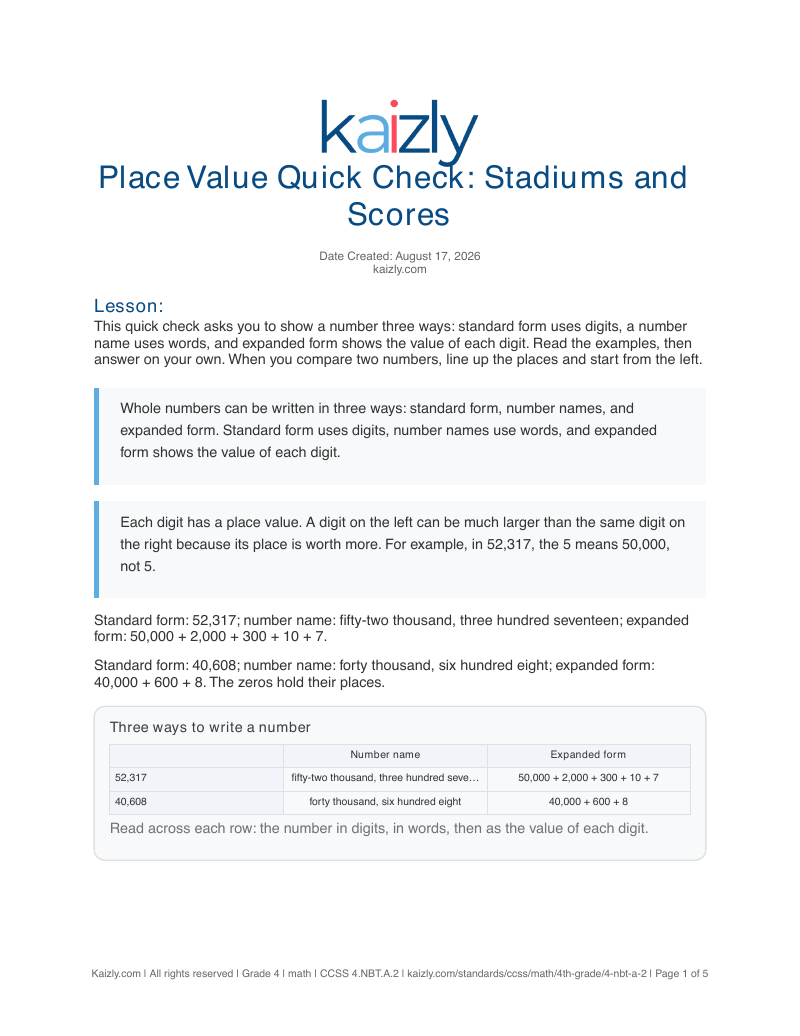
This quick check asks you to show a number three ways: standard form uses digits, a number name uses words, and expanded form shows the value of each digit. Read the examples, then answer on your own. When you compare two numbers, line up the places and start from the left.

Whole numbers can be written in three ways: standard form, number names, and expanded form. Standard form uses digits, number names use words, and expanded form shows the value of each digit.
Each digit has a place value. A digit on the left can be much larger than the same digit on the right because its place is worth more. For example, in 52,317, the 5 means 50,000, not 5.
Worked exampleStandard form: 52,317; number name: fifty-two thousand, three hundred seventeen; expanded form: 50,000 + 2,000 + 300 + 10 + 7.
Worked exampleStandard form: 40,608; number name: forty thousand, six hundred eight; expanded form: 40,000 + 600 + 8. The zeros hold their places.
Three ways to write a number
Number nameExpanded form
52,317fifty-two thousand, three hundred seventeen50,000 + 2,000 + 300 + 10 + 7
40,608forty thousand, six hundred eight40,000 + 600 + 8

Read across each row: the number in digits, in words, then as the value of each digit.

To compare two multi-digit numbers, start with the leftmost digits and move right only if the digits match. Use > for greater than, < for less than, and = for equal to.
When numbers have the same first digit, place value must do the work. For example, 36,540 is greater than 34,980 because 6,000 is greater than 4,000 in the thousands place.
Worked example36,540 > 34,980 because 6,000 is greater than 4,000 in the thousands place.
Worked exampleStadium attendance: 64,300 is less than 66,030.
Worked exampleTwo forms can name the same number: 27,080 = twenty-seven thousand, eighty. If both forms show the same number, use the = symbol.
This skill helps when reading stadium attendance, game scores, city populations, and other large numbers in real life.

Practice questions

  1. 1

    Your final video game score is seventy-three thousand, five hundred nineteen. Write this score in standard form.

  2. 2

    A stadium attendance number is 64,300. What digit is in the thousands place?

  3. 3

    Compare the stadium attendance numbers: 58,412 and 57,998. Enter 1 if 58,412 is greater, 0 if they are equal, and -1 if 58,412 is less.

  4. 4

    Your video game score is 91,250. Your friend's score is written as ninety-one thousand, two hundred fifty. Enter 1 if your score is greater, 0 if the scores are equal, and -1 if your score is less.

  5. 5

    A stadium's attendance is 48,206. In expanded form, 48,206 = 40,000 + ___ + 200 + 6. What number goes in the blank?

Part of the question set is shown. Generate the whole intervention, freshly themed and with an answer key, for your own class in the product.

Watch for this

Common mistakes

Mixing up place values when reading or comparing numbers. Students may read each digit correctly but ignore what place it is in, so they think 64,300 has a 4 in the thousands place or compare 58,412 and 57,998 by the first digit only and stop too soon. They also sometimes forget that zeros hold a place in expanded form, so a number like 48,206 is written with all its place values, even when one term is 0.

Vocabulary

Key terms

standard form
Standard form uses digits to write a whole number.
number name
A number name uses words to write a whole number.
expanded form
Expanded form shows the value of each digit.
place value
Place value tells how much a digit is worth because of its position in a number.

In the classroom

How to use this intervention

Use this quick check as a 5-minute independent practice after a short whole-class review of standard form, number names, expanded form, and comparison symbols. If a few students need support, pull a small group to work through the first example together before they finish the remaining items on their own.

Want this themed to your class instead?

Generate a fresh, standards-aligned intervention like this one, themed to whatever your students are into, in about 2 minutes.

Generate for my class

Questions educators ask

Educator FAQ

What grade is this worksheet for?

This worksheet is for Grade 4.

Which CCSS standard does it align to?

It aligns to CCSS 4.NBT.A.2, which focuses on reading and writing multi-digit whole numbers using place value and comparison symbols.

Is an answer key included?

Yes, the worksheet content includes example answers and the final response format for each question.