Common Core (CCSS)8th GradeMath

8.EE.C.7Solving Equations with Variables on Both Sides

Expressions & Equations · 8.EE.C: Analyze and solve linear equations and pairs of simultaneous linear equations.

Free printable worksheet

Download the 8.EE.C.7 worksheet

The lesson, the visual models, and 3 practice questions with space to work.

Download the PDF

PDF · 3 pages · no sign-up

What this standard means: By eighth grade, students have been solving equations since about sixth. Even so, 8.EE.C.7 is where the work stops being routine. Two things make it harder. First, the variable now appears on both sides of the equal sign, so students can no longer just undo operations from the outside in; they have to collect like terms across the equals first, and that step is where most errors start. Second, an equation no longer always has exactly one answer. Simplifying can leave a false statement like 6 = 10, which means there is no solution, or a true one like −3 = −3, which means there are infinitely many. Students who have only ever met equations with a single tidy answer often read those results as a mistake in their own work rather than as the answer.

Good instruction on this standard keeps the balance model visible long after the arithmetic turns abstract: whatever you do to one side, you do to the other. A table of values helps too. It turns “these two sides are never equal” into something a student can see rather than a rule to memorize. Students who stay shaky here tend to struggle with systems of equations (8.EE.C.8) and with slope-intercept work, because both assume confident, fluent rearranging.

Before you download

What you get, and who it’s for

Everything below is measured from the actual lesson and the actual file. Nothing here is an estimate.

Time to run
About 45 minutes. 15 min lesson, then 30 min of practice.
In the download
3 printable pages: the full lesson, the worked examples, the visual models, and 3 practice questions with space to work. Answers to the practice questions are not included, so it is ready to hand out. The lesson’s worked examples do show their solutions, because that is how they teach.
Question set
The download carries 3 of the 16 questions in the full intervention. Generate the whole set, themed to your class, in the product.
Question format
Every question is numeric answer. Students show their work on the page.
Assumed before this

Students who are shaky on these will struggle with 8.EE.C.7. Worth a quick check first.

  • 7.EE.A.1(7th Grade) Apply properties of operations as strategies to add, subtract, factor, and expand linear expressions with rational coefficients.
  • 7.EE.B.4.a(7th Grade) Solve word problems leading to equations of the form px + q = r and p(x + q) = r, where p, q, and r are specific rational numbers. Solve equations of these forms fluently. Compare an algebraic solution to an arithmetic solution, identifying the sequence of the operations used in each approach.
Dates
Published August 4, 2026. Not revised since.

The sample intervention

See a real lesson for 8.EE.C.7

A real intervention, not a generic worksheet.

8.EE.C.7

Solve for the Unknown: Equation Practice Mix

Solve linear equations in one variable using balancing steps and checking for special cases.

Read the lesson first, then work through the practice set. You will solve equations with the variable on one side and equations with the variable on BOTH sides, and you will meet all three possible outcomes: exactly one solution, no solution, or infinitely many solutions. Show every balancing step, and check each answer by putting it back into the original equation.

A linear equation in one variable is a number sentence with one letter, such as x, that stands for an unknown number. To solve it, keep the equation balanced by doing the same operation to both sides. Each move should undo the operation attached to the variable until the letter is alone.
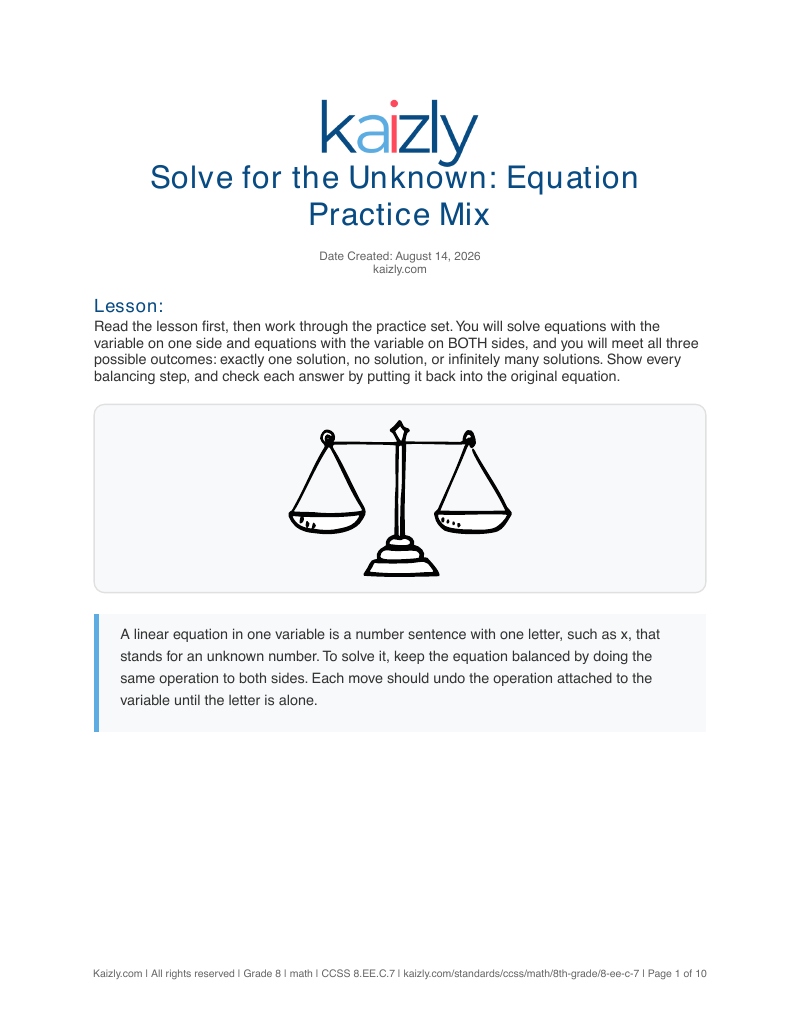
Think of a balance scale: if one side changes, the other side must change in the same way. For example, if 3x + 4 = 19, subtract 4 from both sides, then divide both sides by 3. The equation stays balanced at every step, and the final value tells you the unknown number.
Balance the equation

3x + 4 = 19 — the same equation worked step by step in Example 1.

Worked exampleExample 1: 3x + 4 = 19 → subtract 4 from both sides: 3x = 15 → divide both sides by 3: x = 5.
Variables on BOTH sides

Here x sits on both pans. Take 2x off both sides first, then finish as in Example 2.

Worked exampleExample 2: 5x + 2 = 2x + 11 → subtract 2x from both sides: 3x + 2 = 11 → subtract 2: 3x = 9 → divide by 3: x = 3.
What "distribute" really means

2(x + 4)

Two groups of (x + 4): 2 x-tiles and 8 units, so 2x + 8. BOTH terms get multiplied — the same is true when the second term is negative.

Do 4x + 6 and 4x + 10 ever meet?
4x + 64x + 10
x = 0610
x = 11014
x = 21418
x = 31822

The two sides stay exactly 4 apart, so no value of x makes them equal.

Practice questions

  1. 1

    Solve for x: 2x + 5 = 17.

  2. 2

    A student solved 4x - 3 = 13 like this: 4x = 10, so x = 2.5. What is the correct value of x?

  3. 3

    A ticket package costs $9 plus $4 per ticket. The total is $29. How many tickets were bought?

Part of the question set is shown. Generate the whole intervention, freshly themed and with an answer key, for your own class in the product.

Want this themed to your class instead?

Generate a fresh, standards-aligned intervention like this one, themed to whatever your students are into, in about 2 minutes.

Generate for my class