NGSS5th GradeScience

5-LS2-1Modeling Matter Movement in a Forest Ecosystem

Life Science · 5-LS2: Ecosystems: Interactions, Energy, and Dynamics

Free printable worksheet

Download the 5-LS2-1 worksheet

The lesson, the visual models, and 13 practice questions with space to work.

Download the PDF

PDF · 12 pages · answer key · no sign-up

What this standard means: Develop a model that shows how matter moves among plants, animals, decomposers, and the environment in a forest ecosystem. You are going to read and use a model of ONE forest. The same forest is used the whole way through: trees, a rabbit, a mouse, a wolf, an owl, and the decomposers living in the soil.

A model uses arrows to show where matter goes. In this lesson every arrow means "matter moves this way." It always points from where the matter is now to where it goes next:

- from the air, the water, and the soil into the trees - from the food to whoever eats it (trees to rabbit, rabbit to wolf) - from anything that dies or leaves waste into the decomposers - from the decomposers back out to the soil and air

Careful: the arrow does not point from the eater to its food. It follows the matter. A wolf eats a rabbit, so the arrow points rabbit to wolf.

Matter and energy are not the same thing. Matter goes around the same circle again and again. Energy comes in from the sun, travels the same direction as the arrows, and does not come back around.

You have got it when you can put your finger on any living thing in the model and say where its matter came from and where its matter goes next.
What the standard says, word for word · 5-LS2-1

Develop a model to describe the movement of matter among plants, animals, decomposers, and the environment.
Read it at the source: Next Generation Science Standards

What’s inside

What you get, and who it’s for

Everything below is measured from the actual lesson and the actual file. Nothing here is an estimate.

Time to run
About 35 minutes. 15 min lesson, then 20 min of practice.
In the download
12 printable pages: the full lesson, the worked examples, the visual models, and 13 practice questions with space to work. An educator answer key is included at the end, so the student pages come first and it is still ready to hand out. The lesson’s worked examples do show their solutions, because that is how they teach.
Question set
The download carries all 13 questions. The page shows 13 of them as a sample.
Question format
Every question is multiple choice. Students show their work on the page.
Assumed before this

Students who are shaky on these will struggle with 5-LS2-1. Worth a quick check first.

  • 5-LS1-1(Grade 5) Students should already be able to support an argument that plants get the materials they need for growth chiefly from air and water.
Dates
Published August 5, 2026. Last updated August 14, 2026.

The sample intervention

See a real lesson for 5-LS2-1

A real intervention, not a generic worksheet.

5-LS2-1

Forest Energy and Matter Practice Set

Develop a model that shows how matter moves among plants, animals, decomposers, and the environment in a forest ecosystem.

You are going to read and use a model of ONE forest. The same forest is used the whole way through: trees, a rabbit, a mouse, a wolf, an owl, and the decomposers living in the soil. A model uses arrows to show where matter goes. In this lesson every arrow means "matter moves this way." It always points from where the matter is now to where it goes next: - from the air, the water, and the soil into the trees - from the food to whoever eats it (trees to rabbit, rabbit to wolf) - from anything that dies or leaves waste into the decomposers - from the decomposers back out to the soil and air Careful: the arrow does not point from the eater to its food. It follows the matter. A wolf eats a rabbit, so the arrow points rabbit to wolf. Matter and energy are not the same thing. Matter goes around the same circle again and again. Energy comes in from the sun, travels the same direction as the arrows, and does not come back around. You have got it when you can put your finger on any living thing in the model and say where its matter came from and where its matter goes next.

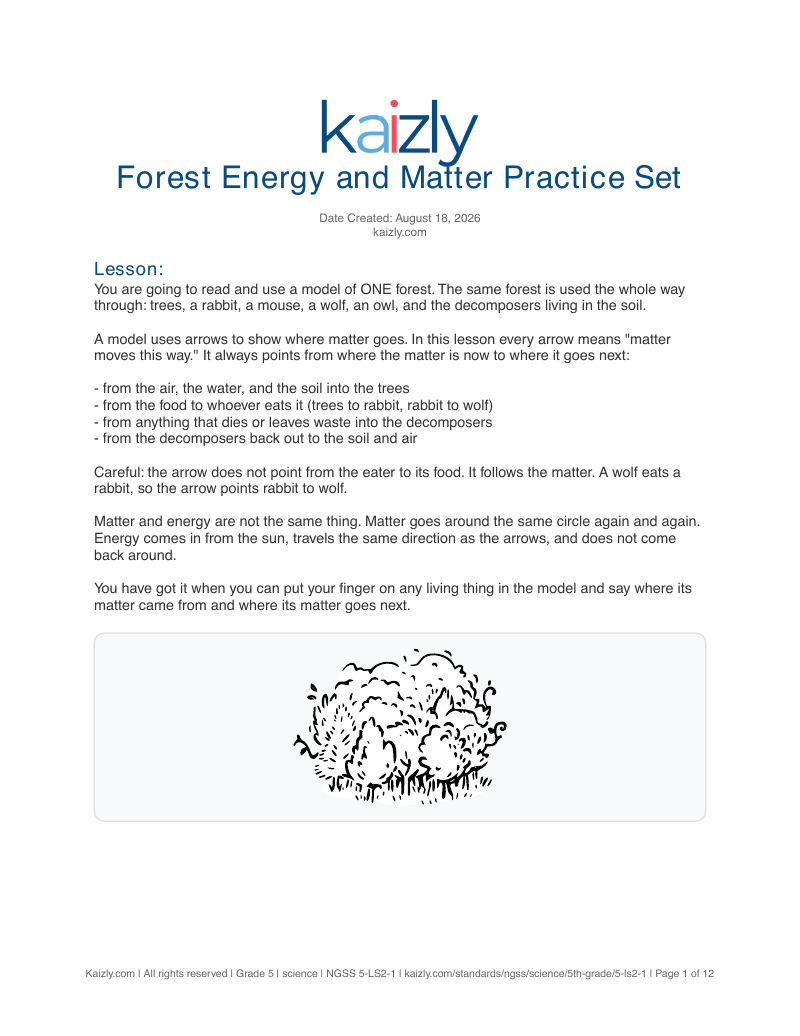
A black and white line drawing of a group of leafy trees, showing the forest used in this lesson.
Everything in a forest is made of matter. Matter is the stuff that takes up space and has weight. Our forest has trees, a rabbit, a mouse, a wolf, an owl, and decomposers living down in the soil. The trees are producers, which means they make their own food. Sunlight gives them the energy to do it. But the matter they build with comes from carbon dioxide in the air and from water they pull up through their roots. That matter becomes wood, bark, leaves, roots, and seeds. Here is the part that surprises people: a huge tree is not made mostly of soil. Most of a tree came out of the air.
Worked exampleWhere does a tree's matter come from? Look at one new leaf on one of our trees and ask what it is made of. Carbon dioxide from the air, and water from the ground. Sunlight is the energy that puts those together, but sunlight is not matter, so no part of the leaf is made of sunlight. Arrow: air, water, and soil --> trees
Animals cannot make their own food, so they are consumers. They get their matter by eating. In our forest, the rabbit and the mouse eat parts of the trees: leaves, bark, seeds, and berries. The wolf eats the rabbit. The owl eats the mouse. Every time something is eaten, matter moves into the eater and becomes part of its muscles, bones, fur, and feathers for a while. Not all of it stays. Some leaves the animal as waste. Some leaves as a gas every time the animal breathes out. That matter is not gone. It has just moved somewhere else.
Worked exampleFollow one bite. A rabbit eats a tree leaf, and matter from that leaf becomes rabbit muscle. Later a wolf eats the rabbit, and that same matter becomes wolf muscle. Arrows: trees --> rabbit --> wolf Notice which way the arrows point. They point away from the one being eaten, not toward it.
Worked exampleThe other chain in this same forest. A mouse eats seeds and berries from the trees, and an owl eats the mouse. Arrows: trees --> mouse --> owl Two chains, one forest. Both of them start at the trees, because the trees are the only ones here who can make food.
Every living thing in the forest dies sooner or later: the leaves, the rabbit, the mouse, even the wolf and the owl. So why is the forest floor not piled high with dead bodies and old leaves? Decomposers. Fungi, like the mushrooms you see on the forest floor, and bacteria too small to see, break dead things and waste back apart. The matter they release goes into the soil and into the air. That is what closes the loop. The trees pull that matter back in and build with it all over again. Nothing in a forest gets thrown away.
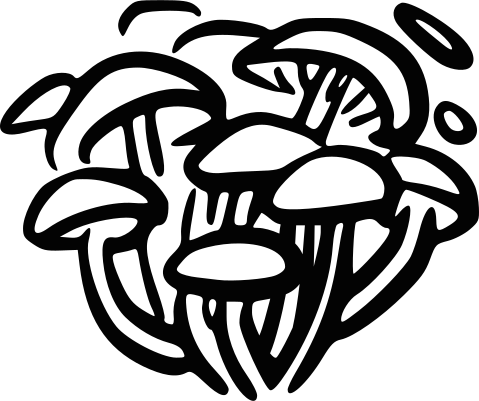
A drawing of a cluster of mushrooms growing on the forest floor.
Worked exampleWhat happens when the wolf dies? Its matter does not disappear, because matter never does. Decomposers break the body apart. That matter goes into the soil and the air, and the trees take it back in to build new leaves. Arrows: wolf --> decomposers --> soil and air --> trees Now think back. The wolf ate the rabbit, and the rabbit ate the trees. So some of the matter sitting in that brand new leaf has already been all the way around this forest once.
A model lets you see all of this at once. How to read it: every arrow means "matter moves this way." Put your finger on any living thing and follow the arrow out of it to see where its matter goes next. Follow an arrow backwards to see where its matter came from. The most common mistake is pointing the arrow the wrong way. A wolf eats a rabbit, so it feels natural to draw wolf --> rabbit. But the matter moves out of the rabbit and into the wolf, so the arrow is rabbit --> wolf. The arrow follows the food, not the hunter. One more rule worth knowing. Matter travels in a circle: air, water and soil --> trees --> animals --> decomposers --> back to the soil and air --> trees again. The same matter gets used over and over. Energy does not do that. Energy arrives from the sun, travels along those same arrows, and leaves as heat. It never loops back around, which is why the sun has to keep shining on this forest every day.
How matter moves through this forest
  • producer
  • consumer
  • decomposer

Every arrow means "matter moves this way." Put your finger on any organism and follow the arrow out of it to see where its matter goes next. Notice that every a

The matter cycle: it always comes back

Matter never runs out and never gets used up. It just keeps going around this loop. Energy is different: it comes in from the sun, travels the same way, and does not come back around. Follow the numbers around and see if you can find where the loop starts.

Worked exampleYour turn. Try it first, then check yourself. Question: where did the matter in the owl's feathers come from? Work backwards along the arrows: owl <-- mouse <-- trees <-- air, water and soil. So those feathers are built out of matter that used to be a tree seed, and before that was gas floating in the air. Now work forwards: when the owl dies, decomposers --> soil and air --> trees. Same matter. Still moving.
Follow the matter, organism by organism
Where its matter comes fromWhere its matter goes next
TreesAir, water and soilThe rabbit and mouse that eat them
RabbitThe tree leaves it eatsThe wolf, and decomposers when it dies
WolfThe rabbit it eatsDecomposers when it dies
OwlThe mouse it eatsDecomposers when it dies
DecomposersDead plants, animals and wasteBack to the soil and air, then the trees

Every living thing takes matter in from somewhere and passes it along to something else. Nobody in the forest creates matter, and nobody destroys it.

Practice questions

  1. 1

    In this forest, which living thing makes its own food using sunlight, water, and carbon dioxide?

    • The rabbit
    • The trees
    • The wolf
    • The owl
  2. 2

    In this forest, which path best shows matter moving from the environment into a plant?

    • Soil and air → trees
    • Wolf → trees
    • Trees → soil and air
    • Owl → rabbit
  3. 3

    Which pair shows a consumer and what it eats in this forest?

    • Rabbit and plants
    • Decomposers and sunlight
    • Soil and air
    • Trees and sunlight
  4. 4

    A student says, 'Trees get matter by eating a rabbit.' What is wrong with this idea?

    • Rabbits make their own food, so trees eat them.
    • Owls get matter from sunlight, so trees eat owls.
    • Wolves make the soil, so trees eat wolves.
    • Trees make their own food, so they do not eat rabbits.
  5. 5

    Which chain shows matter moving in the correct order in this forest?

    • Wolf → trees → rabbit
    • Rabbit → wolf → trees
    • Wolf → rabbit → trees
    • Trees → rabbit → wolf
  6. 6

    In this forest, a rabbit eats plants. What happens to some of the matter from the plants?

    • It disappears forever.
    • It stays only in the roots of the trees.
    • It becomes part of the rabbit's body for a time.
    • It turns into sunlight.
  7. 7

    In a forest, an owl eats a mouse, and the mouse ate seeds and berries. Which statement best describes how matter moves through this system?

    • Matter moves from seeds and berries to the mouse, and then to the owl.
    • Matter moves from the owl to the mouse, and then to the seeds and berries.
    • Only the owl gets matter, because the mouse loses all of its matter when eaten.
    • Matter moves from the seeds and berries to the owl, but not through the mouse.
  8. 8

    Why are decomposers important in the forest?

    • They make sunlight for trees.
    • They turn wolves into rabbits.
    • They stop matter from moving.
    • They break down dead things and waste.
  9. 9

    Which model best shows matter moving after a mouse dies in the forest?

    • Mouse → decomposers → soil and air
    • Mouse → wolf → sunlight
    • Mouse → trees → rabbit
    • Mouse → sunlight → owl
  10. 10

    Which choice best compares the roles of trees and decomposers?

    • Trees and decomposers both eat only wolves.
    • Trees break down waste, and decomposers make food.
    • Trees are consumers, and decomposers are sunlight.
    • Trees make food, and decomposers break down dead things.
  11. 11

    Which sentence explains why matter in a rabbit does not stay in one place forever?

    • Matter stays trapped inside one animal forever.
    • Matter only moves from wolves to owls.
    • Matter disappears after the animal eats.
    • Matter moves through living things and can return to the environment.
  12. 12

    A student writes: 'Sunlight is matter because trees use it.' Which choice best fixes the mistake?

    • Sunlight is a kind of rabbit food.
    • Sunlight is the same as decomposers.
    • Sunlight is not matter; it is energy.
    • Sunlight is matter because it becomes soil.
  13. 13

    A forest model shows these arrows for energy flow: sunlight → trees → rabbit → wolf. What does this model show best?

    • Energy flows from sunlight through living things.
    • Energy moves only inside the soil.
    • Energy moves from wolf to rabbit to trees.
    • Energy stops after the trees use it.

Part of the question set is shown. Generate the whole intervention, freshly themed and with an answer key, for your own class in the product.

Watch for this

Common mistakes

Arrow Direction Confusion: Students often draw the arrows backward, showing the eater pointing to what it eats. In this forest model, the arrow must follow the matter, so it goes from the food or dead organism to the organism that receives that matter, such as trees to rabbit, rabbit to wolf, and dead matter to decomposers. Students may also mix up matter and energy, and think sunlight is matter instead of the energy trees use to build new plant material.

Vocabulary

Key terms

producers
Producers are living things, like trees, that make their own food.
consumers
Consumers are animals that cannot make their own food and get their matter by eating.
decomposers
Decomposers are fungi and bacteria that break dead things and waste back apart.
matter
Matter is the stuff that takes up space and has weight.

In the classroom

How to use this intervention

Use the 15-minute lesson time for a brief whole-class read-aloud and model review, then have students work independently on the 20-minute practice set. Circulate to check arrow direction and press students to explain where matter came from and where it goes next in each question.

Want this themed to your class instead?

Generate a fresh, standards-aligned intervention like this one, themed to whatever your students are into, in about 2 minutes.

Generate for my class

Questions educators ask

Educator FAQ

What grade is this worksheet for?

It is for Grade 5.

Which NGSS standard does it align to?

It aligns to NGSS 5-LS2-1, Develop a model to describe the movement of matter in an ecosystem.

Is an answer key included?

Yes, the free worksheet PDF includes all questions with a complete answer key.