Matter Detectives: Spiral Review Check
Classify and describe matter using what you can observe: temperature, mass, magnetism, relative density, and physical state.
Read the passages and examples below to learn about how matter can be classified by what you observe.
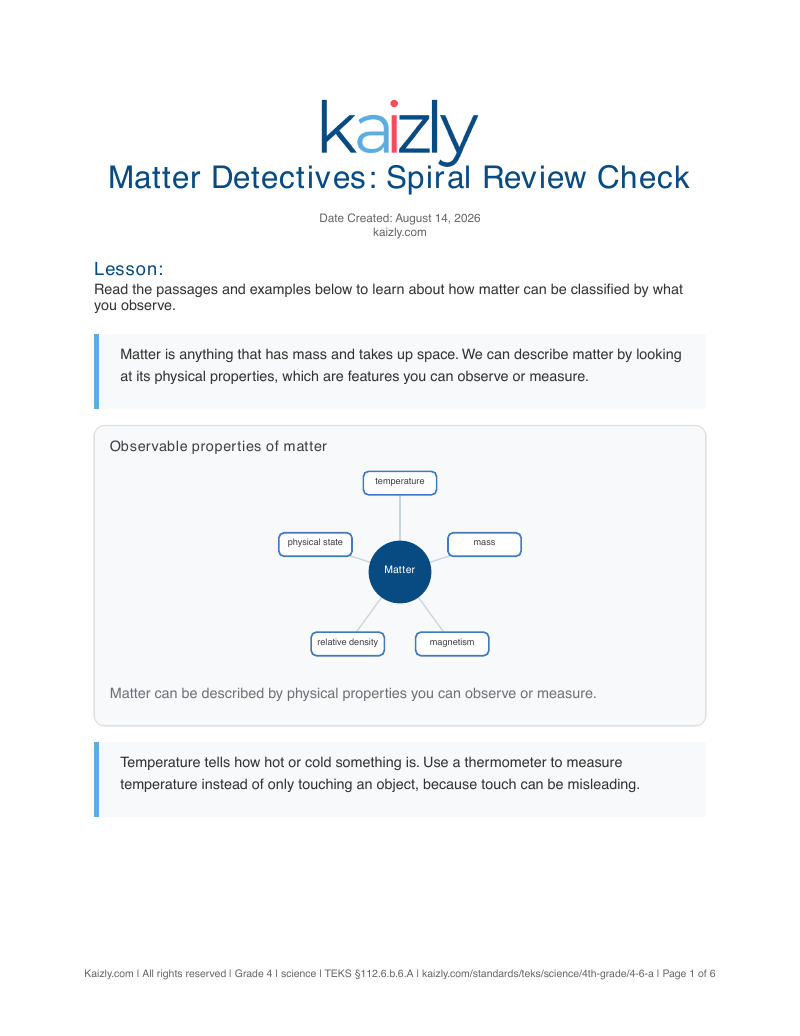
Matter can be described by physical properties you can observe or measure.
| What it tells you | How you check it | |
|---|---|---|
| temperature | how hot or cold it is | use a thermometer |
| mass | how much matter is in it | use a balance, in grams |
| magnetism | whether a magnet pulls it | hold a magnet near it |
| relative density | whether it floats or sinks | put it in water |
| physical state | solid, liquid, or gas | look at its shape and flow |
Each property has its own test. Match the clue in the question to the right property.
Practice questions
- 1
Which property tells how hot or cold something is?
- Mass
- Temperature
- Relative density
- Magnetism
- 2
A student says, 'This block feels cooler, so it must have a lower temperature.' What is the best correction?
- The student is wrong because a thermometer should be used instead of touch.
- The student is right because cooler-feeling objects always have the same temperature.
- The student is wrong because weight tells temperature.
- The student is right because touch is the best way to measure temperature.
- 3
Two objects are made of different materials. Object A has more mass than Object B, but both fit in one hand. Which statement best describes the matter in Object A?
- Object A has less matter because it fits in one hand.
- Object A has more matter because it has greater mass.
- Object A and Object B must have the same mass.
- Object A cannot be compared because it is made of a different material.
- 4
A student thinks the heavier object always sinks. Which case shows that idea is not always true?
- A large piece of wood floats, even if it is heavier than a small coin.
- A metal ball sinks, and a plastic bead floats.
- A small stone sinks, and a large stone also sinks.
- A paper clip floats, and a feather floats.
- 5
Which material is a gas at room temperature?
- A wooden block
- Ice
- Air
- Water
- 6
A magnet is brought near four objects. Which object is least likely to be attracted?
- A plastic straw
- A paper clip made of iron
- An iron nail
- A steel spoon
- 7
Two students measure an object. One says it has more mass, and the other says it weighs more. What is the best idea to remember?
- Mass tells whether an object is a solid or liquid.
- Weight tells how much matter an object has, and mass tells how hot it is.
- Mass tells how much matter an object has, and weight is the pull of gravity.
- Mass and weight always mean the same thing.
- 8
Which sentence best describes matter using observable physical properties?
- Matter is anything that is always heavy.
- Matter is anything that feels warm to your hand.
- Matter is anything that has mass and takes up space.
- Matter is anything that can be seen only in water.
Part of the question set is shown. Generate the whole intervention, freshly themed and with an answer key, for your own class in the product.