Common Core (CCSS)3rd GradeMath

3.NF.A.2Fractions on a Number Line

Number & Operations—Fractions · 3.NF.A: Develop understanding of fractions as numbers.

Free printable worksheet

Download the 3.NF.A.2 worksheet

The lesson, the visual models, and 12 practice questions with space to work.

Download the PDF

PDF · 8 pages · answer key · no sign-up

What this standard means: In this lesson, your child will learn that a fraction can name a point on a number line from 0 to 1. They will practice using the bottom number to see how many equal parts the line is split into, and the top number to see how many parts to count from 0. The lesson shows that the whole line stays the same size while the number of equal parts changes. Your child will look at simple examples such as 1/2, 1/3, 2/3, 1/4, 2/4, and 3/4, and place fractions on the line. They will also answer quick checks by entering a fraction or its value.

What the standard says, word for word · 3.NF.A.2

Understand a fraction as a number on the number line; represent fractions on a number line diagram
Read it at the source: Common Core State Standards

What’s inside

What you get, and who it’s for

Everything below is measured from the actual lesson and the actual file. Nothing here is an estimate.

Time to run
About 33 minutes. 10 min lesson, then 23 min of practice.
In the download
8 printable pages: the full lesson, the worked examples, the visual models, and 12 practice questions with space to work. An educator answer key is included at the end, so the student pages come first and it is still ready to hand out. The lesson’s worked examples do show their solutions, because that is how they teach.
Question set
The download carries all 12 questions. The page shows 12 of them as a sample.
Question format
Every question is numeric answer. Students show their work on the page.
Assumed before this

Students who are shaky on these will struggle with 3.NF.A.2. Worth a quick check first.

  • 3.NF.A.1(Grade 3) Students should already be able to count equal parts and identify simple fractions such as halves, thirds, and fourths. They also need experience recognizing that a fraction names one part of a whole.
Dates
Published August 12, 2026. Last updated August 14, 2026.

The sample intervention

See a real lesson for 3.NF.A.2

A real intervention, not a generic worksheet.

3.NF.A.2

Fractions on a Line: Guided Notes and Quick Checks

Understand a fraction as a number on a number line and represent fractions on a number line diagram.

Every fraction in this lesson is a POINT on the number line from 0 to 1. To find a point: the bottom number tells how many equal parts the whole is split into, and the top number tells how many parts to count from 0. Watch one thing the whole way through: the line from 0 to 1 never changes size. Only the number of equal parts changes. When you answer, you can enter a fraction like 3/4 or its value.
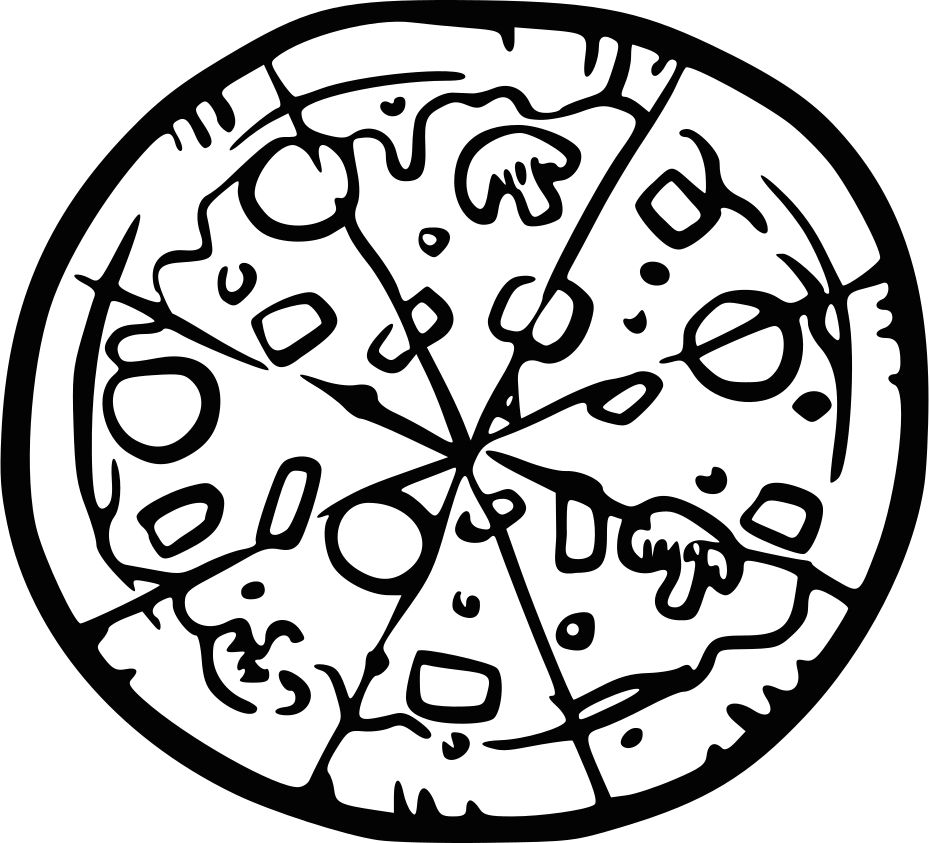
A whole pizza seen from above, not yet cut into slices.
A fraction names a point between 0 and 1. The whole line from 0 to 1 stays the same size. We split that whole into equal parts.
The bottom number of a fraction tells how many equal parts the whole is split into. The top number tells how many of those parts we count, starting from 0. So for 3/4: split the line into 4 equal parts, then count 3 parts from 0.
If the line is split into 2 equal parts, the point halfway from 0 to 1 is 1/2. If the line is split into 3 equal parts, the points are 1/3 and 2/3. If the line is split into 4 equal parts, the points are 1/4, 2/4, and 3/4.
Fraction bars

Each bar is the same whole split into equal parts: halves, thirds, and fourths. On the number line, each fraction is the point where its bar ends. The whole never changes.

Worked exampleExample 1: Split the line from 0 to 1 into 2 equal parts. The bottom number is 2, so count 1 part from 0. You land on the point 1/2, exactly halfway.
Worked exampleExample 2: Use the SAME line from 0 to 1. Now split it into 3 equal parts. Count 1 part from 0 to land on 1/3. Count 2 parts from 0 to land on 2/3.
Worked exampleExample 3: Same line from 0 to 1, now split into 4 equal parts. To find 3/4, count 3 parts from 0. Notice the whole did not change, only the number of equal parts did.
Fourths on the number line

The line from 0 to 1 is split into 4 equal parts. Each point gets a fraction name. Count 3 parts from 0 to land on 3/4, the point in Example 3.

We can show the same whole on a measuring tape, a running track, or a pizza. The picture may look different, but the whole is still 1. A fraction is the point that shows a part of that whole.
A school ruler with evenly spaced tick marks.
Use the same number line from 0 to 1 to see halves, thirds, fourths, sixths, and eighths. The whole does not change. Only the number of equal parts changes.
Worked exampleExample 4: Same line from 0 to 1, split into 6 equal parts. Count 2 parts from 0 to land on 2/6. The parts are smaller now, but the whole is still exactly 1.
Worked exampleExample 5: Same line from 0 to 1, split into 8 equal parts. Count 4 parts from 0 to land on 4/8. Look closely: 4/8 sits at the very same point as 1/2. Two fractions can name the same point.
Some fractions name the same point. For example, 1/2 and 2/4 land on the same spot. That happens because the whole is split into different equal parts, but the point stays in the same place.
Eighths: 4/8 lands on 1/2

Split into 8 equal parts, the point 4/8 lands on the same spot as 1/2. The whole never changed.

Practice questions

  1. 1

    A number line goes from 0 to 1. What number is halfway between 0 and 1?

  2. 2

    A student splits the line from 0 to 1 into 3 equal parts. The first point after 0 is written as 2/3. What is the correct point?

  3. 3

    A measuring tape from 0 to 1 is split into 4 equal parts. What number is the third point after 0?

  4. 4

    A pizza is one whole. If it is split into 4 equal slices, what fraction names the point at the first slice after 0 on the number line?

  5. 5

    A runner moves along a track from 0 to 1. The line is split into 6 equal parts. A student writes 3/6 for the second point after 0. What is the correct point?

  6. 6

    On a track, the line from 0 to 1 is split into 8 equal parts. What is the value of the fourth point after 0?

  7. 7

    Use the same whole from 0 to 1. What is the fraction for the point that is 2 equal parts from 0 when the line is split into 8 equal parts?

  8. 8

    A runner starts at 0 on a track line from 0 to 1. Which is greater: 1/3 or 2/3? Enter 1 for 2/3 and 0 for 1/3.

  9. 9

    A measuring tape from 0 to 1 is split into 2 equal parts. A student says the point at the middle is 2/2. What is the correct number for the middle point?

  10. 10

    A student says 2/4 is a different point from 1/2. Enter 1 if the student is wrong, or 0 if the student is right.

  11. 11

    On one number line from 0 to 1, which point is farthest right: 1/4, 1/2, or 3/4? Enter the number value of the fraction.

  12. 12

    A student says the whole line from 0 to 1 gets bigger when it is split into more equal parts. Enter 1 if that is wrong, or 0 if that is right.

Part of the question set is shown. Generate the whole intervention, freshly themed and with an answer key, for your own class in the product.

Watch for this

Common mistakes

Confusing the number of parts with the point on the line. Students may count the equal parts correctly but name the wrong fraction, or they may think the whole from 0 to 1 changes size when it is split into more parts. On this skill, the bottom number tells how many equal parts the whole is split into, and the top number tells how many parts to count from 0 on the same unchanged line.

Vocabulary

Key terms

fraction
A fraction names a point between 0 and 1.
whole
The whole line from 0 to 1 stays the same size.
equal parts
We split the whole into equal parts.
number line
A fraction is a point on the number line from 0 to 1.

In the classroom

How to use this intervention

Use the lesson for a brief whole-class warm-up or guided check-in, since the concept is introduced in 10 minutes and the questions focus on one consistent number line from 0 to 1. Then have students work independently or in a small group for the 23 minutes of practice, while you circulate to check that they are counting equal parts from 0 and keeping the whole the same size.

Want this themed to your class instead?

Generate a fresh, standards-aligned intervention like this one, themed to whatever your students are into, in about 2 minutes.

Generate for my class

Questions educators ask

Educator FAQ

What grade is this worksheet for?

This worksheet is for Grade 3.

Which CCSS standard does it align to?

It aligns to CCSS 3.NF.A.2, understanding fractions as numbers on a number line.

Is an answer key included?

Yes, the worksheet includes the questions and the answer key can be determined from the lesson content provided.