3rd Grade Readiness: Free Summer Assessment & Guide for Rising Third Graders
Third grade is a big milestone, and if you're feeling those back-to-school jitters, take a breath. Our quick, free assessment shows where your rising third grader shines and where to give a little TLC.

Lindsay Carlson
Parent & Education Contributor

Third grade already? It's a pivotal year on two fronts: in reading, kids shift from learning to read to reading to learn, and in math, they move past basic facts into multiplication and division. Both are the ground floor for everything that follows, which is why catching a wobble now matters. Our free 3rd Grade Readiness Assessment gives you clarity in about 25 minutes, no stress, no grades, just insight. Check out all grade readiness assessments if you have kids in other grades too.
TL;DR: Third grade marks the shift from learning to read to reading to learn. This free 25-minute assessment checks reading fluency, basic math, writing, and general knowledge skills. Includes a parent answer key with explanations and practice recommendations. No account or cost required.
What You'll Learn
Why third grade is a critical turning point for reading (children not proficient by end of 3rd grade are 4x less likely to graduate on time)
A checklist of the specific reading, writing, math, and general knowledge skills your rising 3rd grader should have
How our free 25-minute assessment works and what to do with the results
Why Third Grade Matters So Much
Why such focus on this grade? Research shows that children who aren't proficient readers by the end of third grade are four times more likely to not graduate from high school on time than those who are proficient (Annie E. Casey Foundation, 2011). Math also ramps up significantly: addition and subtraction facts up to 100 should be second nature before multiplication and division arrive. The summer slide can widen these gaps if kids don't stay engaged over the break.
Quick Checklist of Skills to Watch
Reading & Comprehension: Can your child read a short story or informational passage (a few paragraphs) and tell you the main idea? By now, they should be able to read simple texts fluently (no more painfully sounding out every word) and answer basic questions about the story. Identifying the main idea or describing a story's beginning, middle, and end are key skills for 3rd grade reading.
Vocabulary: Do they understand common second-grade level words and maybe some fun new ones picked up from summer reading? For instance, if a story says "the enormous dog", can they figure out that enormous means very big? Knowing how to use context clues for new words will help them tackle 3rd grade texts.
Writing: Can they write a short paragraph (3-5 sentences) about a simple topic, like their favorite game or what they did over the summer? A rising third grader should be able to write complete sentences that start with capital letters and end with punctuation, and the sentences should connect to one topic. Spelling of basic words (think house, friend, because) should be mostly correct, though creative spelling of harder words is okay.
Math (Addition/Subtraction Fluency): By the end of 2nd grade, kids are expected to add and subtract within 20 quickly, and tackle two-digit addition and subtraction (like 47 + 28, or 92 - 19) with regrouping. They should understand the concept of place value (ones, tens, hundreds up to 1,000) pretty solidly. For example, if you ask "What number comes 3 after 497?", a rising 3rd grader might reason it out as 498, 499, 500. These skills are crucial since 3rd grade math jumps into multiplication, division, and more complex problem solving.
World Knowledge (Science & Social Studies): Has your child learned some basics about the world around them? By now, they should know simple science facts like "plants need water and sunlight to grow" and familiar tools (if you show a thermometer, do they know it tells temperature?). In social studies, most 2nd graders learned about their community and country, so a rising 3rd grader should know the country they live in (USA) and recognize major holidays like Independence Day (and that July 4th celebrates America's birthday/freedom). These might seem like random facts, but they show your child has been paying attention to the world, which is important as 3rd grade dives deeper into science experiments and U.S. communities/history.
If you're checking off most of these, fantastic! If not, don't worry, that's exactly what our Free 3rd Grade Readiness Assessment will help clarify. It's normal for kids to be stronger in some areas (say, a math whiz!) and need a boost in others (maybe reading fluency). The goal here is to identify those areas before school starts. For a head start, try our free fractions on a number line worksheet or main idea and key details worksheet.
How Our Free Assessment Works
So how does our free assessment work? It's a simple downloadable PDF with a series of short activities and questions spanning reading, writing, math, science, and social studies, basically a mini preview of 3rd grade expectations. You can sit with your child or let them try it independently (with you nearby for encouragement). In total, it's about 25 minutes of activities, perfect for an afternoon when it's too hot to play outside.
As your child works through it, you'll likely get a sense ("Oh, he zoomed through the addition, but struggled to summarize the story"). And here's the best part: when you download the assessment, you also get an answer key and skill guide. This guide doesn't just say "Right/Wrong", it explains the skill behind each question and offers suggestions if your child missed it. For example, if a question asks about the main idea of a passage and your child gets it wrong, the guide might suggest practicing with short paragraphs at home, asking your child, "What was this mostly about?" Similarly, for a missed math question, it might direct you to fun ways to practice subtraction (like using snacks or playing store). The answer key and skill guide give you an immediate read: as soon as you see which questions were tricky, you'll know exactly what to do about it.
Download Your Free 3rd Grade Assessment
Ready to get started? Click the button below to download your complete assessment package. It's the perfect way to get a clear picture of your child's skills.
Includes: Complete assessment + Answer key + Skill explanations + Practice recommendations
This is a quick, free assessment designed to reflect a national average; your child's school performance level and individual abilities may vary. When using the Kaizly online platform, we strive to quickly hone in on your child's abilities and challenge them at the right level using direct answers.
Making the Most of the Assessment
The assessment's recommendation section will give you plenty of ideas. And remember, this isn't a verdict on your child's potential. It's a roadmap for a smoother journey into third grade. If the map shows a detour (like extra reading practice), you'll be glad you found out now, not in October during parent-teacher conferences.
Lastly, if you want more interactive support, you can also plug into Kaizly's online system. Our platform can provide real-time coaching, like mini-lessons for any questions your child missed, and even track progress if you decide to do a quick re-check later. Some parents love this feature because it turns the assessment into a jumping-off point for summer learning activities (in a fun, gamified way). Building a daily reading routine alongside the platform can make a real difference.
Ready for a Great School Year?
The tips and insights from this readiness check are just the beginning. With Kaizly, you get a personalized learning plan that adapts to your child's unique needs, turning insights into action. Start a free trial today and see how our real-time coaching can help your child start the school year with confidence.
FAQ: 3rd Grade Readiness
What if my child doesn't do well on the assessment?
The results show which skills need practice, not a grade. Focus on the one or two weakest areas and spend 15 minutes daily on targeted activities. The answer key includes specific suggestions. Many families see improvement within a few weeks of consistent, focused daily practice.
Is this test aligned with my state's standards? We're in a non-Common Core state (Texas).
Yes. The assessment covers foundational skills that virtually all states expect for rising third graders, including Common Core, TEKS, and SOLs. The core reading, writing, and math skills tested are consistent across state frameworks.
With this readiness check, you're taking an awesome step to support your child's education. Give yourself a pat on the back (and maybe an extra cup of coffee) for being such a proactive parent. Here's to a confident, successful start to third grade!
Found a gap? Make a practice worksheet for a skill your 3rd grader missed.
Pick a subject and we'll set up the grade for you.
Or start with a skill:
Or start with a skill:
Tags
References
The Effects of Summer Vacation on Achievement Test Scores. Cooper, H., Nye, B., Charlton, K., Lindsay, J., & Greathouse, S. (1996). Review of Educational Research, 66(3), 227-268.
Double Jeopardy: How Third-Grade Reading Skills and Poverty Influence High School Graduation. Hernandez, D.J. (2011). Annie E. Casey Foundation.
Common Core State Standards Initiative. National Governors Association Center for Best Practices & Council of Chief State School Officers (2010).
About Lindsay Carlson
Lindsay Carlson is a mom of three in elementary school in Dallas, TX. She writes about practical ways families can support their kids' learning at home.
Related Articles

Free Grade Readiness Assessments for Grades 3-8
Hub page with all grade-level readiness assessments and a comparison table of skills covered.
Read Article
4th Grade Readiness Assessment
Free assessment for rising fourth graders covering multi-paragraph reading, multiplication, and opinion writing.
Read Article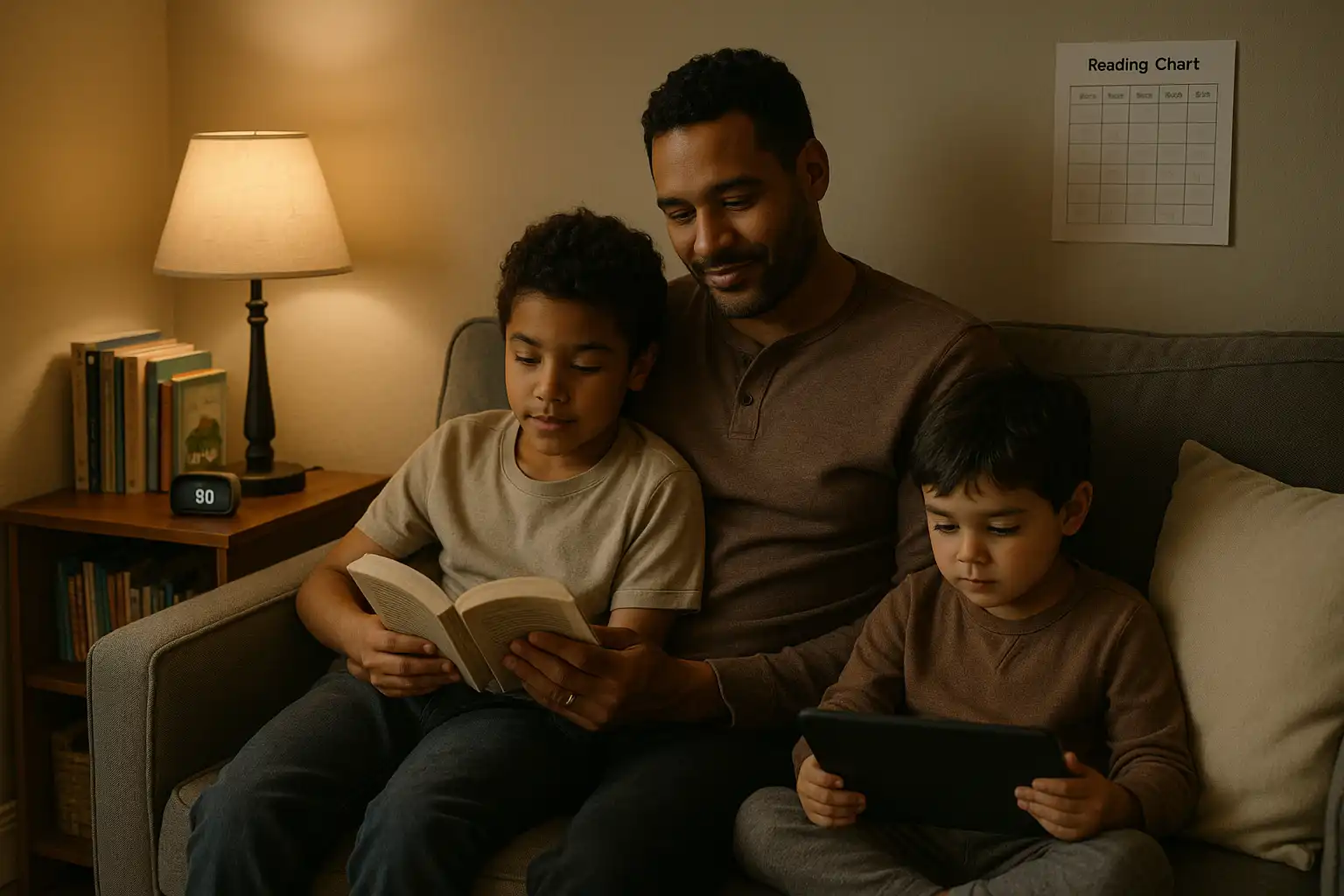
Daily Reading Routines for Busy Families
A practical daily reading routine that builds fluency and comprehension in 20 minutes.
Read ArticleShare this article