Texas TEKS4th GradeEla

4.6GIdentifying Key Ideas from Details

Comprehension skills · b.6: Comprehension skills: listening, speaking, reading, writing, and thinking using multiple texts. The student uses metacognitive skills to both develop and deepen comprehension of increasingly complex texts. The student is expected to:

Free printable worksheet

Download the 4.6G worksheet

The lesson, the visual models, and 6 practice problems with space to work.

Download the PDF

PDF · 7 pages · answer key · no sign-up

What this standard means: In this lesson, your child will practice figuring out which details matter most in a passage and how those details work together to show the main idea. Using fossil clues about Maiasaura nests, eggs, and young dinosaurs, they will read carefully, notice repeated and related facts, and explain what those clues suggest. They will learn that a topic is the general subject, while a key idea tells what the author wants readers to understand about that subject. By looking at how the important details connect, your child will decide what the passage is mostly saying and explain their thinking in clear words.

What the standard says, word for word · §110.6.b.6.G

evaluate details read to determine key ideas
Read it at the source: Texas Education Agency (TEA)
← Builds on · Grade 3§110.5.b.6.G Identifying Key Ideas from Details
You are here · Grade 44.6G Identifying Key Ideas from Details

What’s inside

What you get, and who it’s for

Everything below is measured from the actual lesson and the actual file. Nothing here is an estimate.

Time to run
About 25 minutes. 7 min lesson, then 18 min of practice.
In the download
7 printable pages: the full lesson, the worked examples, the visual models, and 6 practice problems with space to work. An educator answer key is included at the end, so the student pages come first and it is still ready to hand out. The lesson’s worked examples do show their solutions, because that is how they teach.
Question set
The download carries all 6 questions. The page shows 6 of them as a sample.
Question format
Every question is short answer. Students show their work on the page.
Assumed before this

Students who are shaky on these will struggle with 4.6G. Worth a quick check first.

  • b.1.A(4th Grade) Students should already be able to identify the topic of a passage and tell the difference between a topic and a key idea. They should also know how to point out important details that support one main idea.
Dates
Published September 11, 2026. Not revised since.

The sample intervention

See a real lesson for 4.6G

A real intervention, not a generic worksheet.

4.6G

Dinosaur Details: Follow the Fossil Clues

Decide which details matter and explain how they work together to reveal what a passage is mostly saying.

Read the passages and examples below to learn about how details reveal a key idea. Notice how each important detail adds a clue about the same idea.
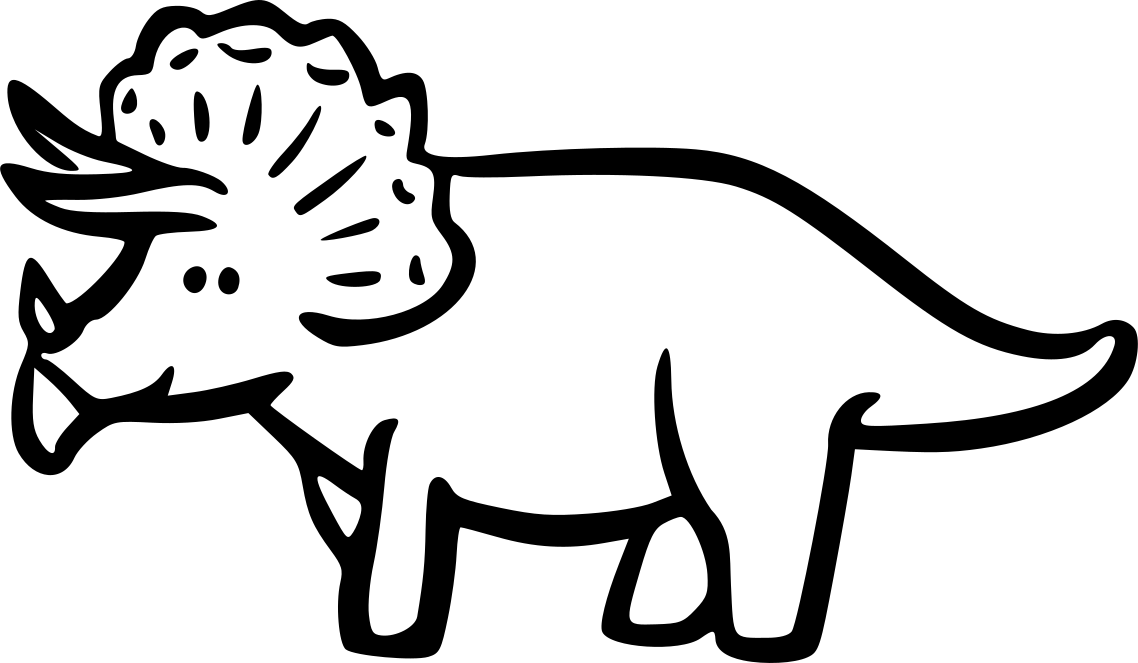
Triceratops
A topic names the general subject, but a key idea tells what the author wants readers to understand about that subject. Imagine shining a spotlight on each detail. Keep details that illuminate the same important idea, and explain how their clues connect.
Maiasaura Nesting Clues — Fossils cannot show dinosaur behavior as it happened. However, the locations and conditions of fossils provide clues. At sites in Montana, paleontologists uncovered Maiasaura nests, eggs, and remains of young dinosaurs.
Many nests were located near one another. Scientists also found nesting areas in rock layers formed at different times. These details suggest that Maiasaura gathered in groups and used the same general area during more than one nesting season.
Some young Maiasaura found inside nests had grown beyond the size of newly hatched babies. This detail suggests that the young remained in their nests as they grew. Together, the fossils reveal important information about how Maiasaura nested and cared for its young.
Worked exampleWorked Example 1 — Full model: Topic label: “Maiasaura.” This only names the subject. Key idea: “Maiasaura fossils reveal that these dinosaurs nested in groups and that their young remained in nests while growing.” This complete sentence tells what the details reveal about Maiasaura.
Worked exampleWorked Example 2 — Supported model: One detail says that many nests were located near one another. Another says that nesting areas appeared in rock layers from different times. The first detail suggests group nesting, while the second suggests repeated use of the area. Their connected clue is that Maiasaura had organized nesting behavior.
Worked exampleWorked Example 3 — Faded model: Weak version: “Nests, eggs, rock layers, and young dinosaurs.” This list names details but does not connect them. Strong version: “Nearby nests and young dinosaurs found inside them reveal that Maiasaura gathered to nest and that its young stayed there while growing.” The strong version explains how the details lead to a key idea.

Practice questions

  1. 1

    A reader writes “Tyrannosaurus rex” as the key idea of the passage. Explain why this is only a topic, and state a key idea that connects the smell and vision details.

  2. 2

    Consider these two details from the passage: Detail 1 says T. rex had large olfactory bulbs that processed smells. Detail 2 says its forward-pointing eye sockets created overlapping views. Which detail more directly supports the idea that T. rex had a strong sense of smell, and why?

  3. 3

    A Borealopelta fossil had thick armor and preserved color patterns. Its back was darker than its underside, a pattern that can make an animal harder to notice. Complete this key idea and explain how both details support it: “The Borealopelta fossil suggests that this dinosaur protected itself by ____.”

  4. 4

    Evaluate these details about Borealopelta. Detail 1: It had thick armor. Detail 2: Its darker back and lighter underside may have helped it hide. Detail 3: A mine worker discovered the fossil in Alberta. Which detail should be left out of a key idea about protection from predators, and why?

  5. 5

    Archaeopteryx fossils show feathered wings like those of birds. They also show teeth, clawed fingers, and a long bony tail like features found in other dinosaurs. What key idea do these details support, and how do the details connect?

  6. 6

    One fossil preserves a Velociraptor and a Protoceratops locked together. The Protoceratops has its beak around the Velociraptor’s arm, while the Velociraptor has a curved foot claw near the Protoceratops’s neck. What key idea do these details reveal? Explain how the details work together.

Part of the question set is shown. Generate the whole intervention, freshly themed and with an answer key, for your own class in the product.

Watch for this

Common mistakes

Detail-Listing Instead of Key-Idea Thinking: Students often name the topic or repeat a list of facts, like “T. rex,” “nests and eggs,” or “armor and color patterns,” without explaining what those details show together. The mistake is not choosing which details matter most and how they connect to reveal one main idea, such as a dinosaur’s senses, behavior, or protection from predators.

Vocabulary

Key terms

topic
The general subject the passage is about.
key idea
What the author wants readers to understand about the subject.
detail
A small piece of information that gives a clue about the key idea.
fossil
The preserved remains or trace of a living thing from long ago.

In the classroom

How to use this intervention

Use the worksheet as a brief whole-class warm-up to model how a topic becomes a key idea, then let students work independently or with a partner for the remaining questions during the 18-minute practice block. If some students need more support, pull a small group to reread the details and explain which ones best match the main idea.

Want this themed to your class instead?

Generate a fresh, standards-aligned intervention like this one, themed to whatever your students are into, in about 2 minutes.

Generate for my class

Questions educators ask

Educator FAQ

What grade level is this worksheet for?

It is for Grade 4.

Which TEKS standard does this worksheet align to?

It aligns to TEKS §110.6.b.6.G, which asks students to evaluate details to determine key ideas.

Does the worksheet include an answer key?

Yes, the lesson text includes worked examples and modeled responses, which serve as the answer support shown here.