Science Safety First: Guided Notes Check-In
Demonstrate safe practices and use safety equipment during classroom and field investigations.
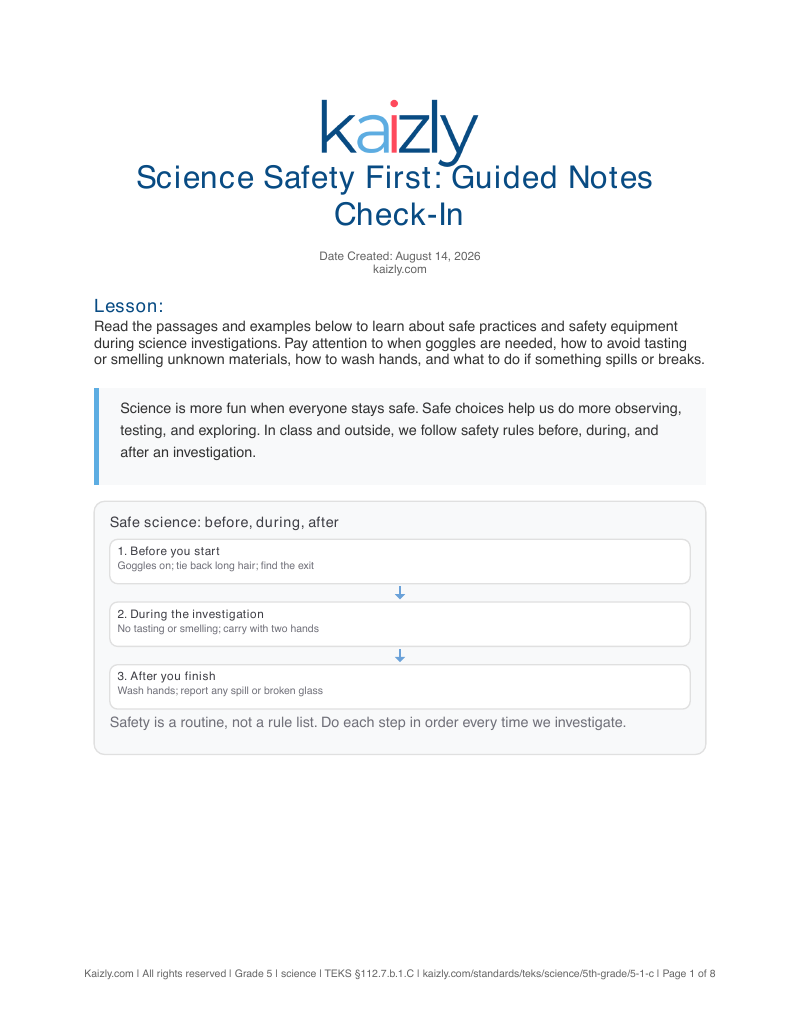
Read the passages and examples below to learn about safe practices and safety equipment during science investigations. Pay attention to when goggles are needed, how to avoid tasting or smelling unknown materials, how to wash hands, and what to do if something spills or breaks.
Safety is a routine, not a rule list. Do each step in order every time we investigate.
| What it protects you from | When you use it | |
|---|---|---|
| goggles | splashes, dust, and small pieces | before mixing or pouring anything |
| soap and water | materials left on your hands | after handling any material |
| eye wash station | something that got into your eyes | right away, and tell the teacher |
| fire extinguisher | a small fire | an adult uses it, not students |
| the exit route | staying in an unsafe room | when the teacher says to leave |
Find each of these in our room today. Knowing where they are is part of being ready to do science.
Practice questions
- 1
Mia is about to mix a liquid, and her teacher says there may be tiny splashes. What should Mia do first?
- Taste the liquid carefully
- Put her hands in her pockets
- Smell the liquid directly
- Put on goggles
- 2
A student says, 'I can sniff this powder quickly to see what it is.' What is wrong with that idea?
- Students should smell all science materials directly.
- Students should never smell science materials directly.
- It is fine if the powder looks clean.
- Only taste tests are unsafe.
- 3
Two students finish handling soil and water samples. Which student made the safer choice?
- The student who wipes hands on a shirt
- The student who washes hands with soap and water
- The student who touches a desk first
- The student who keeps working right away
- 4
The class is starting an investigation. A teacher says, 'Before we begin, know where the fire extinguisher, eye wash station, and exit are.' Why is this important?
- It helps everyone reach the right safety place quickly.
- It helps students finish faster than other classes.
- It only matters after the investigation is over.
- It is mainly for decorating the room.
- 5
Noah needs to carry a tray with cups of water across the room. Which way is safest?
- Swing it to show he is careful
- Hold it above his head
- Carry it with two hands and keep it level
- Carry it with one hand and move fast
- 6
The teacher wants students to notice a smell in a safe way. Which action should they use?
- Waft gently only when the teacher says to do it
- Shake the material near the face
- Put the material right under the nose
- Taste the material instead
- 7
A jar tips over on the table. Jamal starts to reach for it, then remembers the safety plan. What should he do first?
- Move it closer to the edge
- Step back and tell the teacher immediately
- Pick it up quickly with his bare hands
- Ignore it and keep working
- 8
Which student is showing the best safety choice during a lab investigation?
- Ava, who wears safety goggles before mixing liquids
- Ben, who tastes a material to identify it
- Carla, who runs across the room with glassware
- Diego, who points a tube toward a classmate
- 9
Read the safety note: 'Tie back long hair before using a burner or moving near flames.' What does this note mean?
- Long hair should be left loose during the activity.
- Long hair should be tied back before working near flames.
- Long hair only matters after the lesson ends.
- Long hair is used to help the burner stay lit.
- 10
A student says, 'Safety rules slow science down, so we should skip them.' Which response best matches the lesson?
- Safety rules make science impossible.
- Safety rules are only for field trips.
- Safety rules help everyone do science safely and keep working.
- Safety rules matter only for the teacher.
Part of the question set is shown. Generate the whole intervention, freshly themed and with an answer key, for your own class in the product.