Texas TEKS5th GradeScience

§112.7.b.1.DUse tools, including calculators, microscopes

Scientific and engineering practices · b.1: Scientific and engineering practices. The student asks questions, identifies problems, and plans and safely conducts classroom, laboratory, and field investigations to answer questions, explain phenomena, or design solutions using appropriate tools and models. The student is expected to:

Free printable worksheet

Download the §112.7.b.1.D worksheet

The lesson, the visual models, and 4 practice questions with space to work.

Download the PDF

PDF · 5 pages · answer key · no sign-up

What this standard means: TEKS §112.7.1.D asks fifth graders to use science tools such as graduated cylinders, balances, thermometers, and rulers to collect accurate measurements. This intervention, Tool Reading Quick Check, practices that skill with numeric-entry questions built from four real readings: a meniscus sitting at 37 mL, a thermometer four degrees below zero, a balance showing 62 grams, and a ruler reading to the nearest tenth of a centimeter. Students must read at eye level, use the bottom of the curve on liquids, and remember the negative sign below zero, then enter the exact value. With repetition, reading a tool correctly the first time, rather than estimating, becomes a reliable habit before data collection begins.

Before you download

What you get, and who it’s for

Everything below is measured from the actual lesson and the actual file. Nothing here is an estimate.

Time to run
About 8 minutes. 3 min lesson, then 5 min of practice.
In the download
5 printable pages: the full lesson, the worked examples, the visual models, and 4 practice questions with space to work. A teacher answer key is included at the end, so the student pages come first and it is still ready to hand out. The lesson’s worked examples do show their solutions, because that is how they teach.
Question set
The download carries all 4 questions. The page shows 3 of them as a sample.
Question format
Every question is numeric answer. Students show their work on the page.
Dates
Published August 6, 2026. Not revised since.

The sample intervention

See a real lesson for §112.7.b.1.D

A real intervention, not a generic worksheet.

§112.7.b.1.D

Tool Reading Quick Check

Use science tools to observe, measure, test, and analyze information by reading measurements correctly.

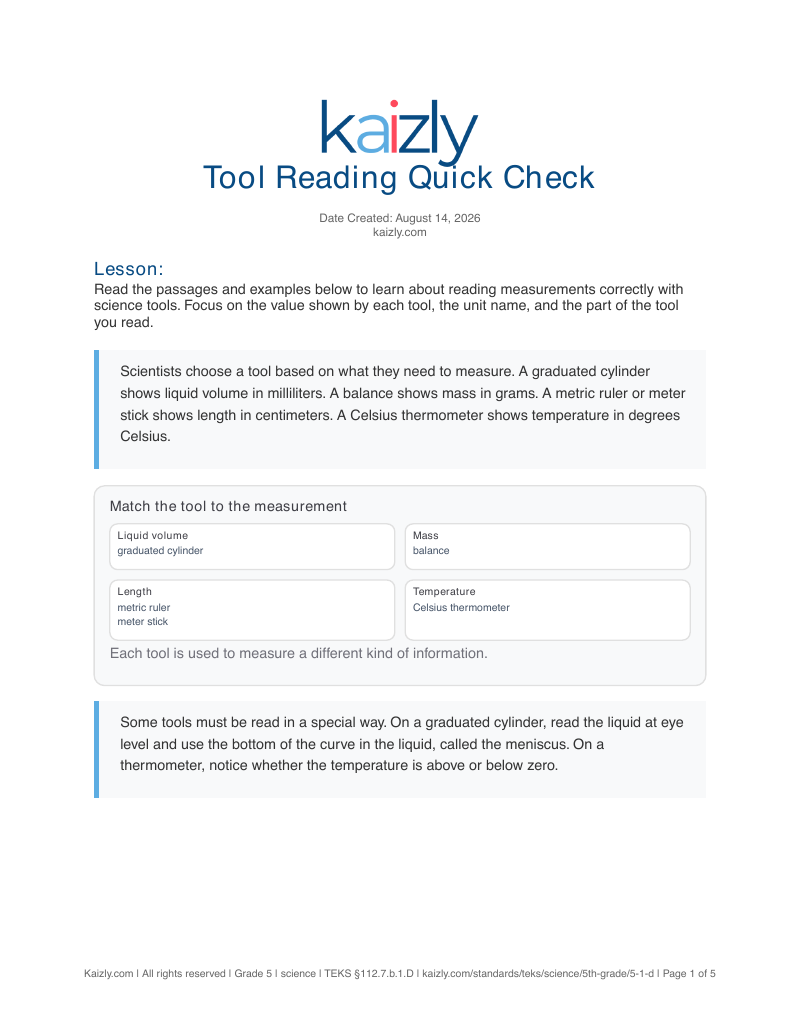
Read the passages and examples below to learn about reading measurements correctly with science tools. Focus on the value shown by each tool, the unit name, and the part of the tool you read.

Scientists choose a tool based on what they need to measure. A graduated cylinder shows liquid volume in milliliters. A balance shows mass in grams. A metric ruler or meter stick shows length in centimeters. A Celsius thermometer shows temperature in degrees Celsius.
Match the tool to the measurement

Each tool is used to measure a different kind of information.

Some tools must be read in a special way. On a graduated cylinder, read the liquid at eye level and use the bottom of the curve in the liquid, called the meniscus. On a thermometer, notice whether the temperature is above or below zero.
Worked exampleGraduated cylinder: the liquid curves down in the middle. Read at eye level — the bottom of the meniscus sits at 25 mL, so you record 25 mL.
How to read a graduated cylinder

Reading: 45 mL

Read at the BOTTOM of the curved surface (the meniscus), with your eye level with it. This one reads 45 mL.

Worked exampleThermometer: the red line stops 6 marks below the 0, so the temperature is -6 °C. Below-zero readings always get a negative sign.
Reading below zero

Reading: -6°

The liquid stops between -10 and 0. Below zero is written with a minus sign, so this reads -6 degrees C.

How to read a balance

Reading: 85 g

Mass is measured in grams. Read where the pointer settles: this balance reads 85 g.

Reading to the nearest tenth

Reading: 12.6 cm

The end falls past 12 cm, six small marks along. Each small mark is one tenth, so this reads 12.6 cm.

Practice questions

  1. 1

    A graduated cylinder has the bottom of the meniscus at 37 mL. What volume should you enter?

  2. 2

    A thermometer reads 4 degrees below zero. What temperature should you enter?

  3. 3

    A balance shows a mass of 62 g. What mass should you enter?

Part of the question set is shown. Generate the whole intervention, freshly themed and with an answer key, for your own class in the product.

Want this themed to your class instead?

Generate a fresh, standards-aligned intervention like this one, themed to whatever your students are into, in about 2 minutes.

Generate for my class