Fractions Routine: Cook, Cut, Number Line Plan
Fractions routine: start with Cook → Cut → Number Line and 20–30 minute nightly sessions. Build fluency and connect to decimals with a step-by-step plan.

Jim Carlson
Co-Founder & Parent
What You'll Learn
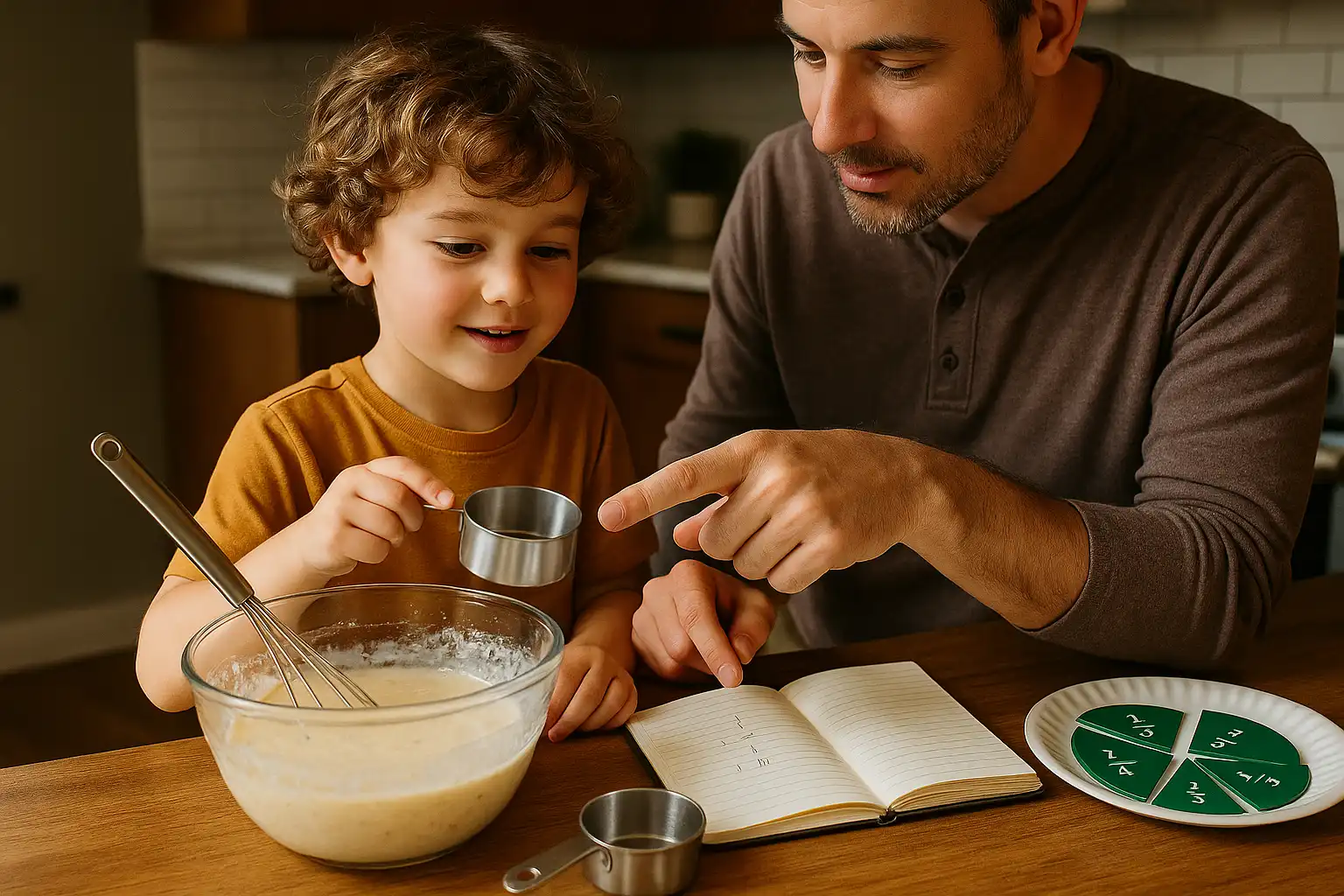
Start with hands-on meaning before symbols: Cook to feel fractions, Cut to see them, Number Line to place them.
Short, consistent 20-to-30-minute nightly sessions build confidence and lasting fluency through micro goals and meaningful practice.
Use Kaizly to turn the Cook → Cut → Number Line sequence into a personalized routine that tracks progress and keeps practice doable. Try the Kaizly dashboard to set a 5-week plan and track nightly wins.
Introduction
TL;DR: Rebuild fractions from concrete to abstract using Cook → Cut → Number Line, practice 20 to 30 minutes a night, and use Kaizly to turn those nightly wins into steady progress. This approach matters because busy parents need a structured yet flexible routine that is easy to run at home and grounded in real life. The rest of this article explains step by step how to run ready-to-use activities, what to expect each week, and how to connect this work to decimals, percentages, and later algebra. For more on designing routines that adapt to a child’s strengths, see our guide to Personalized Learning. If your child also struggles with word problems that use fractions, pair this routine with the Word Problems Routine. For summer math practice ideas, see Summer Math Activities.
Why this matters to busy parents
Fractions are a gateway skill. When children understand them, decimals, percentages, ratios, and much of middle school math become manageable. Research and national standards emphasize the central role of fractions in later math success (National Mathematics Advisory Panel, 2008; Common Core State Standards Initiative, 2010). Short, consistent practice with meaningful tasks produces better retention than marathon sessions, so a 20 to 30 minute nightly plan fits working family schedules and yields measurable gains.
Why fractions get lost in translation
Many students learn rules before they learn what the rules represent. That creates fragile understanding and quick frustration. Typical pitfalls include:
Learning procedures such as "invert and multiply" without a physical or visual anchor.
Visual models being dropped too soon when symbolic work begins.
Assumptions that the student "should already know this" which let gaps widen quietly.
Research and standards note the connection between fraction understanding and later algebra readiness (National Mathematics Advisory Panel, 2008; Common Core State Standards Initiative, 2010). The fix is a clear, repeatable sequence that restores meaning step by step.
The Cook → Cut → Number Line sequence
Overview: each stage has a focused goal. Cook helps children experience part and whole through measurement and proportion. Cut turns those experiences into accurate visual models. Number Line locates fractions as distances and bridges to decimals and percents.
Step 1: Cook — Make fractions real
Goal: Let your child touch and feel fractional quantities so equivalence and proportional thinking make sense.
Materials:
A simple recipe that uses 1/2, 1/3, 1/4, 3/4 cups or tablespoons
Measuring cups and spoons (1 cup, 1/2 cup, 1/3 cup, 1/4 cup; spoons down to 1/8 if possible)
Kitchen scale if available (grams or ounces)
Notebook or recipe remix sheet and pencil
Activity 1: Double and Half Recipe Challenge
Time: 20 to 30 minutes
Choose a simple recipe your child likes such as pancakes, muffins, or a no bake snack.
Read the recipe together. Identify quantities that use fractions: 1/2 cup, 3/4 cup, 1/3 cup, etc.
Ask your child to double or halve the recipe. Have them predict the new measurements before measuring.
Measure the ingredients physically. For example, to double 3/4 cup, measure two 3/4 cups or convert to cups and fractions: 3/4 + 3/4 = 6/4 = 1 1/2 cups. Practically, show two 3/4 measurements in the bowl or use a 1 cup plus 1/2 cup.
Discuss what happened. Ask your child to show how many 1/4 cups make 1/2 cup and how to measure 3/8 cup if you only have 1/4 and 1/8.
What they learn:
Equivalence and composition: how parts combine to a whole or to other parts.
Proportional reasoning: doubling and halving affect each ingredient proportionally.
Measurement awareness: fractions describe size and quantity not just symbols.
Variation and extensions:
If a recipe calls for 3/4 cup and you only have 1/4 cup, measure three times. If you have an 1/8 cup measure, show how two of those equal 1/4.
Use the kitchen scale to show that two 1/2 portions weigh the same as one whole portion.
Keep a "recipe remix" notebook where your child writes the original and adjusted measurements and draws quick fraction sketches.
Ask, "If we only have a 1/4 cup, how can we measure 3/4 cup of flour?" This encourages proportional reasoning and creative problem solving.
Step 2: Cut — Make fractions visible
Goal: Turn tactile experience into precise visual models so the child can see equal parts and compare sizes.
Materials:
Paper, scissors, ruler
Playdough or clay
Cardboard circles or disposable paper plates
Marker for labeling
Tape to assemble displays on the fridge
Activity 2: Fraction Folding Game and Fraction Pizza Board
Time: 15 to 30 minutes for first session, 5 to 10 minutes in follow ups
Give three strips of paper the same size or three identical paper plates.
Fold or cut one into halves, one into thirds, one into quarters. Encourage your child to fold carefully, aiming for equal parts.
Label each piece clearly with the fraction name: 1/2, 1/3, 1/4.
Line pieces up and compare sizes. Which piece is bigger 1/3 or 1/4? Why?
Combine pieces: show that two 1/4 pieces equal 1/2 by placing them together.
Create a Fraction Pizza Board: glue paper circles for selected denominators on cardboard, label pieces, and keep the board on the fridge as an everyday reference.
What they learn:
Unit fractions are building blocks.
Equal parts are essential to the meaning of fractions.
Visual comparison is more reliable than guessing numbers.
Variation and extensions:
Use playdough to make 3D fractions, which helps kinesthetic learners.
Make a matching game: write fraction names on slips and match them to the cut pieces.
Step 3: Number Line — Make fractions measurable
Goal: Place fractions as distances to help comparison, addition, subtraction, and conversion to decimals and percents.
Materials:
Ruler or tape measure
Masking tape for floor or long strip of paper
Marker to label 0 and 1 and benchmarks such as 1/4, 1/2, 3/4
Optional: small toys or tokens to mark positions
Activity 3: The Fraction Walk and Number Line Mapping
Time: 10 to 20 minutes
Draw or mark a number line from 0 to 1 on paper or on the floor using tape.
Label 0 and 1. Ask your child where 1/2 would be, and mark it.
Ask where 1/4 and 3/4 would be; mark them and have the child place tokens at each point.
Walk it: have your child stand at 0 and take steps that represent 1/4 or 1/8. Counting steps builds a physical sense of fractional distance.
Ask comparison questions: which is larger 1/3 or 1/4? How far apart are 1/3 and 1/2?
Convert to decimals: place 0.25, 0.5, 0.75 at the same spots to show equivalence.
What they learn:
Fractions are numbers on a continuum.
Comparing fractions is easier when you see distances.
Decimals and percents are natural notations of the same quantities.
Fridge Sheet Tip: Print or create a 0 to 1 number line with 1/4, 1/2, 3/4 labeled and place unit fraction visuals beside it. Use it during homework and cooking.
A free printable for the number line step
You do not have to draw the 0 to 1 line yourself any more. Our free fractions on a number line worksheet is a printable PDF with 12 practice problems and a full answer key, free and with no sign-up. Every question on it treats a fraction as a point on the same 0 to 1 line the Fraction Walk marks out on the floor, so the paper version and the floor version teach the same idea instead of two different ones. Print it once, keep it with the fridge sheet, and use it on the nights nobody has the energy for masking tape.
Real-life practice that sticks
To make learning durable, connect it to whatever your child already enjoys. Keep each practice session short, predictable, and applied.
| Day | Theme | Challenge Example |
|---|---|---|
| Monday | Fraction Cooking | Double or halve a simple recipe. Predict new measurements before checking. |
| Tuesday | Sports Stats | Compare two players' free throw percentages. Write as fraction and decimal. |
| Wednesday | Art Fractions | Divide a design into halves, thirds, quarters. Discuss visual balance. |
| Thursday | Number Line Mapping | Plot 0 to 1, estimate where 2/3 or 7/8 would land. |
| Friday | Decimal Link | Convert fractions to decimals using prices, distances, or recipes. |
Keep sessions to 30 minutes or less. Repeat, then build small variations the next week.
The 30-minute weekly catch-up plan
Use this five week track as a clear progression. Each nightly session includes one visual activity, one short explanation, and one applied problem.
| Week | Focus | Goal and Example |
|---|---|---|
| 1 | Unit fractions and equivalence | Practice 1/2, 1/3, 1/4. Show two 1/4 pieces equal 1/2 using paper cuts. |
| 2 | Comparing fractions visually | Use folding and number lines to order fractions like 2/5, 3/8, 1/2. |
| 3 | Adding and subtracting with common denominators | Combine 1/4 + 1/4, then 3/8 + 1/8 using cut pieces and number line jumps. |
| 4 | Fractions to decimals | Convert 1/2 to 0.5, 1/4 to 0.25 using recipes and money examples. |
| 5+ | Ratio and percent reasoning | Apply fractions to recipes, sports stats, discounts, and probability examples. |
How to run a 30 minute evening session — a reproducible template
5 minutes - Warm up: quick review from previous day. Use a fridge sheet or a token walk.
10 minutes - Visual or hands on activity: cook, fold, or number line walk.
10 minutes - Short explanation and targeted question: ask your child to explain what happened and why.
5 minutes - Applied problem and reflection: one quick problem connected to life and one sentence written reflection in the recipe remix notebook.
The Kaizly move: micro goals that build mastery
Kaizly turns this sequence into a guided nightly plan that fits family life. Features that parents appreciate:
Weekly focus with daily 30-minute sessions planned for you.
Visual tools and prompts to run the Cook → Cut → Number Line activities at home.
Personalization so tasks adapt as your child progresses and confidence improves (Personalized Lesson Plans).
Progress tracking and streaks to motivate children and inform parents.
If you want to set this up quickly, register with Kaizly, add your child and choose a 5-week Fractions learning plan. The dashboard guides each nightly activity and records progress so you can see growth week by week.
Tips for success and common pitfalls
Consistency matters more than duration. Twenty to thirty minutes each night with the same structure builds secure understanding faster than a single long weekend of practice.
Common mistakes to avoid
Skipping hands on steps and jumping to procedures.
Letting visuals fade after initial lessons.
Overcorrecting language before the child can model the concept physically.
Why parents report a turning point
Homework becomes less stressful because the child can show, not just memorize.
Small wins boost confidence and reduce the "I am not a math person" narrative.
Understanding fractions transfers to easier work with decimals and percents.
Supporting evidence and sources
The Common Core State Standards identify fraction understanding as essential for middle school math and algebra readiness (Common Core State Standards Initiative, 2010). National reviews and advisory panels highlight fraction competence as a predictor of success in higher mathematics (National Mathematics Advisory Panel, 2008). Spaced, meaningful practice produces more durable learning than massed practice, which supports 20 to 30 minute nightly sessions.
Conclusion
Fractions are fixable when you rebuild meaning from the ground up: Cook to feel parts of a whole, Cut to see equal parts and comparisons, then use the Number Line to place fractions as numbers and connect to decimals and percents.
Start with hands on meaning before symbols.
Use short, consistent 20 to 30 minute sessions to build lasting fluency.
Turn the sequence into a personalized routine with Kaizly for guided practice and progress tracking. Get started in the Kaizly dashboard and adapt the 5-week plan to your schedule.
Next step
Begin tonight with a 20 to 30 minute Cook session. Pick a simple recipe, ask your child to halve or double it, and follow the reproducible template above. When you are ready to make this a predictable plan you can track, register in Kaizly’s dashboard.
Frequently Asked Questions
Question: My 5th grader is lost on fractions, where do we start?
Answer: Start at the hands on level, not at the homework problem. Use cooking or folding to rebuild what a whole and a part mean. Kaizly’s Week 1 plan starts there with unit fractions and equivalence. To learn more about building an adaptive routine, see our notes on Personalized Learning.
Question: Where can I find practice with fractions and decimals applied to real life so it sticks?
Answer: Use cooking, sports statistics, and money. The sample weekly mini-challenges above give ready to use ideas. Kaizly lessons also use these contexts to make practice meaningful.
Question: Where can I find a weekly catch-up plan for 20 to 30 minutes a day?
Answer: Kaizly’s 5 week Fractions Catch Up Track is made for that routine and personalizes each day’s visual mini lesson and applied problem. Register on the dashboard to start a guided 5-week plan.
Question: Should I review fractions or jump to decimals?
Answer: Always secure fraction meaning first. Decimals are another notation for fractions so they will make sense once the parts of a whole are secure.
Question: How can I tell if my child’s fraction confusion is about numbers or language?
Answer: Ask them to show a fraction rather than just name it. If they can model 3/4 but can’t explain it, focus on vocabulary. If they cannot model it, start with Cook and Cut to rebuild meaning.
Question: What materials do I need to start tonight?
Answer: Common household items are enough: measuring cups and spoons, paper, scissors, tape, a ruler or masking tape for a floor number line, and a notebook. A kitchen scale is optional but helpful. Start small and build your toolkit over a couple of weeks.
Question: Is there a free printable number line I can use instead of drawing one?
Answer: Yes. The free fractions on a number line worksheet is a printable PDF with 12 practice problems and a full answer key. It is free, it needs no sign-up, and it uses the same 0 to 1 line the Fraction Walk uses.
Final thought: Fractions are a doorway to richer math thinking, not a roadblock. With structured activities, short nightly practice, and the right supports, your child can move from guessing to confident reasoning. When you are ready to turn these activities into a tracked, personalized plan that fits your schedule, explore Kaizly and set up a tailored five-week routine.
Tags
References
Common Core State Standards — Mathematics Grades 3–8. Defines grade-level expectations for mathematical practice and content, including operations with fractions and decimals.
What Works Clearinghouse — Improving Mathematical Problem Solving in Grades 4 Through 8. U.S. Department of Education practice guide offering evidence-based recommendations for supporting students’ mathematical reasoning and problem solving.
Understood.org — Helping Your Child Learn Fractions. Parent-friendly guidance for when kids learn fractions.
About Jim Carlson
Jim Carlson is the co-founder and CEO of Kaizly. A former marketing and technology executive and parent of three, he created Kaizly to help families support their children's learning and growth at home.
Related Articles
How Our Approach Transforms Lesson Plans into Truly Personalized Learning Journeys
Discover how Kaizly transforms lesson plans into personalized learning journeys with flexible timelines, engaging rubrics, and AI-powered insights.
Read Article
How Personalized Learning Builds Skill, Confidence, and Joy Outside the Classroom
Fill after school and summer time with tailored practice that boosts skills and confidence.
Read Article
How to Help Kids With Word Problems: The Read-Label-Plan Routine
Word problems: Teach the Read-Label-Plan routine, log one nightly error tag, and use quick sketches. Parents get a two-minute routine that lowers load and builds reliable problem solving.
Read ArticleShare this article