How to Create a Personalized Lesson Plan for Your Child (Template + Example)
Step-by-step guide to building a personalized lesson plan for your child in grades 3-8, with a 6-step framework, grade-band examples, and FAQ.

Matt Locke
Co-Founder & CTO
What You'll Learn
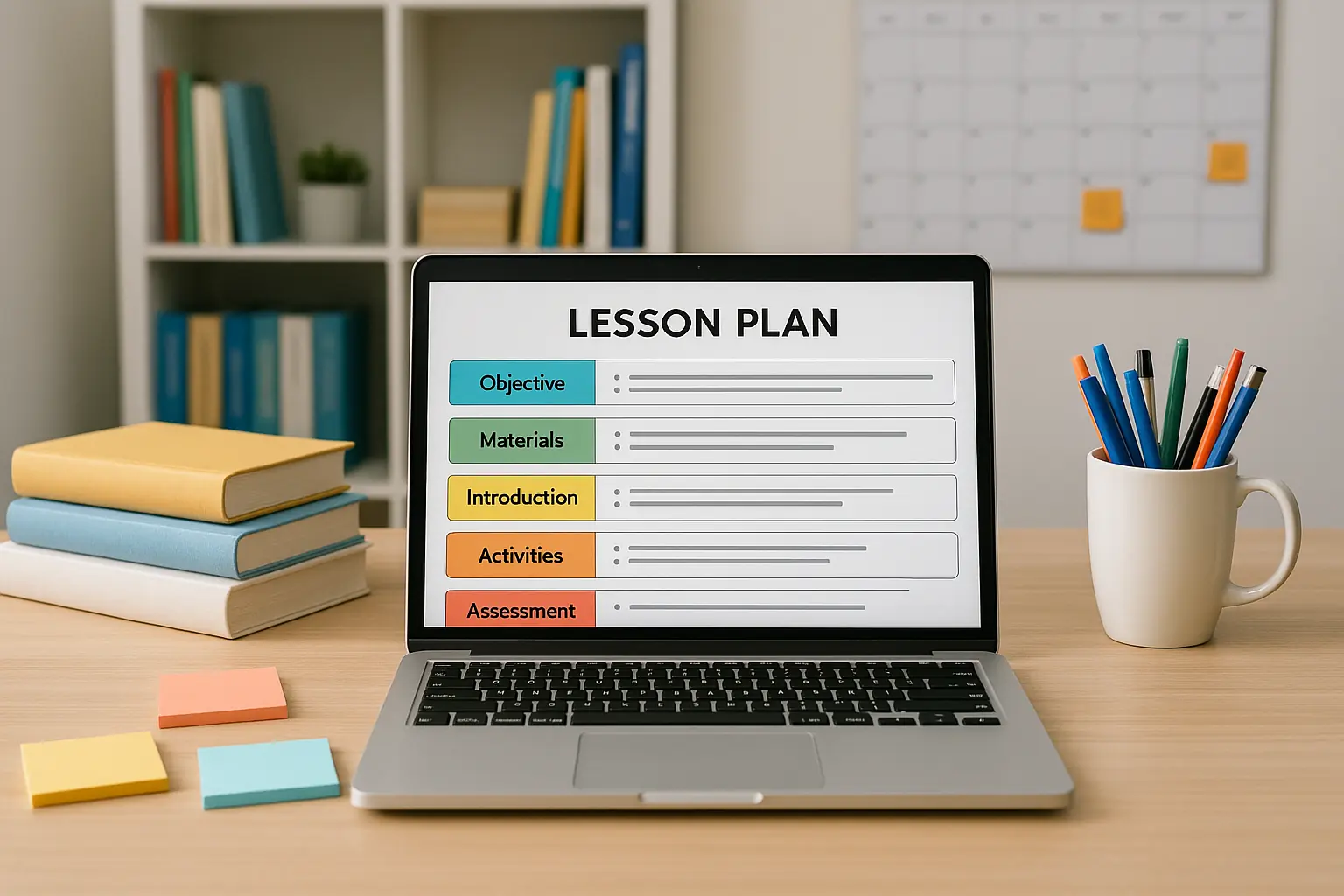
A 6-step framework for building a personalized lesson plan at home
How to assess your child's starting point without being a teacher
Sample weekly plans for grades 3-4, 5-6, and 7-8
Common mistakes parents make when creating lesson plans
How to track progress and adjust the plan over time
Why a personalized lesson plan matters
A personalized lesson plan targets what your child actually needs rather than following a generic curriculum. Research on personalized learning shows that students who receive instruction matched to their skill level make significantly greater gains than peers in one-size-fits-all settings (Pane et al., 2015). For a deeper look at the principles behind personalized learning, see our parent's guide to personalized learning.
The good news is that you do not need a teaching degree to build one. You need a clear picture of where your child is, a few focus areas, and a simple weekly structure. This guide walks you through it step by step.
How to create a personalized lesson plan in 6 steps
Step 1: Assess your child's current level
Before you can personalize anything, you need to know where your child stands. You have several options: review recent report cards and teacher feedback, use a free online diagnostic (like our grade readiness assessments), or simply observe which homework problems cause frustration and which are too easy. The goal is to identify specific strengths and gaps, not to assign a label. For example, your child might read at grade level but struggle with multi-step word problems.
Grades 3-4 example: Ask your child to read a short passage aloud and retell it in their own words. Note whether they stumble on decoding, miss the main idea, or both. In math, try a mix of multiplication facts and simple word problems.
Step 2: Identify 2-3 focus areas
Resist the urge to address everything at once. Pick two or three focus areas where improvement will have the most impact. Common choices include reading comprehension, math fluency (fractions, decimals, or operations), writing structure, or study habits. Fewer focus areas mean deeper practice and faster visible progress.
Grades 5-6 example: A child transitioning to upper elementary might focus on fraction operations and paragraph-to-essay writing. These two skills form the foundation for middle school math and ELA.
Step 3: Choose activities and materials
For each focus area, select 2-3 types of activities that match your child's interests. A child who loves cooking can practice fractions through recipe scaling. A child who loves sports can work on data analysis with game statistics. Mix formats: some written, some hands-on, some digital. If you are considering using AI tools or hiring a tutor to supplement, see our guide to choosing between a tutor, AI, and self-directed learning. For more on how AI adapts learning in real time, see AI in Education.
Step 4: Set a weekly schedule
Build a realistic schedule with 3-5 short practice sessions per week. Research on effective learning supports consistent, spaced practice over long cramming sessions. A typical weekly structure might look like:
| Day | Focus | Duration | Activity Type |
|---|---|---|---|
| Monday | Reading comprehension | 30 min | Guided reading + summary writing |
| Tuesday | Math fluency | 30 min | Problem set + interest-based application |
| Wednesday | Writing | 25 min | Paragraph practice with peer or parent review |
| Thursday | Math fluency | 30 min | Word problems connected to real-world topics |
| Friday | Review + reflection | 20 min | Week recap: what clicked, what was hard, what to adjust |
The table above is a filled-in example showing what a balanced week can look like. The one below is a blank template you can copy and fill in with your own child's focus skills, checking off each day as you go.
| Day | Focus Skill | Activity (20-30 min) | Done? |
|---|---|---|---|
| Monday | Fractions | 10 word problems or recipe scaling | ☐ |
| Tuesday | Reading comprehension | Read a passage + 3 questions | ☐ |
| Wednesday | Multiplication facts | Timed drill + a quick game | ☐ |
| Thursday | Writing | One-paragraph response | ☐ |
| Friday | Review | Redo 3 missed problems | ☐ |
Adjust the schedule to fit your family. If weekday afternoons are too hectic, shift sessions to mornings or weekends. The key is consistency, not perfection.
Step 5: Track progress weekly
Use a simple checklist or journal to track what your child works on each day and how it went. Note which activities felt too easy (time to increase difficulty), which caused frustration (may need scaffolding or a different approach), and which your child genuinely enjoyed (lean into these for motivation). Weekly check-ins do not need to be formal — a five-minute Friday conversation works.
Step 6: Adjust every 2-4 weeks
A personalized lesson plan is a living document. Every two to four weeks, review what is working and make changes. If your child has mastered single-digit multiplication, move to multi-digit. If reading comprehension has improved but writing is still a struggle, shift the balance. The point of personalization is that the plan evolves as your child grows.
Sample lesson plans by grade band
Grades 3-4: 30-minute daily plan
Focus areas: reading fluency and basic multiplication. Monday and Wednesday: 15 minutes of guided reading (a chapter book at the right level) plus 15 minutes of multiplication fact practice using flashcards or an adaptive app. Tuesday and Thursday: 15 minutes of reading response writing (summarize what happened in the chapter) plus 15 minutes of word problems using multiplication. Friday: 20-minute review game or interest-based project (e.g., using multiplication to calculate how many Lego bricks are needed for a design).
Grades 5-6: 45-minute daily plan
Focus areas: fraction operations and paragraph writing. Monday and Wednesday: 20 minutes of fraction practice (converting, adding, subtracting) plus 25 minutes of paragraph writing with a clear topic sentence, evidence, and conclusion. Tuesday and Thursday: 20 minutes of fraction word problems using real-world contexts (recipes, sports stats) plus 25 minutes of reading a grade-level article and writing a one-paragraph response. Friday: 30-minute project that combines both skills (e.g., plan a party budget using fractions and write up the plan).
Grades 7-8: 60-minute daily plan
Focus areas: pre-algebra and analytical writing. Monday and Wednesday: 25 minutes of equation solving and proportional reasoning plus 35 minutes of analytical writing (read a short article, identify the author's argument, write a two-paragraph response). Tuesday and Thursday: 25 minutes of data analysis using real datasets (weather data, sports stats, survey results) plus 35 minutes of persuasive writing practice. Friday: 45-minute independent project where the student picks a topic, researches it, and presents findings.
Common mistakes to avoid
Trying to cover everything at once. Two or three focus areas produce better results than spreading effort across six subjects.
Making sessions too long. Younger children lose focus after 30 minutes; even middle schoolers do better with focused 45-60 minute blocks than marathon study sessions.
Skipping the assessment step. Without knowing where your child actually stands, you are guessing at what to practice. Even an informal assessment saves weeks of wasted effort.
Not adjusting the plan. A plan that stays the same for two months is no longer personalized. Review and adjust every 2-4 weeks.
Treating it like school. Home learning works best when it connects to your child's interests. A lesson plan that feels like extra homework will meet resistance.
Kaizly creates a personalized lesson plan in about ten minutes. Set your child's goals, complete a quick assessment, and get a custom weekly schedule that adapts as your child progresses. Start free trial
Tags
References
Continued Progress: Promising Evidence on Personalized Learning. Pane, J. F., Steiner, E. D., Baird, M. D., Hamilton, L. S., & Pane, J. D. (2015). RAND Corporation.
What is PBL?. PBLWorks — Buck Institute for Education.
Universal Design for Learning Guidelines. CAST — Center for Applied Special Technology.
Learner-Centered Psychological Principles. American Psychological Association (1997). APA Work Group of the Board of Educational Affairs.
About Matt Locke
Matt Locke is the co-founder and CTO of Kaizly. He leads product and engineering, turning learning science into tools that help families build effective learning routines at home.
Related Articles

Personalized Learning at Home: A Parent's Guide for Grades 3-8
What personalized learning means for grades 3-8 and how to start at home.
Read Article
Tutor vs. AI vs. Self-Directed: How to Choose Learning Support
Compare human tutors, AI platforms, and self-directed practice to find the right fit.
Read Article
AI in Education: How Adaptive Learning Helps Kids at Home
How AI-powered adaptive learning works for grades 3-8 and what the research shows.
Read ArticleShare this article