The 90-Minute Homework Routine That Ends Nightly Battles (2026)
Ninety-minute homework routine helps busy parents after school. Use a 10-minute kickstart, two focused blocks, timers and Kaizly to build independence.

Jim Carlson
Co-Founder & Parent
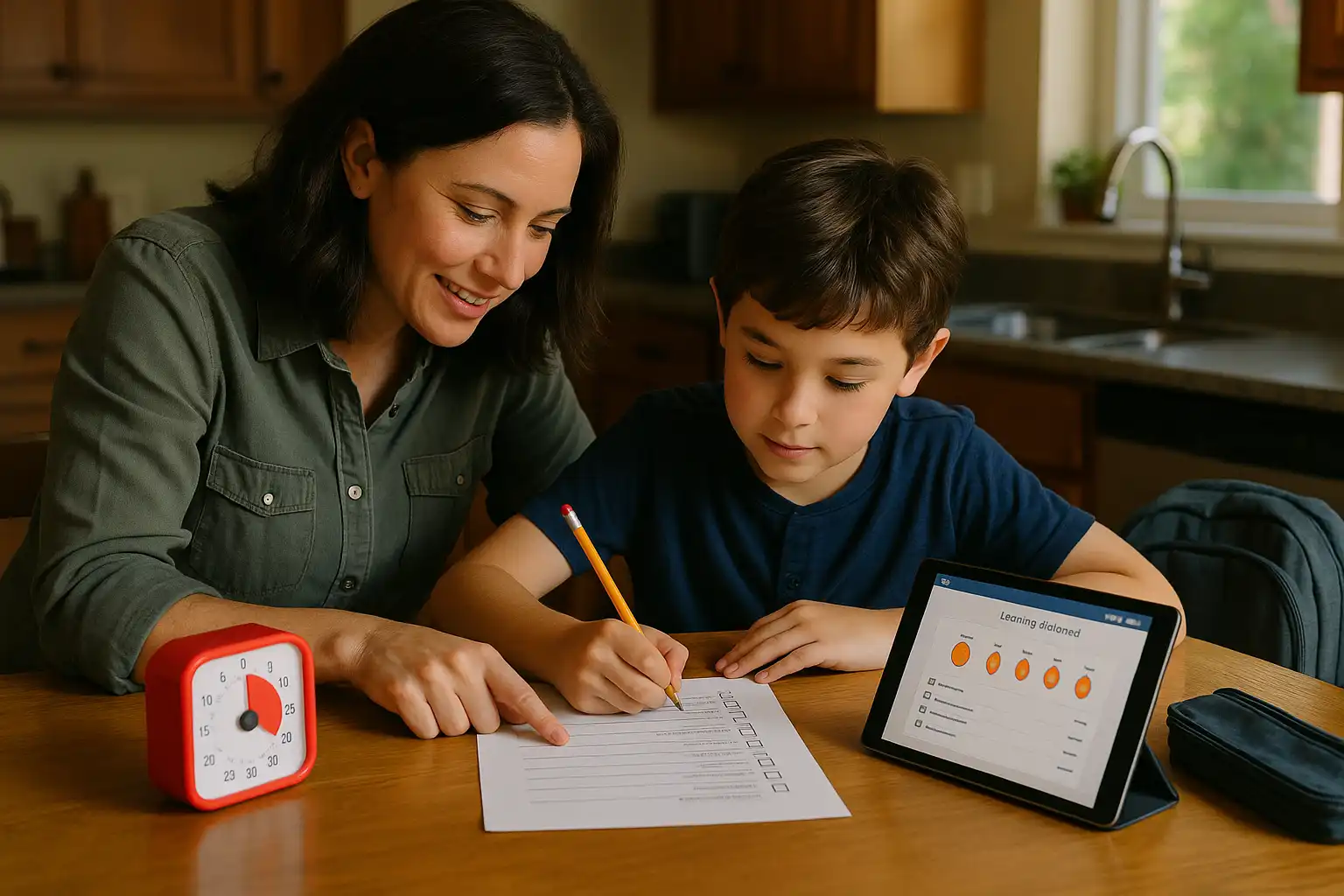
Homework in Ninety Minutes or Less: A Personalized Learning Routine Busy Parents Can Use Tonight
Set a predictable ninety minute routine with a ten minute kickstart, two focused work blocks, and a ten minute wrap up to make homework efficient and calm.
Use visible systems like timers, checklists, and Kaizly two task streaks to build independence and reduce parental nagging.
Prioritize structure over perfection; adapt timing for activity evenings and track progress so habits stick.
TL;DR: Here is how you can turn chaotic evenings into a consistent, ninety minute homework rhythm that respects your child's energy and your family schedule. Start tonight with a ten minute setup, two structured work blocks, and a ten minute wrap up, and use visible tools so your child learns to manage work with less prompting.
Busy parents value structure that is flexible and science based. When homework is predictable and visible, kids know what to do and parents do not have to become homework police. This post gives step by step instructions you can use from beginning to end, includes example schedules you can copy, and points to simple tools and research that back the approach.
Why homework drags on forever
Cognitive fatigue
After a full school day, working memory and attention are taxed. Expecting an immediate switch into sustained focus is unrealistic. Give kids a short recovery window so they can actually do productive work rather than powering through tiredness.
No clear start or stop boundaries
The instruction "just get your homework done" is too vague. Kids start and stop more easily when they know exactly when work begins and when it ends. Naming the window and making it visible reduces avoidance.
Distractions and task switching
Even brief interruptions make it harder to finish work. Researchers at the University of California Irvine found that after an interruption it can take on average 23 minutes to fully refocus on the original task, which multiplies time lost across an evening.
Executive function overload
Planning, organizing, and remembering instructions are executive function skills that mature over many years. Scaffolding these skills with external systems like checklists and timers helps children complete tasks without constant adult direction. For background on executive function development see the Harvard Center on the Developing Child resource on executive function and self regulation.
Emotional friction
When homework triggers nagging and tension, avoidance follows. The goal is to make the routine the boss, so the emotional battle stops.
What to do first
Start with timing not content. Define the ninety minute window and make the first night a practice run. Use visible timers and a simple checklist. Stop at the end of the window even if work is not finished. Over days the child will adapt and use time more efficiently.
The block schedule that works
Predictability matters more than perfection. Below are two ready to use sample schedules that you can copy exactly or adapt.
| Time | Activity | Purpose |
|---|---|---|
| 3:30 to 4:00 | Snack and decompression | Brain recovery and emotional reset |
| 4:00 to 4:10 | Setup time | Review planner and organize supplies |
| 4:10 to 5:00 | Deep work block 1 | High focus homework such as math, reading or writing |
| 5:00 to 5:10 | Short break | Stretch, snack, refill water |
| 5:10 to 5:50 | Deep work block 2 | Remaining assignments or project work |
| 5:50 to 6:00 | Wrap up | Review checklist and pack backpack |
Total time in focus approximately ninety minutes
Example 2: Sports or activity day
| Time | Activity | Purpose |
|---|---|---|
| 3:30 to 4:00 | Snack and downtime | Prevent burnout after school |
| 4:00 to 4:30 | Setup and block 1 | Focused thirty minute effort |
| 5:00 to 7:00 | Practice or music | Movement and creativity time |
| 7:15 to 8:00 | Block 2 and wrap up | Light work and prep for next day |
Notice timing shifts but structure stays consistent. Children learn there is a homework rhythm they can rely on.
The three stage timer routine
This time management routine turns ninety unfocused minutes into ninety productive minutes. It is based on attention science and time boxing best practices.
Stage 1 — Kickstart ten minutes
Goal: Transition from downtime to focus
Review planner and list every assignment that needs attention.
Set up work area. Remove phones or place devices in another room.
Choose the hardest or most important task first.
Start a ten minute activation timer with the only goal to get started.
The activation period reduces friction. Beginning is often the hardest part. Ten minutes of momentum makes the rest easier.
Stage 2 — Deep work two or three blocks of thirty to forty minutes
Goal: Maximize sustained focus
Run thirty to forty minutes of uninterrupted work. For younger children use twenty five minute blocks to build capacity.
Use a visible timer so the child can see time passing and learn to self regulate.
Take five to ten minute breaks that avoid screens. Break activity examples include a quick walk, stretching, or a simple chore.
Research and practice show that structured work with breaks improves persistence and reduces mental fatigue. The work popularized as the Pomodoro approach originated with Francesco Cirillo and many families adapt the same timing ideas to build focus.
Stage 3 — Wrap up and reflect ten minutes
Goal: Reinforce executive function and close the session
Review completed tasks against the planner.
Correct any obvious errors and make notes for the teacher if needed.
Pack supplies and lay out anything needed for tomorrow.
Plan tomorrow's top two priorities and record progress in a visible tracker. This is where Kaizly's two task streak becomes practical.
The Kaizly move: the two task streak
Kaizly's Move feature turns consistency into a simple daily game. Here is how to use it tonight.
Each evening your child picks two small tasks: one academic task and one organizational task such as emptying the backpack or placing permission slips in the folder.
When both tasks are complete they earn a daily streak.
The Kaizly dashboard shows status so parents can see progress without reminding.
The psychological power: Small wins increase self efficacy and habit formation. Bandura's work on self efficacy shows that mastery experiences are a strong source of confidence, which supports persistence over time.
Practical tools to build independence
Parents want support strategies that are simple to run and easy to teach. Make systems visible rather than verbal.
Self checklists
A visible checklist on a whiteboard, printable routine, or the Kaizly dashboard walks kids through every step.
Visible timers
External timers make time concrete. A visual timer such as Time Timer or a Pomodoro style app helps children learn to pace themselves and to see time as a resource.
Progress trackers
Streaks, stickers, or a Kaizly progress view give immediate feedback. Children respond to visible progress more than to repeated reminders.
Example checklist:
Check planner
Set timer
Start task one
Take a five minute break
Start task two
Review and pack up
What if your schedule gets messy
Split it up: Two forty five minute sessions, one before and one after dinner, still work.
Shift timing: On late activity nights move the block earlier and finish lighter tasks later.
Protect consistency over exact timing: Keeping the routine predictable matters more than the clock you choose.
Batch lighter tasks: On hectic days focus on quick wins like flashcard review or organizing notes.
Even partial adherence keeps momentum and prevents the total restart trap.
Why this routine works
Executive function alignment: The routine reduces task switching, provides clear start and stop cues, and builds metacognitive reflection through the wrap up.
Emotional regulation: Predictable routines lower anxiety. Clear expectations and a firm end time reduce resistance and make evenings calmer.
Cognitive efficiency: Structured work blocks with brief breaks mirror strategies used by high performers across domains. They maximize productive focus and manage fatigue.
Family harmony: When the system is doing the reminding, parents step back. Kids gain competence and the whole household reclaims evening time.
A predictable routine becomes the teacher's assistant. When the system is visible children learn to manage time, and parents stop becoming the homework police.
Important note on energy curves
Younger children usually need a recovery break after school before doing focused work. Older children sometimes prefer to finish activities and do homework later. Pick a time window and commit to it for at least two weeks before you change things.
Actionable night by night checklist you can use today
Tonight, set a visible ninety minute window.
Do the ten minute kickstart: snack, planner review, workspace set up.
Run two deep work blocks with a visible timer.
Finish with a ten minute wrap up and mark the Kaizly two task streak.
Repeat and track streaks for one week.
Conclusion
Homework does not have to take over the evening. With a predictable ninety minute rhythm, visible systems, and small daily wins you can create calmer nights and build your child's independence.
Ready to put this into practice? Sign up for Kaizly to set up your child's two task streak and start building the homework habit this week. For guidance on customizing tasks, review our personalized lesson plans. If your child needs focused reading practice, see our Reading Comprehension Two-Week Routine. For writing homework, try the One-Paragraph Writing Routine. If word problems are the sticking point, see our Word Problems Routine. For math-specific routines, check out the Fractions Routine.
Frequently Asked Questions
Question: “Homework takes all night what should we change first?”
Answer: Start with timing not content. Define a clear ninety minute window and stick to it. Use visible timers and stop at the end of the window even if work is not complete. Productivity improves as children learn to focus within limits.
Question: “What is a good after school schedule when kids have sports or music?”
Answer: Consistency beats rigidity. If practice is five to seven PM, try homework from four to five PM and seven thirty to eight thirty PM. If practice ends later, shift to after dinner. Always begin each session with a ten minute setup to transition from activity mode to focus mode.
Question: “How do I build independence without hovering?”
Answer: Give ownership through tools not talk. Use a visible checklist or Kaizly streak tracker and let the system do the reminding. Praise consistency rather than compliance.
Question: “Should my child do homework right after school or after dinner?”
Answer: It depends on your child's energy curve. Younger children often do better after thirty to forty five minutes of recovery and a snack. Older children may prefer after dinner. Pick a time and try it for two weeks before changing.
Question: “How do I keep them from rushing through assignments?”
Answer: Rushing often signals fatigue or unclear goals. Use deep work blocks for focus and finish with a wrap up stage where the child reviews and checks work. The five minute reflection at the end improves quality.
Tags
References
Gloria Mark, Daniela Gudith, Ulrich Klocke, The cost of interrupted work More speed and stress, CHI 2008. CHI 2008 conference paper (Mark et al.), University of California, Irvine
Harvard Center on the Developing Child Executive Function and Self Regulation overview. Harvard Center on the Developing Child — executive function overview
Francesco Cirillo and the Pomodoro approach background. Wikipedia page about author and describing the Pomodoro Technique
Albert Bandura on self efficacy theory summary at SimplyPsychology. SimplyPsychology summary of Bandura's self-efficacy theory
Time Timer visual timers product information. Time Timer product site (visual timers)
About Jim Carlson
Jim Carlson is the co-founder and CEO of Kaizly. A former marketing and technology executive and parent of three, he created Kaizly to help families support their children's learning and growth at home.
Related Articles
How Our Approach Transforms Lesson Plans into Truly Personalized Learning Journeys
Discover how Kaizly transforms lesson plans into personalized learning journeys with flexible timelines, engaging rubrics, and AI-powered insights.
Read Article
How Personalized Learning Builds Skill, Confidence, and Joy Outside the Classroom
Fill after school and summer time with tailored practice that boosts skills and confidence.
Read Article
How to Help Kids With Word Problems: The Read-Label-Plan Routine
Word problems: Teach the Read-Label-Plan routine, log one nightly error tag, and use quick sketches. Parents get a two-minute routine that lowers load and builds reliable problem solving.
Read ArticleShare this article