Texas TEKS5th GradeScience

5.6BExplaining Properties of Mixtures

Matter and energy · b.6: Matter and energy. The student knows that matter has measurable physical properties that determine how matter is identified, classified, changed, and used. The student is expected to:

Free printable worksheet

Download the 5.6B worksheet

The lesson, the visual models, and 20 practice questions with space to work.

Download the PDF

PDF · 13 pages · answer key · no sign-up

What this standard means: TEKS §112.7.6.B asks fifth graders to demonstrate and explain that some mixtures keep the properties of their separate ingredients, such as iron filings and sand or sand and water. This intervention, Mixtures Keep Their Properties, practices that skill through short multiple-choice checks built on the lesson's examples: a magnet pulling iron filings back out of sand, correcting the claim that sand disappears in water, and sorting trail mix, salt water, and an iron-and-sand blend by whether their parts can still be separated. Students learn to tell a true mixture, where a magnet or sieve can pull ingredients apart, from a solution, where one substance dissolves evenly. With repetition, spotting which separation method fits a given mixture becomes routine.

What the standard says, word for word · §112.7.b.6.B

demonstrate and explain that some mixtures maintain physical properties of their substances such as iron filings and sand or sand and water
Read it at the source: Texas Education Agency (TEA)

What’s inside

What you get, and who it’s for

Everything below is measured from the actual lesson and the actual file. Nothing here is an estimate.

Time to run
About 35 minutes. 15 min lesson, then 20 min of practice.
In the download
13 printable pages: the full lesson, the worked examples, the visual models, and 20 practice questions with space to work. An educator answer key is included at the end, so the student pages come first and it is still ready to hand out. The lesson’s worked examples do show their solutions, because that is how they teach.
Question set
The download carries all 20 questions. The page shows 20 of them as a sample.
Question format
Every question is multiple choice. Students show their work on the page.
Assumed before this

Students who are shaky on these will struggle with 5.6B. Worth a quick check first.

  • §112.6.b.6.B(Grade 4) Students should already be able to investigate and compare a variety of mixtures, including solutions such as solids dissolved in liquids.
Dates
Published August 11, 2026. Last updated August 14, 2026.

The sample intervention

See a real lesson for 5.6B

A real intervention, not a generic worksheet.

5.6B

Mixtures Keep Their Properties: Practice Check

Demonstrate and explain that some mixtures keep the properties of their ingredients, such as iron filings and sand or sand and water.

Read the passages and examples below to learn about how mixtures can keep the properties of their parts.

A mixture is made when two or more substances are combined, but each substance stays itself. In some mixtures, you can still see or use the different parts because their physical properties do not change.
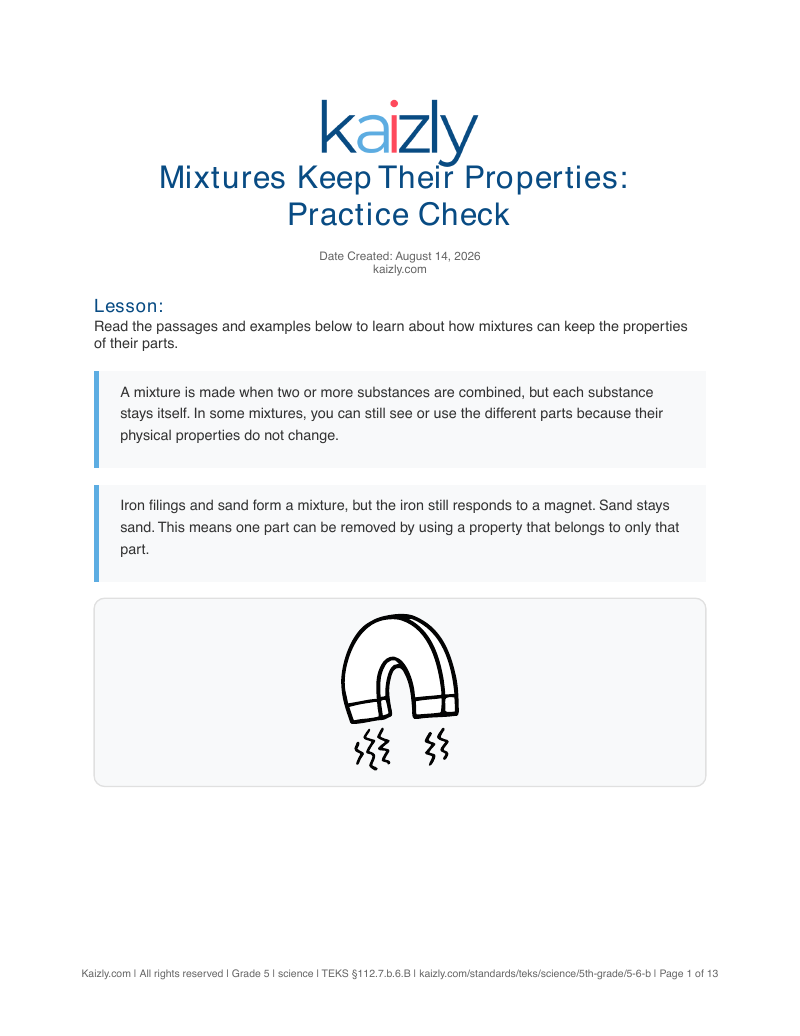
Iron filings and sand form a mixture, but the iron still responds to a magnet. Sand stays sand. This means one part can be removed by using a property that belongs to only that part.
Line drawing of a horseshoe magnet with iron filings being pulled up toward it.
Sand and water also form a mixture. The sand does not disappear, and the water does not turn into sand. The sand may sink, but it is still there and can be separated from the water.
Some mixtures can be separated because the parts have different properties, such as size, weight, magnetism, or whether they evaporate. A sieve can separate larger pieces from smaller ones, a magnet can remove iron, and evaporation can leave dissolved material behind.
Separating mixtures: property to tool
What is different about the partsTool that separates them
Iron filings + sandOnly the iron sticks to a magnetMagnet
Sand + waterSand does not dissolve; it settlesLet it settle, then pour off the water
Rice + beansThe pieces are different sizesSieve (screen with small holes)
Salt + water (a solution)Salt dissolves and spreads out evenlyEvaporation (water leaves, salt stays)

Match the property that is different to the tool that separates it. The last row is a solution: the salt is still there, even when you cannot see it.

A solution is different from a mixture like sand and water or iron and sand. In a solution, one substance seems to disappear because it dissolves evenly, but it is still present in the liquid. This lesson focuses on mixtures where the parts keep their properties and can often be separated without changing them.
Mixtures: what happens to the parts?

Sort each example. In both groups nothing disappears - the parts are still there.

Worked exampleIron filings in sand can be pulled out with a magnet.
Worked exampleSand in water can settle to the bottom and be separated.
Worked exampleTrail mix keeps the look and taste of each ingredient.
Worked exampleSalt water is a solution because the salt dissolves evenly.

Practice questions

  1. 1

    A student mixes iron filings and sand. What happens to the iron filings?

    • They still respond to a magnet.
    • They turn into sand.
    • They disappear.
    • They become water.
  2. 2

    A student says, 'The sand disappeared after it was mixed with water.' What is wrong with that idea?

    • The sand changed into water.
    • The water turned into sand.
    • The mixture became a solution.
    • The sand is still there, even if it sinks.
  3. 3

    Which pair is a mixture where the parts can still keep their own properties?

    • Salt water
    • Sugar water
    • Iron filings and sand
    • Milk and chocolate syrup
  4. 4

    A class records these mixtures: 1. iron filings and sand 2. salt water 3. trail mix Which one shows the best way to remove one part with a magnet?

    • Both salt water and trail mix
    • Salt water
    • Trail mix
    • Iron filings and sand
  5. 5

    How would you explain why a sieve can separate some mixtures?

    • Because heavier pieces always turn into new substances.
    • Because larger pieces stay on the sieve.
    • Because all substances dissolve in water.
    • Because magnets remove every kind of material.
  6. 6

    A jar has sand and water. Which action would help separate the sand from the water?

    • Add more sand until it disappears.
    • Use a magnet on the jar.
    • Let the sand settle, then pour off the water.
    • Freeze the mixture forever.
  7. 7

    Which statement best matches a trail mix mixture?

    • The ingredients always dissolve in water.
    • The ingredients change into one new substance.
    • The ingredients keep their own properties.
    • The ingredients disappear when mixed.
  8. 8

    A student mixes iron filings, sand, and water. Which tool could remove the iron filings first?

    • A clock
    • A ruler
    • A magnet
    • A sponge
  9. 9

    Look at these two mixtures: A: iron filings and sand B: salt water Which statement is true?

    • A is a mixture, and B is a solution.
    • A is a solution, and B is a mixture.
    • Both A and B are the same kind of mixture.
    • Both A and B are solutions.
  10. 10

    A student writes: 'If a substance sinks, it is gone.' Which choice corrects that idea?

    • If a substance sinks, it is gone forever.
    • If a substance sinks, it has become a gas.
    • If a substance sinks, it may still be in the mixture.
    • If a substance sinks, it always dissolves.
  11. 11

    Which method would best separate rice grains from larger beans in a mixed container?

    • A magnet
    • A freezer
    • A sieve
    • Evaporation
  12. 12

    A teacher says, 'Salt water is a mixture because the salt stays visible as separate grains.' What is the best response?

    • That is incorrect because salt turns into sand.
    • That is correct because salt water is a mixture with visible salt grains.
    • That is incorrect because the salt dissolves evenly in water.
    • That is correct because all liquids are mixtures.
  13. 13

    A class compares two mixtures. Mixture 1: iron filings and sand Mixture 2: sand and water Which tool would work on Mixture 1 but not on Mixture 2?

    • A notebook
    • A spoon
    • A towel
    • A magnet
  14. 14

    A student mixes two substances. One substance seems to disappear, but it is still present in the liquid. What does that describe?

    • A solid only
    • A solution
    • A magnet
    • A rock
  15. 15

    Which explanation best shows why salt and sand can be separated after mixing them?

    • The sand dissolves in water, but the salt stays solid.
    • The salt and sand both disappear when they are mixed.
    • The salt changes into sand when water is added.
    • The sand stays sand, and the salt can dissolve and be separated.
  16. 16

    A student wants to separate a mixture of iron filings and sand, then separate the sand from water. Which order makes the most sense?

    • Use a sieve first, then add more sand.
    • Use a magnet first, then settle or pour off the water.
    • Use evaporation first, then use a magnet.
    • Stir harder until both mixtures disappear.
  17. 17

    A student says, 'Trail mix is a solution because it has many parts.' What is the best correction?

    • Trail mix is not matter.
    • Trail mix is a mixture because the parts stay separate.
    • Trail mix becomes one new substance.
    • Trail mix is a solution because all foods dissolve.
  18. 18

    Data table: Mixture A: iron filings and sand Mixture B: salt water Which mixture can be separated with a magnet?

    • Mixture A
    • Neither mixture
    • Both mixtures
    • Mixture B
  19. 19

    A student mixes sand and water, waits, and then sees the sand at the bottom. Which sentence best explains this?

    • The sand is still there and settled down.
    • The sand turned into water.
    • The sand disappeared into the air.
    • The water became a magnet.
  20. 20

    Which choice best compares a mixture and a solution?

    • A mixture and a solution are always exactly the same.
    • A mixture keeps parts separate; a solution has one substance dissolved in another.
    • A solution means the liquid has no substance in it.
    • A mixture has parts that always dissolve; a solution never does.

Part of the question set is shown. Generate the whole intervention, freshly themed and with an answer key, for your own class in the product.

Watch for this

Common mistakes

Mistake: Thinking a mixture makes the parts disappear

Students often think that once substances are mixed, they are no longer there, especially if one part sinks, dissolves, or is harder to see. In this skill, the important idea is that in mixtures like iron filings and sand or sand and water, each part keeps its own properties and can often be separated with tools such as a magnet, a sieve, or settling.

Vocabulary

Key terms

mixture
A mixture is made when two or more substances are combined, but each substance stays itself.
iron filings
Iron filings are tiny pieces of iron that still respond to a magnet.
sand and water
Sand and water form a mixture, and the sand can be separated from the water.
solution
In a solution, one substance seems to disappear because it dissolves evenly, but it is still present in the liquid.

In the classroom

How to use this intervention

Use the 15-minute lesson for a brief whole-class warm-up to review how some mixtures keep the properties of their parts, then give students the worksheet for independent practice during the 20-minute practice time. If needed, pull a small group to revisit examples like iron filings and sand or sand and water while the rest of the class works.

Want this themed to your class instead?

Generate a fresh, standards-aligned intervention like this one, themed to whatever your students are into, in about 2 minutes.

Generate for my class

Questions educators ask

Educator FAQ

What grade is this worksheet for?

This worksheet is for Grade 5.

Which TEKS standard does it align to?

It aligns to TEKS §112.7.b.6.B, about demonstrating and explaining that some mixtures keep the properties of their ingredients.

Is an answer key included?

Yes, the free worksheet PDF includes all questions with a complete answer key.