Solutions Can Change Look, Not Matter
Compare substance properties before and after they are mixed into a solution, and show that the matter is still there.
Read the passages and examples below to review how matter stays the same when substances dissolve into a solution. Then, for each question, find the mistake in the student's claim and fix it. Start your answers with these sentence starters: "The error is…" and "The evidence that matter is conserved is…"
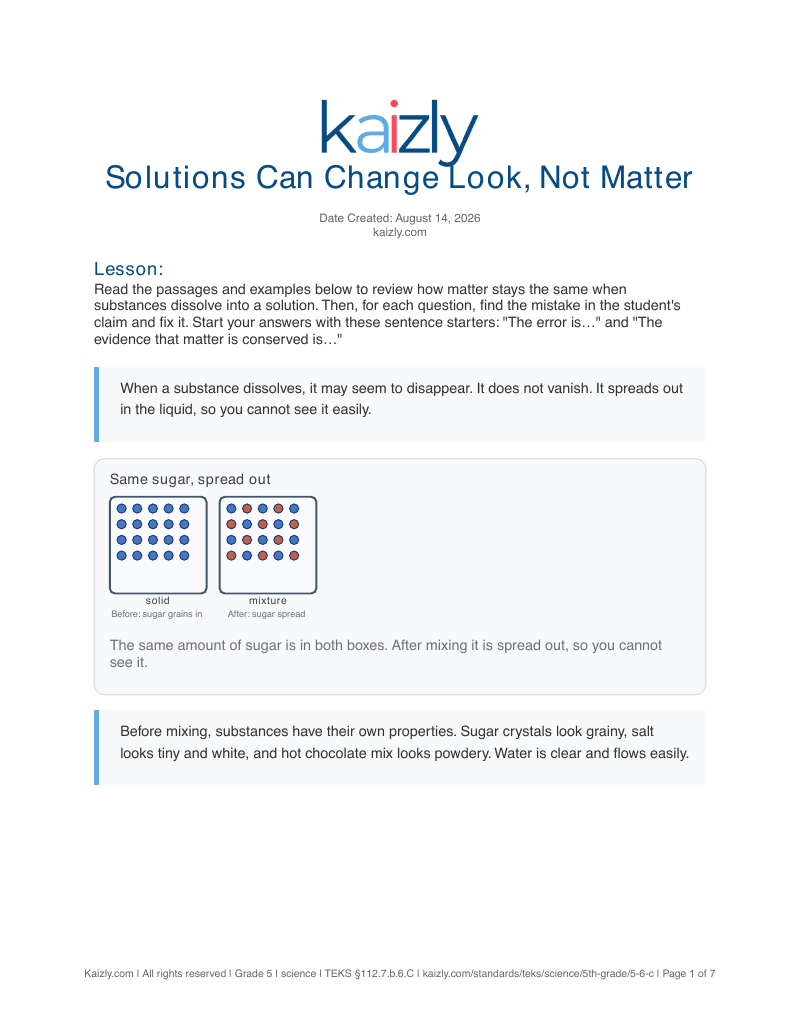
The same amount of sugar is in both boxes. After mixing it is spread out, so you cannot see it.
Dissolving changes what you SEE. It does not change how much matter is there.
| Mass before mixing | Mass after mixing | |
|---|---|---|
| Lemonade | 10 g sugar + 150 g water = 160 g | 160 g of lemonade |
| Salt water | 6 g salt + 120 g water = 126 g | 126 g of salt water |
| Hot chocolate | 8 g mix + 180 g milk = 188 g | 188 g of hot chocolate |
The mass after mixing equals the mass before. Nothing was lost - you just cannot see it any more.
Practice questions
- 1
Mia mixes 5 grams of sugar with 100 grams of water for lemonade. She says, 'The sugar disappeared because I cannot see it anymore.' What is the error in Mia's thinking, and what is the correct idea?
- 2
A student mixes 3 grams of salt with 200 grams of water. They write, 'The water now weighs 200 grams, so the salt must be gone.' What is wrong with this claim? Give the correct total mass after mixing.
- 3
A student says the lemonade has more mass because it has more liquid. Is the student correct? Compare these two cases: a lemonade pitcher with 7 grams of sugar and 93 grams of water, and a hot chocolate mug with 9 grams of mix and 91 grams of milk. Explain why the student is right or wrong.
- 4
A pool cleaner mix starts with 2 grams of cleaner and 50 grams of water. A student says, 'Because the cleaner cannot be seen, the total mass is only 50 grams now.' What does this situation show about matter in solutions?
- 5
A student says, 'Lemonade can look cloudy after mixing, so its matter changed into something new.' Why is this explanation not correct?
- 6
At home, 4 grams of hot chocolate mix are stirred into 96 grams of milk. The cup still has all of its drink. A student says, 'The mix is gone because I cannot see the powder.' What should you say to correct the student?
Part of the question set is shown. Generate the whole intervention, freshly themed and with an answer key, for your own class in the product.