Tiny Pieces of Matter: Guided Notes
Illustrate how matter is made of tiny particles that are too small to see.
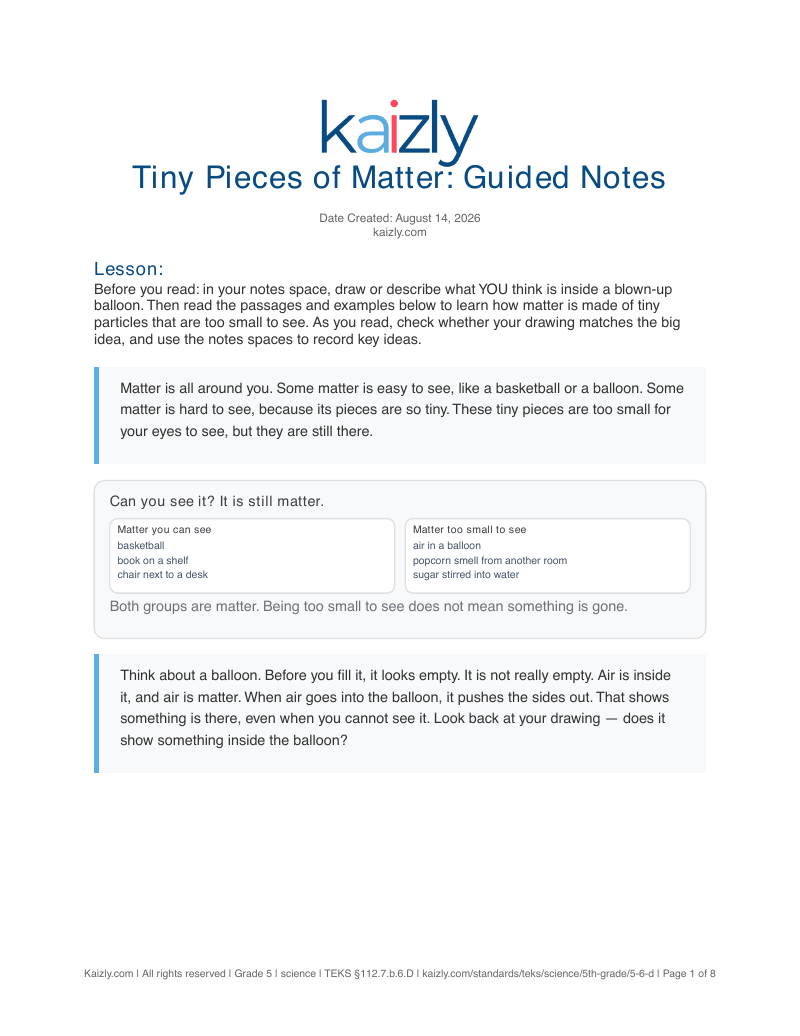
Before you read: in your notes space, draw or describe what YOU think is inside a blown-up balloon. Then read the passages and examples below to learn how matter is made of tiny particles that are too small to see. As you read, check whether your drawing matches the big idea, and use the notes spaces to record key ideas.
Both groups are matter. Being too small to see does not mean something is gone.
| What you notice | What it tells us | |
|---|---|---|
| Balloon | It puffs up and pushes the sides out | Air is in there and takes up space |
| Popcorn smell | You smell it from another room | Tiny pieces travel through the air |
| Sugar in water | It vanishes but the water tastes sweet | It is still there, just spread out |
You cannot see the pieces in any of these clues. You can only see what they do.
All three are matter. The particles are packed close, spread far apart, or mixed in - but they are always there.
Practice questions
- 1
Which statement best matches the big idea of this lesson?
- Only large objects are matter.
- Matter is made of tiny particles that are too small to see.
- Matter disappears when we cannot see it.
- Only water is matter.
- 2
A student says, 'A balloon looks empty, so there is nothing inside.' What is wrong with that idea?
- The balloon is filled with water.
- The balloon only has color inside it.
- The balloon is truly empty.
- Air is inside the balloon, even though we cannot see it.
- 3
Which example shows matter that is hard to see because it is made of tiny pieces?
- A book on a shelf
- A desk in the classroom
- A basketball sitting on the floor
- Popcorn smell coming from another room
- 4
A teacher writes these notes: Balloon: air goes in and pushes the sides out. Which idea does this show?
- Air is inside the balloon and takes up space.
- The balloon is made only of smell.
- The balloon has no matter inside it.
- The balloon gets bigger by itself.
- 5
Which choice best explains why you can smell perfume from another room?
- The other room becomes brighter.
- Tiny pieces from the smell travel through the air.
- The perfume turns into music.
- The perfume only works in silence.
- 6
Which statement compares the balloon and the popcorn smell correctly?
- The balloon shows air filling space, and the smell shows tiny pieces moving.
- The balloon shows sound moving, and the smell shows light moving.
- Both examples show things that are not matter.
- Both examples show matter that is easy to see.
- 7
A student says, 'Sugar disappears in water, so it is gone.' What is the best correction?
- The sugar is gone forever.
- The water removes all matter.
- The sugar changes into air.
- The sugar is still there, but spread out.
- 8
Which example best matches the idea that matter can be hard to see?
- Sugar stirred into water
- A chair next to a desk
- A baseball glove on a table
- A crayon in a box
- 9
A student says, 'If I cannot see it, it cannot be matter.' Why is that statement wrong?
- Because matter always looks colorful.
- Because all matter is made of glass.
- Because matter can be invisible and still be there.
- Because only light can be seen.
- 10
A student inflates a basketball with air. Which clue shows that matter is inside the ball and taking up space?
- The basketball gets lighter.
- The basketball changes shape and becomes bigger.
- The basketball turns a different color.
- The basketball starts to smell like perfume.
- 11
A teacher says, 'Think about what a balloon does when air goes in.' Which answer best explains why this helps us learn about matter?
- It shows air is not matter.
- It shows balloons are living things.
- It shows only solid things are matter.
- It shows matter can be too small to see, but still take up space.
- 12
Which choice is the best summary of the three lesson clues: balloon, smell, and sugar in water?
- Only big objects are matter.
- Matter can be too small to see, but it is still there.
- Smells and sugar are not connected to matter.
- Matter always disappears when it changes form.
Part of the question set is shown. Generate the whole intervention, freshly themed and with an answer key, for your own class in the product.