How to Choose the Best Math Activity for Your Child's Energy
70% of kids lose math skills over summer. Two hands-on activities for grades 3–8, a real-life scavenger hunt and kitchen fractions, each take 20–45 minutes and use what you already have.

Lindsay Carlson
Parent contributor
What You'll Learn
Why 70% of kids lose math skills over summer, and how 20–45 minutes of the right hands-on activity prevents most of it (NWEA, 2024)
Which of the two activities fits your child's energy level today, with a comparison table and step-by-step instructions for each, adapted for grades 3–8
How to extend Kitchen Math into proportional reasoning for older kids, and how to make the Scavenger Hunt challenging enough for a 7th or 8th grader
If your child has energy to burn right now, that's actually good news for math. If they're calm and want to make something (and eat it), that works too. The two activities below were designed for exactly those two situations. Both practice real math skills, fractions, measurement, multiplication, without either of you feeling like it's homework. Math is the subject hit hardest by summer learning loss, but it's also one of the easiest to practice without worksheets. Use the comparison table below to pick the right one for today.
Real-Life Math Scavenger Hunt, a high-energy search around the house or yard
Kitchen Math: Cooking with Fractions, a hands-on session that doubles recipes and math skills
How Do You Pick the Right Activity for Today?
| Criteria | Real-Life Math Scavenger Hunt | Kitchen Math: Cooking with Fractions |
|---|---|---|
| Ideal for kids who | Need to burn energy, love games, enjoy quick wins | Enjoy creating, love food, have patience for step-by-step tasks |
| Time needed | 20–30 minutes (prep plus hunt) | 30–45 minutes (prep, cook, clean) |
| Parent involvement | Light supervision, review answers at the end | Moderate supervision for safety and measuring |
| Mess factor | Low, mostly paper and found objects | Medium, flour on the counter is part of the fun |
| Math focus | Counting, estimation, geometry, algebraic thinking | Fractions, multiplication, unit conversion, proportional reasoning |
| Best mood match | Rainy-day wiggles or post-lunch energy spike | Calm morning, weekend brunch, or reward-based learning |
Quick tip: let your child's energy level steer the decision. If they're bouncing off the walls, start the scavenger hunt. If they want a calm, creative session with a snack at the end, head to the kitchen.
Activity 1: Real-Life Math Scavenger Hunt
Turn your home or backyard into a math playground. Kids search for items and solve mini challenges involving real-world math, shapes, measurements, estimation, and counting. It's energetic and hands-on, perfect for kids who learn by doing. Younger children (grades 3–5) practice basic operations and shape recognition. Older children (grades 6–8) can tackle more advanced clues involving estimation, multiplication, or algebraic thinking.
Why This Works for Grades 3–8
Third through fifth graders are at the stage where concrete experiences help solidify math skills. They'll love racing around to count objects or find shapes. Middle schoolers, who crave independence and relevance, enjoy applying math to everyday objects, and can even write some task questions themselves. This format uses kids' natural enthusiasm for games and competition, making math feel like an adventure rather than practice. Younger kids work at the concrete level (finding and identifying), while older kids handle abstract tasks like calculating totals or solving puzzles.
Materials for the Scavenger Hunt
Paper and pencil
Timer or stopwatch
List of math-related tasks tailored to your child's level
Example tasks: "Find 3 things shaped like a rectangle", "Estimate then measure the length of the kitchen table", or "Find a collection of objects totaling exactly 15"
How to Run the Scavenger Hunt
Create the task list: Make a list of math challenges tailored to your child's grade. Younger kids: 'Find four circles in the house and draw them' or 'Count how many windows are in our home.' Older kids: 'Find two containers and calculate the difference in their heights' or 'Collect items and arrange them in an array with exactly 24 objects, how many rows and columns did you use?' Write each task on a notecard for a treasure-hunt feel.
Set up and explain the rules: Give your child the task list (or one task at a time). Provide any tools needed, a ruler for measurement tasks, paper for calculations. Kids can complete tasks in any order. With multiple kids, run it as a friendly competition or team challenge. Set a time limit to keep the energy up: 20 minutes for 5 tasks is a good starting point.
Hunt and solve: Let your child go. Be available for hints but don't jump in too fast, figuring things out is the point. A younger child might need a nudge ('eggs often come in dozens'), but older kids usually run with it and may add creative touches of their own.
Review together: Go through the answers once time is up. Have your child show you the objects or explain their solutions. If they estimated the table at 60 inches and measured 55, talk through why it was a reasonable estimate. Keep it positive, the goal is for them to feel confident using math in everyday life.
Extend if they want more: Add a lightning round with extra challenges, like a quick mental-math riddle. Or flip roles: let your child create a scavenger hunt for you to solve. Creating the tasks stretches higher-level thinking, especially for older kids.
The Developmental Case for This Activity
Children around 8–10 are transitioning from basic fact memorization to applying concepts. A concrete hunt helps solidify abstract ideas. That concrete-first structure also lines up with CRA research, which shows students learn math concepts more reliably when instruction moves from objects to pictures to symbols (Agrawal and Morin, 2016). Older kids (11–13) are developing independence and may resist 'math practice,' but frame it as a game and they engage. You can adjust clue difficulty for the range of ability levels common in grades 6–8, easier clues for one kid, harder clues for another, same activity.
Helpful Resources
For more math challenges to add to your task list, Bedtime Math provides quick daily math riddles on kid-friendly topics, with levels for different ages (Wee Ones, Little Kids, Big Kids). Their mission is to make math a family ritual, much like bedtime stories. For a game-based approach, the Prodigy math game is an RPG-style app where solving math problems advances the story, useful for kids who need a longer session.
Activity 2: Kitchen Math: Cooking with Fractions
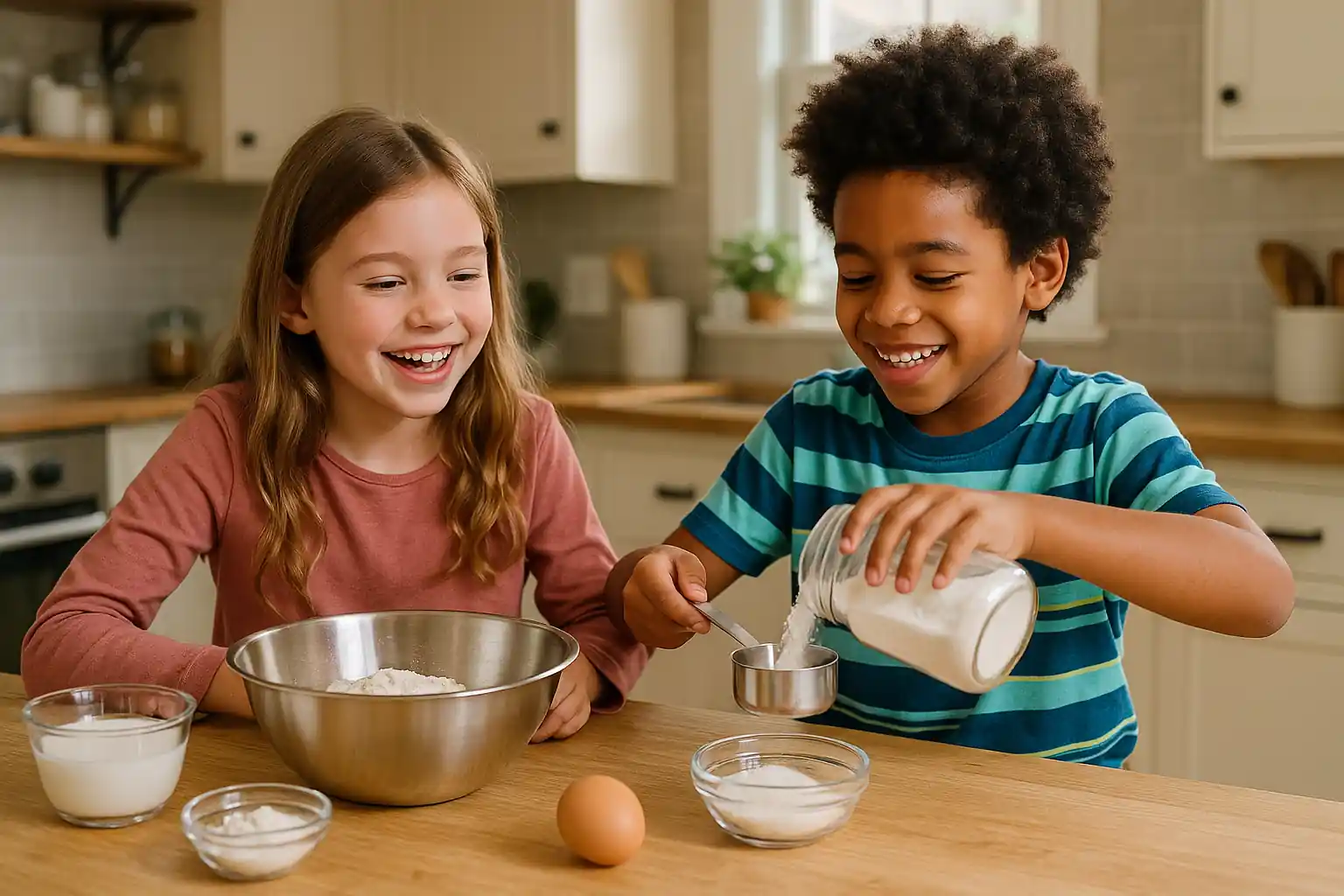
This activity turns your kitchen into a math lab. By following a recipe and doubling it, kids practice fraction addition, multiplication, and measurement, and they get a snack at the end. Ideal for grades 3–8 because younger kids handle measuring and mixing while practicing simple fractions, and older students can adjust recipes, cost out ingredients, and work with ratios. Kids around 9–11 especially love real tasks like baking because they feel capable and grown-up.
Why This Works for Grades 3–8
Third through fifth graders are learning fractions and units of measure in school, so this provides direct reinforcement. Measuring 1/4 cup or 1/2 teaspoon in a recipe makes those numbers mean something, if you double a 1/4 cup, they see why it becomes 1/2 cup. Middle schoolers get the responsibility and independence they want, plus multi-step planning that's genuinely challenging. They often ask why math matters; following and modifying a recipe is a clear answer.
Materials for Kitchen Math
A simple recipe with clear measurements (pancakes, cookies, or lemonade work well)
Measuring cups and spoons
All required recipe ingredients
Paper and pencil to write adjusted measurements
Calculator (optional) for older kids to verify fraction math
Kid-safe kitchen setup with appropriate stove or oven supervision
Cleaning supplies for inevitable messes
How to Do the Kitchen Math Activity
Choose a recipe: Pick something with clear measurements, pancakes, no-bake cookies, trail mix, or simple lemonade. Make sure it's something your child is excited to eat. A recipe with 1/4, 1/3, and 1/2 cup measurements is ideal for fractions practice.
Double (or halve) it: Tell your child you're going to double the recipe. Have them calculate the new measurements for each ingredient. For grades 3–5, doubling is usually the right challenge: 3/4 cup of sugar doubled becomes 1 1/2 cups. Encourage them to do the math first, then write down the new recipe. For grades 6–8, push further: 'What if we wanted 1.5 times the recipe, or only 2/3 of it?' This introduces multiplying by fractions.
Measure and mix: Let your child do as much as safely possible, scooping flour, measuring teaspoons of salt, pouring milk at eye level. As they measure, talk through the math naturally: 'The recipe said 1/2 cup milk, doubled is 1 cup, can you find the 1-cup measure?' If a measurement isn't a round number (doubling 1/3 cup gives 2/3), show how to use two 1/3 scoops. This hands-on experience is exactly what the CRA model of math instruction recommends: concrete before abstract.
Bake or cook and enjoy: Complete the recipe and taste it together. The reward reinforces that accuracy matters, too much salt or a missing 1/4 cup changes the result. If something goes slightly wrong, treat it as a kitchen experiment, not a mistake.
Optional extensions: Cost calculation (grades 6–8), have your child figure out what the batch cost using grocery prices, introducing ratio and proportion. Kitchen science (all ages), discuss why doubling a recipe doesn't always mean doubling the cooking time. Recipe creation (grades 6–8), challenge them to design a trail mix with a 2:1 ratio of cereals to sweets in exactly 4 cups total.
If your child responds well to this concrete-first approach, see The Fractions Routine: Cook, Cut, Number Line → for a year-round version that goes deeper into fraction sense, visual models, and steady practice.
The Developmental Case for This Activity
Cooking hits on multiple developmental positives at once. It's concrete, kids see and touch the quantities, which is exactly what children aged 8–11 need to move from memorizing fractions to understanding them. It gives middle schoolers a sense of contribution: they made dessert for the family. It also puts math inside a real task. Jean Lave's work on everyday mathematics argues that arithmetic changes when it is embedded in real situations like shopping and other daily activities (Cognition in Practice, 1988). And it wraps math in positive feelings, which matters especially for kids who feel anxious about math in a school setting.
Helpful Resources
For kid-friendly recipes that double as science experiments, Science Buddies has a cooking and food science project library, including the Ice Cream in a Bag experiment covered in the science activities guide. Bedtime Math also has food-themed math riddles that keep the kitchen-math theme going between sessions.
For more summer activities across reading, science, and writing, see the full summer learning activities guide for grades 3–8. Or if you'd like a personalized plan built around your child's specific grade and interests, try Kaizly free.
Tags
References
Cognition in Practice: Mind, Mathematics and Culture in Everyday Life. Cambridge University Press (1988)
About Lindsay Carlson
Lindsay Carlson is a mom of three school-age kids in Dallas. After watching her oldest fall behind coming back to 4th grade, she spent two summers testing low-prep learning activities that fit into real family life. She writes about practical at-home learning for Kaizly.
Related Articles
Summer Learning Activities for Grades 3–8: 10 Ideas That Don't Feel Like School
Research shows 70% of kids lose math skills over summer. These 10 hands-on activities use household items to prevent summer slide, no worksheets required.
Read Article
Summer Reading Bingo and Family Book Club Ideas for Grades 3-8
Engage kids with Summer Reading Bingo and Family Book Club ideas. Perfect for grades 3-8, blending fun reading challenges with meaningful family discussions.
Read Article
Science Summer Activities: Ice Cream and Nature Explorers for Grades 3-8
Discover two engaging science activities that blend learning with fun: make ice cream while exploring states of matter, and become backyard nature explorers with a journal and scavenger hunt.
Read Article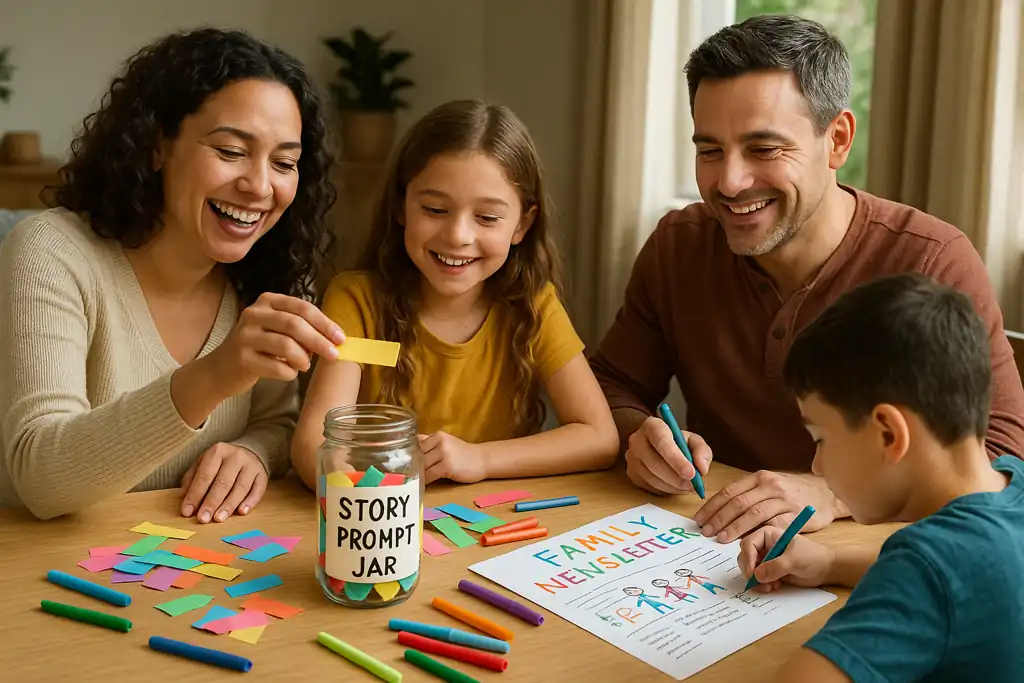
Spark Summer Creativity with Story Prompt Jar & Family Newsletter
Jump-start your child's imagination with a Story Prompt Jar and Family Newsletter. Fun summer writing activities for grades 3 to 8 that boost creativity and confidence.
Read ArticleShare this article