Summer Learning Activities for Grades 3–8: 10 Ideas That Don't Feel Like School
Research shows 70% of kids lose math skills over summer. These 10 hands-on activities use household items to prevent summer slide, no worksheets required.

Lindsay Carlson
Parent contributor
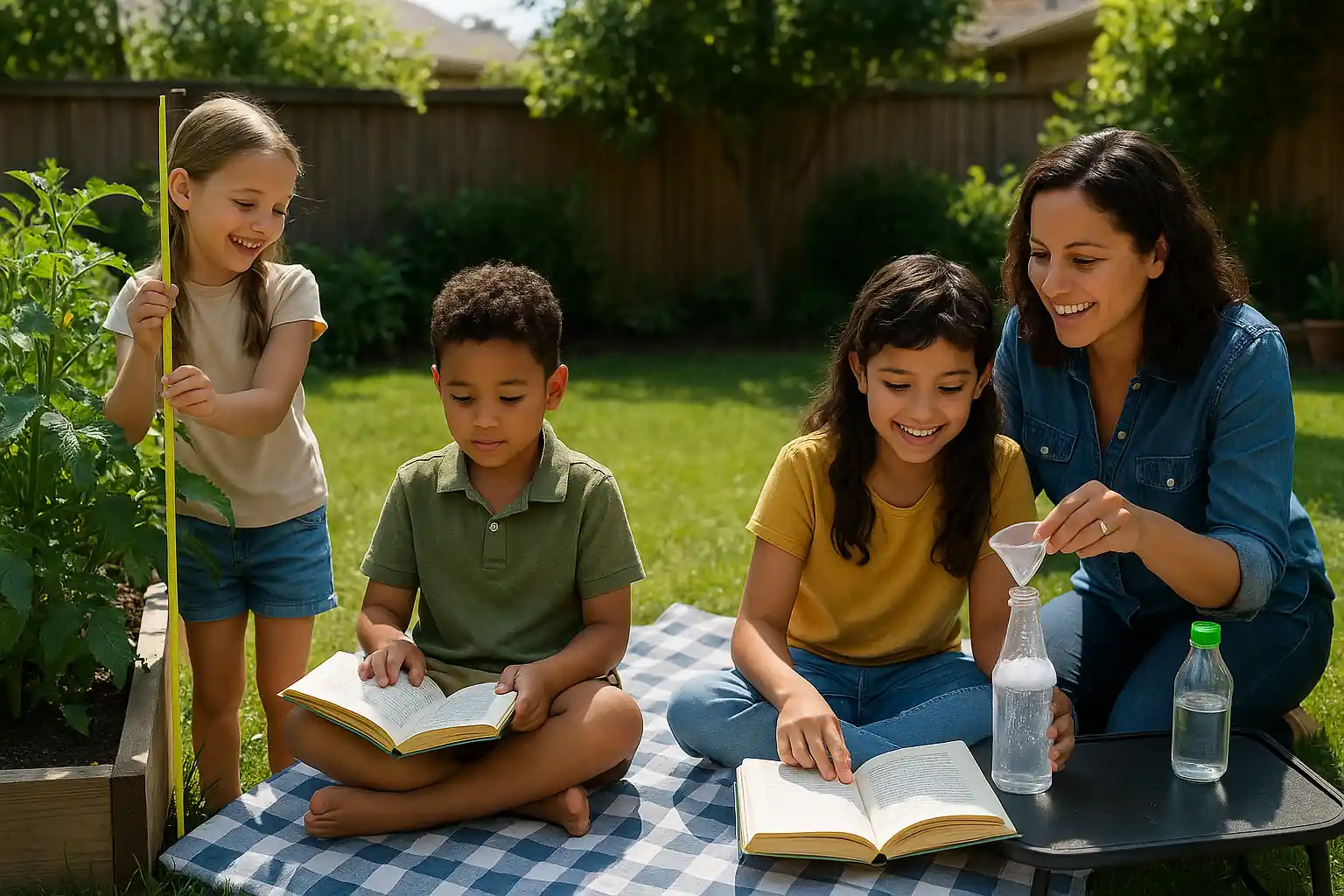
What You'll Learn
Why 70% of kids lose math skills over summer, and the simple activities that stop the slide without adding homework to your day
Ten easy, grade-specific activities across five subjects using materials you already have at home, from kitchen math to backyard science
A quick-pick guide for matching activities to your child's mood, energy level, and the specific skills that slipped most during the school year
Here's something most parents don't hear until September rolls around: 70% of kids lose measurable math skills over summer break. Reading slips too. Research from NWEA tracking 3.4 million students found that kids who made the biggest gains during the school year often lose the most when school's out (NWEA, 2024). By fifth grade, students with consistent summer loss can be two to three years behind their peers.
For a deeper look at why this happens and how summer learning loss compounds over time, see our summer slide prevention guide →. That post explains the research, and a companion piece breaks down how much kids actually forget over summer, grade by grade. This guide focuses on the activities you can start this week.
The activities in this guide take 20–60 minutes and use what's already in your kitchen, backyard, or recycling bin. No worksheets. No curriculum. Ten activities across five subjects that connect learning to real life, which is exactly what makes skills stick over a long break. Each subject section below links to a full how-to guide with grade-specific variations.
Quick-Pick Activity Guide for Grades 3–8
| Subject | Activities | Core Skills | Time Needed |
|---|---|---|---|
| Math in Motion | Real-Life Math Scavenger Hunt, Kitchen Math Cooking with Fractions | Measurement, operations, fractions, logical thinking | 20–40 minutes |
| Reading Games | Summer Reading Bingo Challenge, Family Book Club Adventure | Reading stamina, genre exploration, discussion skills | Ongoing |
| Backyard Science Lab | Homemade Ice Cream Experiment, Backyard Nature Explorer Journal | Scientific method, observation, data recording | 30–60 minutes |
| Write to Create and Connect | Story Prompt Jar, Family Newsletter Project | Creative writing, real-world communication, design | 25 minutes to ongoing |
| Make and Perform | DIY Art Studio in a Box, Homegrown Theater Night | Visual arts, collaboration, presentation skills | 45 minutes to 2 hours |
Each subject section below includes grade-specific tips, what materials you'll need, and what your child is actually practicing, even if it doesn't feel like practice to them.
How Do You Pick the Right Activity for Your Child Today?
Match the mood: If your child has energy to burn, start with the Real-Life Math Scavenger Hunt or a backyard nature walk, movement and learning in one go.
Target a weak spot: If fractions were rocky this spring, make a double batch of something in the kitchen. Kitchen Math is fractions without the worksheet.
Let them choose: Offer two activity options and let your child pick. Kids who have a say in the activity stick with it longer and complain less.
Bring siblings in: Older kids can lead the Kitchen Math measuring or run the Family Book Club discussion. They reinforce their own skills while younger siblings learn alongside them.
Can Everyday Math Actually Stick Over Summer?
Math is the subject hit hardest by summer slide, and it's also the easiest to practice without it feeling like school. The Real-Life Math Scavenger Hunt sends kids outside to find angles, measure distances, and record data. Kitchen Math turns doubling a recipe into a fractions lesson. Research on the Concrete-Representational-Abstract (CRA) model of math instruction shows kids retain concepts far better when they start with hands-on physical experiences before moving to abstract notation (ERIC). Everyday objects, measuring cups, rulers, grocery receipts, are exactly the kind of concrete experience the model calls for.
Both activities scale from 3rd through 8th grade with minor adjustments. The scavenger hunt adds more complex measurement challenges for older kids. Kitchen Math can go from basic doubling (3rd grade) all the way to ratio scaling and unit conversion (7th–8th). If kitchen fractions click for your child, see the year-round fractions routine → for a deeper step-by-step version. All you need are measuring cups, a recipe, and about 30 minutes.
Reading Games: How Do You Build a Book Lover Over Summer?
The trick with summer reading isn't finding the right books, it's making reading feel like a choice, not an assignment. The Summer Reading Bingo Challenge replaces the 'read this book by Friday' pressure with an open grid of genre squares kids fill in any order. The Family Book Club Adventure makes reading social: pick one book together, read it over a week, then talk about it over dinner.
Research compiled by the American Library Association found that children in structured summer reading programs consistently outperformed peers in fall reading assessments, and the gains were largest for kids who were already behind (ALA Libraries Matter). Summer reading gaps compound over time too: by ninth grade, researchers estimate that cumulative summer loss accounts for roughly two-thirds of the reading achievement gap between students (Reading Rockets). Neither of these activities requires a formal program, but both replicate what makes those programs work: low pressure, high engagement, and a social element.
What Makes Backyard Science So Effective?
Science is one of the easiest subjects to turn into a summer activity because your backyard is already a lab. The Homemade Ice Cream Experiment, made in a zip-top bag with cream, sugar, salt, and ice, teaches states of matter through something your child can literally eat. The Backyard Nature Explorer Journal asks kids to observe, sketch, and record what they find outside over a week or two.
What both activities share is the scientific method: observe, hypothesize, test, record. That's the same framework your child's teacher will use in September. Kids who've practiced it informally over summer come back to school with an instinct for how scientific thinking works, without anyone calling it a lesson. Materials needed: zip-top bags, cream, salt, a notebook, and a pencil. Total cost is usually under $5.
How Do You Get Kids Excited About Writing Over Summer?
Most kids freeze when you say 'just write something.' The Story Prompt Jar solves that: write 50 prompts on slips of paper, put them in a jar, and let your child pull one whenever they feel like writing. No deadline, no grade. The Family Newsletter Project goes a step further, your child writes, edits, and designs a real newsletter to send to grandparents or cousins.
The newsletter works especially well because it has a real audience. When kids write for someone who'll actually read it, they naturally self-edit, reach for more specific vocabulary, and care about whether the sentences make sense. That's not a writing lesson, it's authentic communication. The NAEP writing assessment is built around the same idea: students are asked to write for specific purposes and audiences, not just fill space on a page (NAEP, 2011). Both activities build the kind of writing fluency that shows up on state assessments starting in grade 4, and neither requires more than a notebook and 25 minutes to start.
Make and Perform: Arts and Theater at Home
These two activities take a bit more time (45 minutes to two hours), but they build skills that don't show up on standardized tests: planning ahead, working with others, and the confidence to share your work with an audience. The DIY Art Studio in a Box gives your child a dedicated creative space using paper, colors, recycled materials, and whatever's in the junk drawer. The goal isn't a finished product. It's 45 minutes of unstructured creative thinking, which matters more than most parents realize.
Homegrown Theater Night is a family project. Your child writes a short script (any topic works), recruits siblings or parents as cast, makes simple costumes from what's around the house, and performs for the family on a Saturday night. Most kids can finish a basic script in an hour. The performance itself, standing up, speaking clearly, keeping the plot moving, builds the kind of public-speaking confidence that takes most adults years to develop.
Neither activity requires experience or special materials. Paper and a little encouragement cover most of it. These are simpler to run straight from the ideas here than the subject guides above, so you do not need a separate how-to post to get started. If your child takes to either one, consider building in a regular Friday afternoon creative block for the rest of the summer.
"Summer learning doesn't have to mean school at home. Twenty minutes of kitchen fractions, a nature journal, a family book club, that's enough. Consistency beats intensity every time."
Pick one subject from the table, gather what's already at home, and start this week. You don't need to do all ten activities, even two or three done consistently through July can offset most of the summer slide.
If you want a more structured plan built around your child's specific grade and interests, Kaizly builds personalized 30-day learning plans around what your child actually enjoys, so the activities feel like something they chose, not something they're stuck doing.
Tags
References
Summer Reading Loss. Reading Rockets (2023)
Library Summer Reading Programs Impact Student Reading Levels, Ability, and Enjoyment. American Library Association (2022)
About the Writing Assessment. The Nation's Report Card (2011)
About Lindsay Carlson
Lindsay Carlson is a mom of three school-age kids in Dallas. After watching her oldest fall behind coming back to 4th grade, she spent two summers testing low-prep learning activities that fit into real family life, not just Pinterest ideals. She writes about practical at-home learning for Kaizly.
Related Articles
How to Choose the Best Math Activity for Your Child's Energy
Discover fun math activities tailored to your child's energy and interests during school breaks. Boost learning with scavenger hunts and kitchen cooking math.
Read Article
Summer Reading Bingo and Family Book Club Ideas for Grades 3-8
Engage kids with Summer Reading Bingo and Family Book Club ideas. Perfect for grades 3-8, blending fun reading challenges with meaningful family discussions.
Read Article
Science Summer Activities: Ice Cream and Nature Explorers for Grades 3-8
Discover two engaging science activities that blend learning with fun: make ice cream while exploring states of matter, and become backyard nature explorers with a journal and scavenger hunt.
Read Article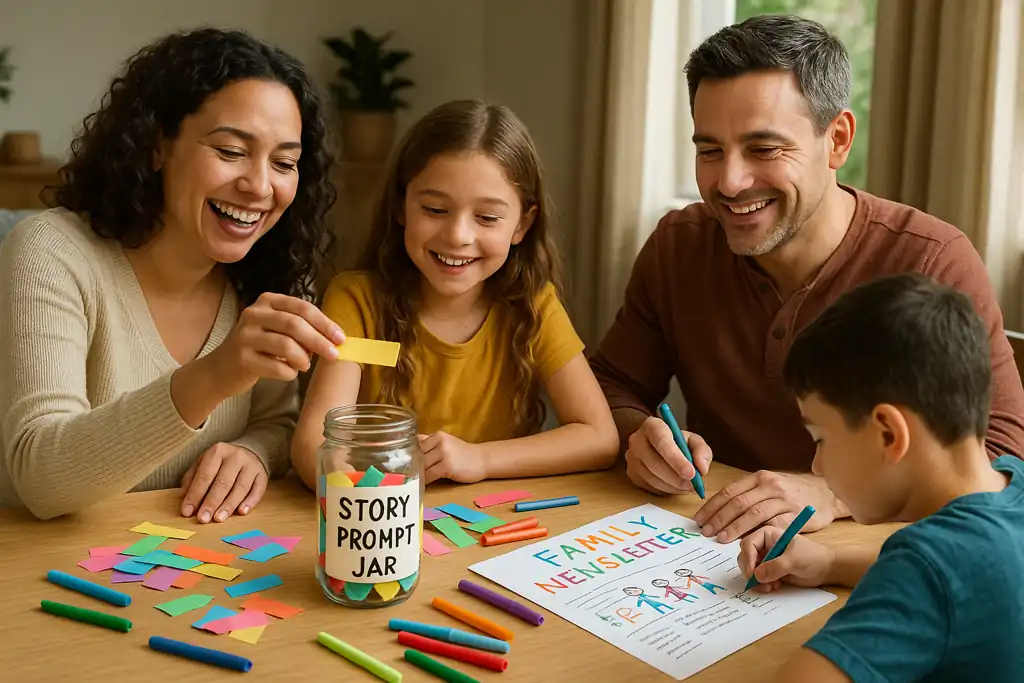
Spark Summer Creativity with Story Prompt Jar & Family Newsletter
Jump-start your child's imagination with a Story Prompt Jar and Family Newsletter. Fun summer writing activities for grades 3 to 8 that boost creativity and confidence.
Read Article
Summer Reading List for Grades 3–8: Best Books by Grade Level
By ninth grade, cumulative summer reading loss accounts for roughly two-thirds of the achievement gap between students. This grade-by-grade reading list gives kids the right book at the right level, fiction and nonfiction picks for grades 3 through 8.
Read ArticleShare this article