Summer Reading List for Grades 3–8: Best Books by Grade Level
By ninth grade, cumulative summer reading loss accounts for roughly two-thirds of the achievement gap between students. This grade-by-grade reading list gives kids the right book at the right level, fiction and nonfiction picks for grades 3 through 8.

Lindsay Carlson
Parent contributor
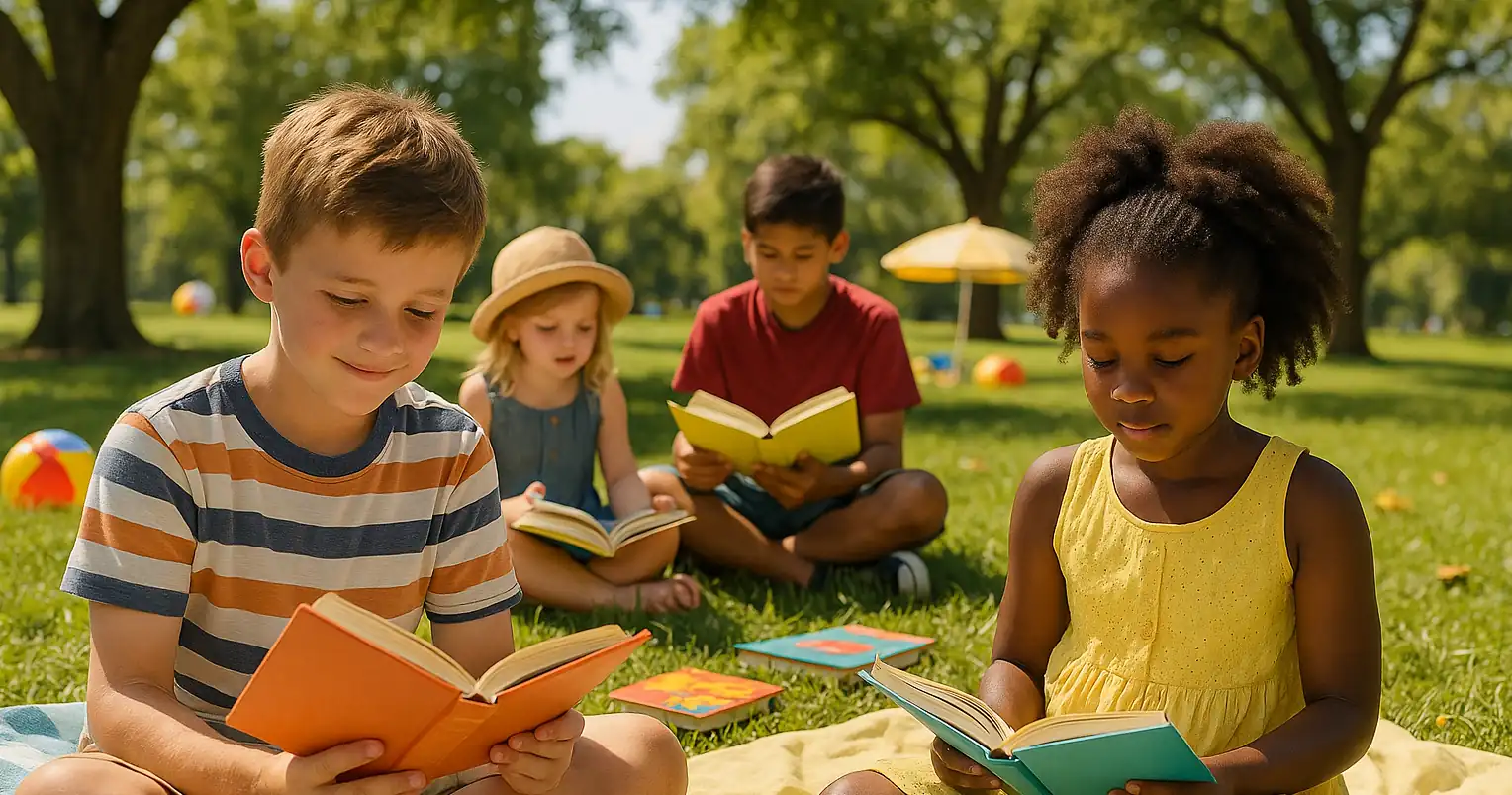
What You'll Learn
Research from Reading Rockets shows that cumulative summer reading loss accounts for roughly two-thirds of the achievement gap between students by ninth grade, and the right book at the right level is the simplest way to prevent it
Hand-selected fiction and nonfiction picks for grades 3 through 8, chosen to hold interest while reinforcing vocabulary and critical thinking
How to build a reading routine that fits into a busy family summer without turning books into homework
At a Glance: Fiction vs Nonfiction Picks by Grade
| Grade | Fiction Pick | Pages | Nonfiction Pick | Pages |
|---|---|---|---|---|
| 3 | Charlotte's Web | 184 | Go Free or Die | 64 |
| 4 | Tales of a Fourth Grade Nothing | 120 | What Are You Figuring Now? | 64 |
| 5 | Holes | 233 | Anne Frank: The Diary of a Young Girl | 283 |
| 6 | The Giver | 240 | Hidden Figures (Young Readers Edition) | 240 |
| 7 | The Outsiders | 192 | I Am Malala (Young Readers Edition) | 272 |
| 8 | The Hunger Games | 374 | Bomb | 266 |
Picking the right summer book isn't about reading level alone, it's about finding stories that feel worth finishing at a time when screens are competing for every hour. This list covers grades 3 through 8 with two picks per grade: one fiction, one nonfiction. Each title is drawn from widely used school reading lists, library guides, and award shortlists. Your child can pick based on interest, read both, or use the list as a starting point for a conversation with a librarian.
Why Grade-Specific Picks Matter More Than Age Ranges
Generic reading lists frustrate kids. A third grader handed a fifth-grade book puts it down by chapter two. An eighth grader given a fourth-grade book feels talked down to. Grade-specific recommendations match vocabulary complexity, theme maturity, and sentence length to where a child actually is, which makes them far more likely to finish the book voluntarily. A finished book builds reading stamina. A half-finished one just adds guilt. The goal this summer isn't to assign reading, it's to find books your child will actually choose to pick up.
Grade 3 Picks: Friendship, Bravery, and Big Feelings
For early readers, literature that echoes friendship, bravery, and imaginative narrative works best.
Fiction Pick: Charlotte's Web by E.B. White
Charlotte's Web tells the classic story of a little girl's pet pig and a wise spider whose resourceful plan builds a narrative of friendship and loyalty, one of the most-read elementary school novels for good reason. At 184 pages with an approximate Lexile range of 680–700L, it sits right in the sweet spot for third graders reading independently.
Discussion: Why does Charlotte decide to help Wilbur even though it's hard work for her?
Discussion: What does Wilbur learn about friendship by the end of the story?
Try next: Because of Winn-Dixie by Kate DiCamillo
Nonfiction Pick: Go Free or Die: A Story about Harriet Tubman by Jeri Ferris
Go Free or Die paints a vivid picture of Tubman's escape from slavery and her brave efforts on the Underground Railroad, making history feel immediate and personal for grade 3 readers. At 64 pages with an approximate Lexile range of 640–660L, it is an accessible entry point into biography for younger readers.
Discussion: What made Harriet Tubman brave? Can you think of a time you had to be brave?
Discussion: Why did Harriet keep going back to help other people escape?
Try next: Who Was Harriet Tubman? by Yona Zeldis McDonough
Grade 4 Picks: Humor and Real-World Problem Solving
In fourth grade, fun and reality blend to create the most engaging stories.
Fiction Pick: Tales of a Fourth Grade Nothing by Judy Blume
Tales of a Fourth Grade Nothing offers humor and real-life experiences through the misadventures of Peter Hatcher and his younger sibling Fudge, a perennial hit with kids this age for its recognizable sibling dynamics. At 120 pages with an approximate Lexile range of 470–490L, it reads fast and keeps fourth graders laughing the whole way through.
Discussion: How does Peter feel about being the responsible older brother? Have you ever felt that way?
Discussion: Which of Fudge's antics was the funniest, and which would be the most frustrating in real life?
Try next: Diary of a Wimpy Kid by Jeff Kinney
Nonfiction Pick: What Are You Figuring Now? A Story about Benjamin Banneker by Jeri Ferris
What Are You Figuring Now? outlines the intriguing life of a self-taught mathematician and astronomer, making the early history of Washington DC come to life through one person's relentless curiosity. At 64 pages with an approximate Lexile range of 700–720L, it pairs well with fourth-grade math and social studies topics.
Discussion: Benjamin Banneker taught himself math and science. What is something you've learned on your own?
Discussion: Why was it important that Banneker helped survey the land for Washington, DC?
Try next: Who Was Benjamin Franklin? by Dennis Brindell Fradin
Grade 5 Picks: Complex Narratives and History
For readers ready to go deeper into complex narratives, fifth grade is where books start asking bigger questions.
Fiction Pick: Holes by Louis Sachar
Holes provides an adventurous tale set in a detention camp filled with mystery and interwoven timelines, engaging enough that most fifth graders finish it without prompting. At 233 pages with an approximate Lexile range of 660–680L, the multiple storylines reward close reading without overwhelming younger middle-grade readers.
Discussion: How do the different timelines in the story connect to each other? What clues did you notice before the reveal?
Discussion: Do you think Stanley's punishment was fair? Why or why not?
Try next: Hatchet by Gary Paulsen
Nonfiction Pick: Anne Frank: The Diary of a Young Girl
Anne Frank: The Diary of a Young Girl gives a firsthand account of courage as seen through the eyes of a young girl during World War II, offering both historical context and emotional learning that typically sparks genuine discussion about fairness, fear, and resilience. At 283 pages with an approximate Lexile range of 1020–1080L, it reads above grade level on paper, but Anne's conversational voice makes it accessible to strong fifth-grade readers.
Discussion: Anne writes about ordinary things like crushes and arguments even while hiding. Why do you think she focused on everyday life?
Discussion: What does Anne's diary teach us about keeping hope during difficult times?
Try next: Number the Stars by Lois Lowry
Grade 6 Picks: Ethical Questions and Social Impact
Middle school readers benefit from stories that introduce ethical dilemmas and provoke discussion.
Fiction Pick: The Giver by Lois Lowry
The Giver is a thought-provoking story about a boy named Jonas who is given memories of both pain and pleasure in a seemingly perfect society, one of the most effective entry points into speculative fiction for sixth graders. At 240 pages with an approximate Lexile range of 760–780L, it reads quickly while raising questions that stay with readers long after the last page.
Discussion: Jonas's community eliminated pain but also eliminated choice. Is that a fair trade? Why or why not?
Discussion: If you were the Receiver of Memory, which memory would be the hardest to carry?
Try next: A Wrinkle in Time by Madeleine L'Engle
Nonfiction Pick: Hidden Figures: Young Readers Edition by Margot Lee Shetterly
Hidden Figures recounts the real story of four African American mathematicians at NASA who played key roles during America's Space Race, demonstrating that history is full of unsung heroes whose work shaped the world. At 240 pages with an approximate Lexile range of 950–990L, the young readers edition strikes the right balance between historical depth and readability for sixth graders.
Discussion: Why were the contributions of these mathematicians hidden from public knowledge for so long?
Discussion: How did the women in the book overcome barriers that were designed to stop them?
Try next: Counting on Katherine by Helaine Becker
Grade 7 Picks: Growing Up and Standing Up
At this stage, stories that address identity and conflict resonate most strongly.
Fiction Pick: The Outsiders by S.E. Hinton
The Outsiders explores friendship and class conflict in 1960s America, a novel that has remained relevant to middle schoolers for decades because its themes of belonging and loyalty don't age. At 192 pages with an approximate Lexile range of 750–770L, it is short enough to finish in a week and deep enough to discuss for much longer.
Discussion: Ponyboy says "things are rough all over." What does he mean, and do you agree?
Discussion: How does the conflict between the Greasers and the Socs reflect issues you see in your own school or community?
Try next: Monster by Walter Dean Myers
Nonfiction Pick: I Am Malala (Young Readers Edition) by Malala Yousafzai
I Am Malala recounts the journey of a Nobel Peace Prize winner who advocated for girls' education in Pakistan under serious personal risk. It connects classroom learning to real-world stakes in a way few other books do for this age. At 272 pages with an approximate Lexile range of 830–850L, it is accessible for seventh graders while covering mature themes with honesty and clarity.
Discussion: Malala risked her life for the right to go to school. What rights do you think are worth standing up for?
Discussion: How did Malala's father influence her beliefs about education? How do the adults in your life shape what you value?
Try next: Enrique's Journey (Young Adult Edition) by Sonia Nazario
Grade 8 Picks: Dystopia and Nonfiction Thrillers
For mature middle school readers, eighth grade is the year to tackle books with real weight.
Fiction Pick: The Hunger Games by Suzanne Collins
The Hunger Games provides an exciting dystopian story through the eyes of Katniss Everdeen as she navigates a high-stakes survival arena, a book that reliably gets reluctant readers turning pages. At 374 pages with an approximate Lexile range of 810–830L, it is longer than most picks on this list but reads fast thanks to short chapters and constant tension.
Discussion: The Capitol uses the Games to control its citizens. What parallels can you draw to how media and entertainment influence people today?
Discussion: Katniss makes several morally complicated decisions during the Games. Pick one and argue whether it was the right call.
Try next: Fahrenheit 451 by Ray Bradbury
Nonfiction Pick: Bomb by Steve Sheinkin
Bomb: The Race to Build and Steal the World's Most Dangerous Weapon is a fast-paced nonfiction thriller written like a spy novel. It covers the race to develop the atomic bomb during World War II and has earned both the Newbery Honor and the Sibert Medal, proof that nonfiction can be just as gripping as fiction. At 266 pages with an approximate Lexile range of 920–950L, it challenges eighth graders with primary-source storytelling while reading like an adventure.
Discussion: The scientists who built the bomb had mixed feelings about their work. Should they have refused? What would you have done?
Discussion: How does Sheinkin make a history book read like a thriller? What writing techniques does he use?
Try next: Unbroken (Young Adult Edition) by Laura Hillenbrand
"Every finished book builds vocabulary and critical thinking. Every half-finished one just sits there. Match the book to the grade, and the grade to the child, and finishing takes care of itself."
How to Build a Summer Reading Habit That Actually Sticks
The simplest reading routines work best in summer. Pick a consistent time, after breakfast or before screen time in the evening, rather than leaving it open-ended. Keep sessions short: 20 to 30 minutes is enough to maintain progress without making it feel like an assignment. Let your child choose which title to start with from their grade's two picks. Having a say in the book makes a real difference in whether they finish it. And visit the library rather than buying every title, a librarian can recommend alternatives if neither pick lands.
Choose a title from the grade-level section above that matches your child's current interests
Visit your local library, librarians can locate these books and recommend other age-appropriate alternatives
Set a consistent reading time that fits your family's schedule, even 20 minutes daily adds up to roughly 3 books over a summer
If building a consistent daily reading habit feels like the bigger challenge, we have a separate guide with practical routines that work around real family schedules: Daily Reading Routines for Busy Families That Work →.
For activities that build on what your child reads, discussion prompts, reading bingo, and a family book club guide, see Summer Reading Bingo and Family Book Club Ideas for Grades 3–8 →.
For the full summer learning guide covering all five subjects, math, reading, science, writing, and arts, see Summer Learning Activities for Grades 3–8 →.
Tags
References
Summer Reading Loss. Reading Rockets (2023)
Library Summer Reading Programs Impact Student Reading Levels, Ability, and Enjoyment. American Library Association (2022)
Common Sense Media Book Reviews and Recommendations. Common Sense Media (2024)
About Lindsay Carlson
Lindsay Carlson is a mom of three school-age kids in Dallas. After watching her oldest fall behind coming back to 4th grade, she spent two summers testing low-prep learning activities that fit into real family life, not just Pinterest ideals. She writes about practical at-home learning for Kaizly.
Related Articles
Summer Reading Bingo and Family Book Club Ideas for Grades 3-8
Engage kids with Summer Reading Bingo and Family Book Club ideas. Perfect for grades 3-8, blending fun reading challenges with meaningful family discussions.
Read Article
How to Choose the Best Math Activity for Your Child's Energy
Discover fun math activities tailored to your child's energy and interests during school breaks. Boost learning with scavenger hunts and kitchen cooking math.
Read Article
Science Summer Activities: Ice Cream and Nature Explorers for Grades 3-8
Discover two engaging science activities that blend learning with fun: make ice cream while exploring states of matter, and become backyard nature explorers with a journal and scavenger hunt.
Read Article
Spark Summer Creativity with Story Prompt Jar & Family Newsletter
Jump-start your child's imagination with a Story Prompt Jar and Family Newsletter. Fun summer writing activities for grades 3 to 8 that boost creativity and confidence.
Read ArticleShare this article