Summer Reading Bingo and Family Book Club Ideas for Grades 3-8
Research shows summer reading loss accounts for two-thirds of the achievement gap by 9th grade. Two low-pressure activities, Reading Bingo and Family Book Club, keep grades 3–8 kids reading all summer.

Lindsay Carlson
Parent contributor
What You'll Learn
How Summer Reading Bingo keeps reluctant readers engaged all summer through choice and visual progress, including what a bingo card looks like and how to customize it by grade
How to run a Family Book Club in 5 steps, with discussion questions that work for both 3rd graders and 8th graders in the same conversation
Why giving kids control over what they read is more effective than a required list, and how these two activities use that insight to build lasting reading habits
The biggest obstacle to summer reading isn't finding books, it's keeping kids motivated when there's no teacher, no deadline, and no reason to open one. The two activities below solve for two different situations: one for kids who like independent mini-challenges with quick wins, one for kids who want to read together as a family. Both build the reading habit without feeling like an assignment.
Summer Reading Bingo Challenge, a game-like twist on daily reading
Family Book Club Adventure, a conversation-driven journey through a shared story
How Do You Choose the Right Activity for Today?
| Reading Bingo Challenge | Family Book Club Adventure | |
|---|---|---|
| Best for kids who | Love variety and quick wins | Enjoy deeper discussion and family time |
| Time needed | Flexible bursts of 10–20 minutes | One to two weeks of reading plus a one-hour meeting |
| Parent involvement | Light setup, periodic check-ins | Moderate, leads the club and joins the discussion |
| Social vibe | Solo play or friendly sibling competition | Collaborative, builds conversation skills |
| Motivation style | Visual progress and small prizes | Shared snacks, themed games, and belonging |
Let your child's mood guide the choice: if they want independent fun, start with Bingo. If they want cozy connection, gather the family and open a book together.
Summer Reading Bingo (Rules + Free Card Ideas)
The first activity is the low-pressure, independent option. Reading Bingo turns a summer of reading into a game of small, self-chosen challenges, and the rules and free card ideas below make it easy to set up in just a few minutes.
Activity 1: Summer Reading Bingo Challenge
Create a Summer Reading Bingo card filled with reading tasks, 'Read under a tree,' 'Read a book about space,' 'Read aloud to a family member,' 'Finish a nonfiction book.' Each time your child completes a task, they mark off the square. The goal is to get a Bingo (a full row, column, or diagonal) or fill the entire card. This injects variety into daily reading and works especially well for reluctant readers because it breaks reading into quirky mini-challenges instead of a page-count obligation.
Why This Works for Grades 3–8
Third through fifth graders are transitioning to more substantial texts. A bingo card gently pushes them to try new types of books (first mystery, first biography) while keeping the choice theirs. The silly tasks, reading in a funny place, reading to a pet, appeal to their sense of play. For grades 6–8, the challenge gives autonomy: they choose books to fulfill each task, which is exactly what research on reading motivation shows matters most for this age group. You can adapt difficulty: a 7th grader's square might say 'Read a classic or award-winner'; a 3rd grader's might say 'Read a book with an animal character.'
Materials for the Reading Bingo Challenge
Make a bingo card on paper or digitally, a 5x5 grid is standard, but a 4x4 works for younger kids. Bingo Baker is a free online creator. Or draw one by hand with a ruler. Leave the center as a free space or label it 'Read anything you want!' In each square, write a reading task. Some ideas by grade:
For any age: 'Read outside for 20 minutes,' 'Read a book recommended by a friend,' 'Listen to an audiobook,' 'Read a book then watch its movie,' 'Read a news or magazine article.'
For grades 3–5: 'Read a graphic novel or illustrated book,' 'Read to a pet or stuffed animal,' 'Read a funny book and tell a joke from it,' 'Read a fairy tale or folk tale,' 'Visit the library and pick any book.'
For grades 6–8: 'Read the first book in a series,' 'Read a biography of someone you admire,' 'Read for an hour straight,' 'Recommend a book to a family member and discuss it,' 'Read a book of poetry or a play.'
Also have stickers or markers to track the card, and a small prize or celebration for completion (optional but motivating). A printable bingo card example from The Chirping Moms works well as a starting template.
How to Run the Reading Bingo Challenge
Design the card together: Work with your child to brainstorm tasks and fill in the squares, involving them increases buy-in. Include a variety of genres and reading experiences. Aim for some quick wins ('read outside') and some more substantial ('finish a nonfiction book'). 16–25 tasks total depending on grid size.
Set the rules: Decide whether the goal is one Bingo by mid-summer, or full blackout by summer's end. Decide if re-reading counts for multiple squares (it discourages reading new books, so usually better if each book fills only one square). Agree on a reward if you want one: ice cream for the first Bingo, a new book purchase for the full card.
Track progress visibly: Keep the card on the fridge or bulletin board. Mark each completed square with a sticker or colored fill. Check in every weekend, 'You haven't tackled the poetry square yet. Want to read some Shel Silverstein together?' The visible progress is the main motivator.
Adjust on the fly: If a square is genuinely unappealing, swap it. The goal is reading, not strict bingo rules. Adding a family version (simplified 9-square cards for parents) makes reading a shared household activity, not just a kid task. Many public libraries also have summer reading challenges, use library program completions to cross off matching squares.
End-of-summer reflection: When the card is done, ask: what was the favorite book? Which task was hardest? Recognizing how much they read builds confidence. If they found a new favorite genre or author, note it for the fall. Some kids want to keep a mini-bingo going into the school year.
The Developmental Case for Reading Bingo
Literacy experts consistently find that reading engagement over summer depends on choice and variety. A meta-analysis by Guthrie and Wigfield found that student choice in reading material is the single strongest predictor of reading engagement, outranking incentives, instruction quality, and social interaction (Guthrie & Wigfield, 2000). By late elementary, kids often develop strong preferences, only dog books, or fixation on one series. The bingo gently nudges broader exploration. Middle schoolers are motivated by progress and self-direction; crossing off squares provides visible achievement. Framing reading as an enjoyable, even playful activity is especially important at this age, when some kids start deciding 'reading isn't for me.' A fun challenge can counteract that.
Helpful Resources
Many libraries offer free printable bingo cards. Highlights has a popular printable version. The American Library Association offers summer reading lists and encourages library program participation. For digital tracking, Beanstack is used by many schools and libraries, kids earn virtual badges for reading goals. Common Sense Media and Goodreads both allow searching for books by age and genre, helpful for filling tricky bingo squares.
For specific book recommendations matched to each grade level, see Summer Reading List for Grades 3–8: Best Books by Grade Level →.
Activity 2: Family Book Club Adventure
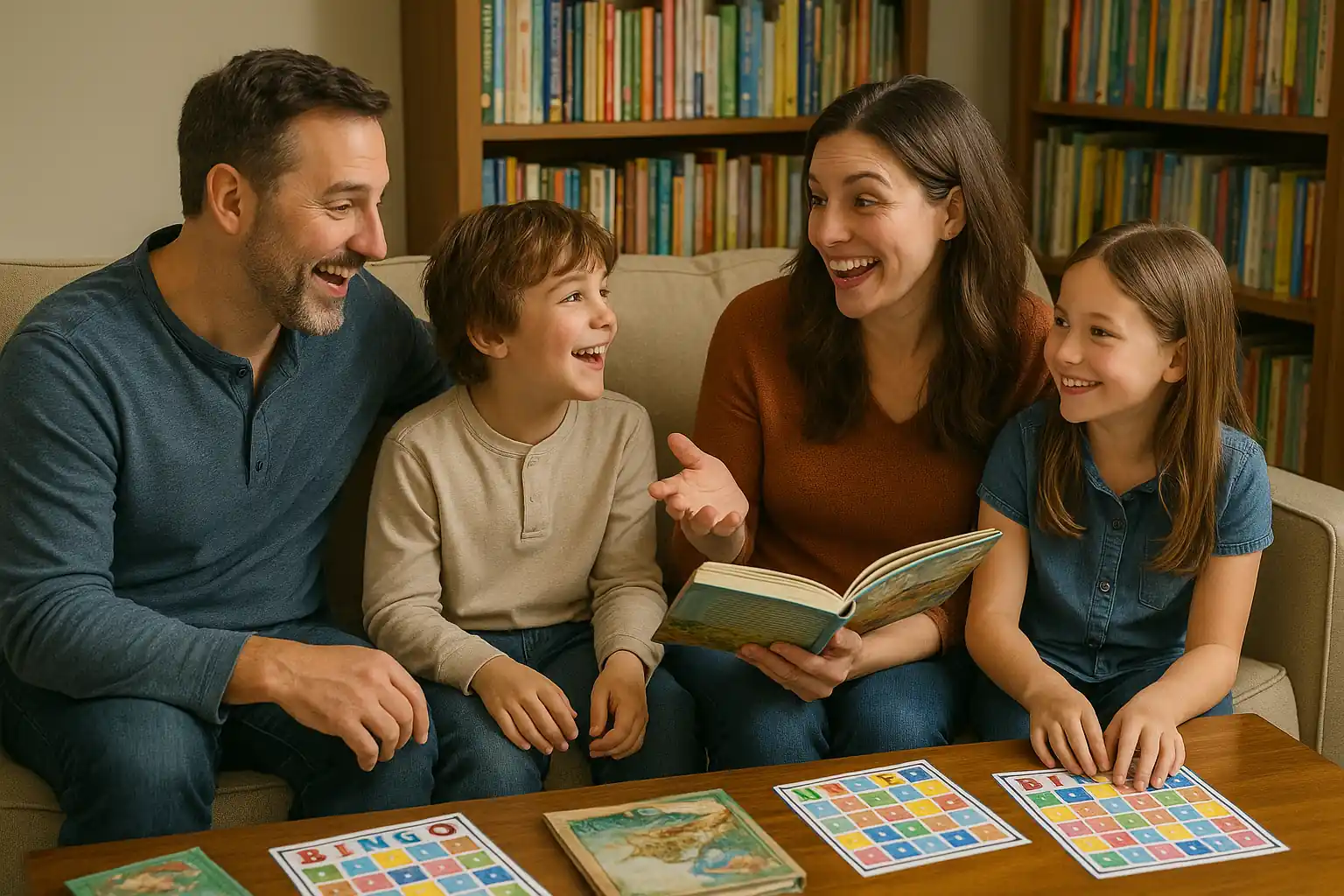
Choose one book that everyone in the family reads, then hold a proper book club meeting, snacks, discussion questions, maybe a related activity or game. For larger families, include cousins or neighbors in person or virtually. This gets kids talking about books at a deeper level: themes, characters, what they liked or didn't. It works especially well for grades 3–8 because the range can share one book, younger kids focus on simpler aspects (favorite character, funniest moment), while older kids tackle themes, author intent, and character change.
Why This Works for Grades 3–8
A 3rd grader loves getting focused adult attention to discuss what they read, it validates their opinions in a way that school rarely does. Middle schoolers enjoy debating and voicing thoughts; a family book club gives them a safe space to do so without being graded. Multi-age book clubs can be particularly effective: older kids reinforce their own comprehension by explaining things to younger ones, and younger kids stretch to keep up with the discussion. According to the American Library Association, children in structured summer reading programs consistently outperform peers in fall reading assessments, and the gains are largest for kids who were already behind.
Materials for the Family Book Club
Choose a book that fits everyone's reading ability, or use an audiobook if reading levels differ significantly. Multi-age classics work well: Charlotte's Web and Charlie and the Chocolate Factory span grades 3–8 comfortably. For a middle-school-focused group, a contemporary novel or YA classic like The Outsiders works if appropriate for your youngest reader. Prepare some discussion questions (search '[Book Title] book club questions kids', many publishers include them in the back). Gather snacks, theme them to the book if you can. Plan an optional related activity: for a mystery book, create a simple 'solve the crime' game; for a nature story, plan an outdoor outing.
How to Run the Family Book Club
Select the book and set the meeting date: Choose and schedule in advance. 'We'll all finish the book by July 31st, and have our book club on the first Sunday in August.' Put it on the family calendar. Give library copies to extended family early if they're joining. Set optional intermediate reading goals ('Let's try to read chapters 1–5 by next weekend') to help younger kids pace themselves.
Read and engage along the way: Encourage informal conversation as the book progresses, 'How do you like it so far? Who's your favorite character?', without spoiling anything for anyone behind. Parents should read alongside. If a child isn't yet a strong independent reader, do a nightly read-aloud of that book. Even older kids enjoy being read to if the content is engaging enough.
Make the meeting an event: Send a playful 'invitation' or hang a sign on the door ('Book Club in Session'). Set up comfortable seating. Serve themed snacks. Start by going around and giving a quick reaction. Then use discussion questions, 'Which part was funniest or scariest?' for younger kids; 'How did the main character change?' or 'What themes did you notice?' for older kids. Mix factual questions with open-ended ones. Make sure everyone gets a turn. Keep the tone supportive, there are no wrong opinions here.
Add a creative twist: Draw a new cover for the book. Act out a favorite scene. Play trivia made from questions in the book (let older kids write the questions). If a movie adaptation exists, watch it after the discussion and compare. These extras make the experience memorable and reinforce comprehension in ways that feel like fun.
Plan the next one: If it worked, plan another meeting for later in the summer. Rotate who picks the next book, giving kids choice cements the habit. Consider inviting a friend and their parent to join. Even a Zoom session with cousins works well for this age group.
The Developmental Case for Family Book Club
Children in upper elementary and middle school are becoming capable of abstract thought, a 5th grader can grasp themes like friendship or loyalty, and a 7th grader can handle irony or moral dilemmas. Talking through these in a family setting helps them articulate thinking and hear other perspectives, building both empathy and critical analysis. It's also profoundly validating for a child to have adults take their literary opinions seriously. Books can also become proxies for real conversations: reading Wonder as a family can open a discussion about kindness that your child might not start on their own.
If your family wants to carry the reading habit into the school year, see Daily Reading Routines for Busy Families → for a year-round approach.
Helpful Resources
Discussion guides for popular children's books are easy to find: search '[Book Title] book club questions kids' or check the publisher's website. Reading Rockets and Scholastic Book Clubs both have discussion resources. For book selection, Brightly has family read-aloud recommendations, and Goodreads lets you search by grade and genre. Imagination Soup offers reading lists grouped by grade level.
For more summer activities across math, science, and writing, see the full summer learning activities guide for grades 3–8. Or if you'd like a personalized plan built around your child's reading level and interests, try Kaizly free.
Tags
References
Summer Reading Loss. Reading Rockets (2023)
Library Summer Reading Programs Impact Student Reading Levels, Ability, and Enjoyment. American Library Association (2022)
Engagement and Motivation in Reading. Contemporary Educational Psychology (2000)
About Lindsay Carlson
Lindsay Carlson is a mom of three school-age kids in Dallas. After watching her oldest fall behind coming back to 4th grade, she spent two summers testing low-prep learning activities that fit into real family life. She writes about practical at-home learning for Kaizly.
Related Articles
Summer Learning Activities for Grades 3–8: 10 Ideas That Don't Feel Like School
Research shows 70% of kids lose math skills over summer. These 10 hands-on activities use household items to prevent summer slide, no worksheets required.
Read Article
How to Choose the Best Math Activity for Your Child's Energy
Discover fun math activities tailored to your child's energy and interests during school breaks. Boost learning with scavenger hunts and kitchen cooking math.
Read Article
Science Summer Activities: Ice Cream and Nature Explorers for Grades 3-8
Discover two engaging science activities that blend learning with fun: make ice cream while exploring states of matter, and become backyard nature explorers with a journal and scavenger hunt.
Read Article
Spark Summer Creativity with Story Prompt Jar & Family Newsletter
Jump-start your child's imagination with a Story Prompt Jar and Family Newsletter. Fun summer writing activities for grades 3 to 8 that boost creativity and confidence.
Read ArticleShare this article